

Dérocheur Laser : Restauration Haute Vitesse Sans Endommager le Métal
For decades, the standard operating procedure for tackling heavy corrosion in small workshops was a combination of brute force and hazardous dust. Whether you were using a wire wheel that skated across the surface or a sandblaster that left a mountain of grit to clean up, the “old way” was always a trade-off between speed and the integrity of the base metal.
That trade-off has officially ended. The Laser Rust Remover has shifted from a million-dollar industrial luxury to a viable, high-speed solution for independent restorers and specialist metalworkers. By utilizing a process known as laser ablation, these machines strip away decades of decay in seconds without ever physically touching—or damaging—the metal substrate beneath.
If you are looking to scale your restoration throughput or simply want to stop breathing in rust dust, understanding how this metal oxidation tool functions is the first step toward a cleaner, faster shop.
Table des matières
How Laser Ablation Technology Works
To understand why a Laser Rust Remover is so effective, we have to look at the physics of light absorption. Unlike mechanical abrasive methods, this technology relies on Laser ablation technology. When the high-energy beam hits the surface, the rust (iron oxide) has a much higher absorption coefficient than the shiny metal underneath.
The rust absorbs the energy almost instantly, causing it to heat up and vaporize—a process called sublimation. Because the base metal reflects most of the laser energy rather than absorbing it, the process remains a non-destructive cleaning method. You can effectively “sweep” the beam across a delicate vintage car panel and remove the oxidation while leaving the original factory stamps and metal thickness perfectly intact.
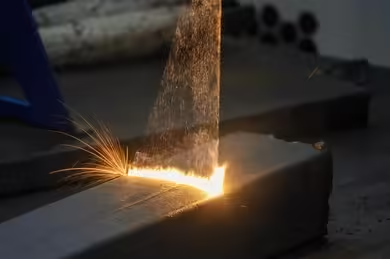
According to research from the Laser Institute of America (LIA), the precision of pulsed fiber lasers allows for the removal of surface contaminants down to the micron level. This level of control is simply impossible with a manual grinder, where a few extra seconds of pressure can lead to structural thinning of the workpiece.
Handheld Laser Rust Remover vs Sandblasting: The ROI Shift
For a small workshop, the comparison of handheld laser rust remover vs sandblasting is often the deciding factor in making an upgrade. Sandblasting requires a dedicated cabinet or a massive cleanup effort, expensive media (sand, garnet, or beads), and heavy-duty air compressors.
In contrast, a handheld fiber laser cleaner is essentially a “plug and play” device. There are no consumables. You don’t have to buy bags of grit, and you don’t have to spend hours masking off parts of the vehicle or boat that shouldn’t be blasted. While the initial capital expenditure for a laser is higher, the cost-per-hour drops significantly over time because you aren’t paying for media or the labor associated with post-job cleanup.
Furthermore, sandblasting can generate significant heat and friction, which often warps thin-gauge sheet metal. The pulsed nature of a Laser Rust Remover keeps the thermal load on the metal remarkably low, preventing the “oil-canning” effect that ruins car hoods and door panels during traditional restoration.
Le Best Portable Laser Rust Remover for Car and Boat Restoration
In the world of professional restoration, portability is everything. You cannot always bring the project to the blast booth. This is where the best portable laser rust remover for car and boat restoration proves its value.
For automotive work, these machines are game-changers for cleaning chassis rails, suspension components, and intricate engine bay areas where a grinder cannot reach. Because it is a non-contact tool, you can remove rust from around bolts and tight corners that would normally require complete disassembly.
In the marine sector, the challenges are even greater. Saltwater environments lead to aggressive pitting. Removing oxidation from aluminum boats with laser is significantly safer than using chemical acids or harsh abrasives that can trigger further galvanic corrosion. A portable laser allows you to perform hull maintenance directly on the dry dock, stripping away marine growth and oxidation in one pass.
Finding the Best 200W Portable Laser Rust Remover for Home Use
Not every shop needs a 3000W industrial beast. In fact, for many car enthusiasts and small-scale fabricators, the best 200W portable laser rust remover for home use is the sweet spot.
A 200W pulsed laser is surprisingly capable. While it may take a few more passes to clear heavy, thick scale compared to a high-power unit, it offers much finer control. Higher wattage continuous-wave (CW) lasers can sometimes be too “hot” for thin sheet metal, whereas a 200W pulsed unit provides the surgical precision needed for detailing and delicate restoration.
When selecting a unit, look for adjustable pulse frequency and scan width. This allows you to tune the Laser Rust Remover specifically for the type of metal you are working on—be it cast iron, carbon steel, or aluminum. Lower power units are also much easier to run on standard workshop electrical circuits, avoiding the need for expensive three-phase power upgrades.
Products by Category
-
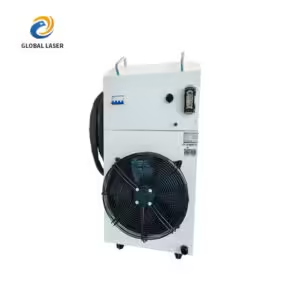
Machine de nettoyage laser 1500W CW | Enlèvement de la rouille | GlobalLaser
$4,000.00 -
Machine de nettoyage laser 2000W CW | Préparation de surface à grande vitesse | GlobalLaser
$5,000.00 -
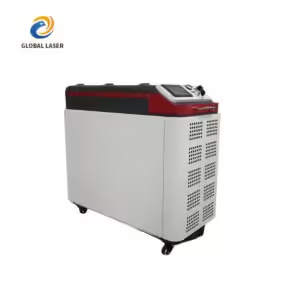
Machine de nettoyage laser pulsée de 200 W | Système portable refroidi par air | GlobalLaser
$6,000.00 -
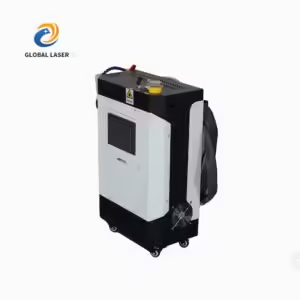
Nettoyeur laser pulsé sur chariot 200W | Mobile Surface Prep | GlobalLaser
$6,000.00 -
Nettoyeur laser industriel 3000W | 3-Phase Heavy Duty System | GlobalLaser
$7,500.00
Essential Safety Equipment for Handheld Laser Cleaning
Operating a high-energy beam requires more than just common sense. You are dealing with Class 4 lasers that can cause permanent eye damage or skin burns in a fraction of a second. Investing in the correct safety equipment for handheld laser cleaning is non-negotiable.
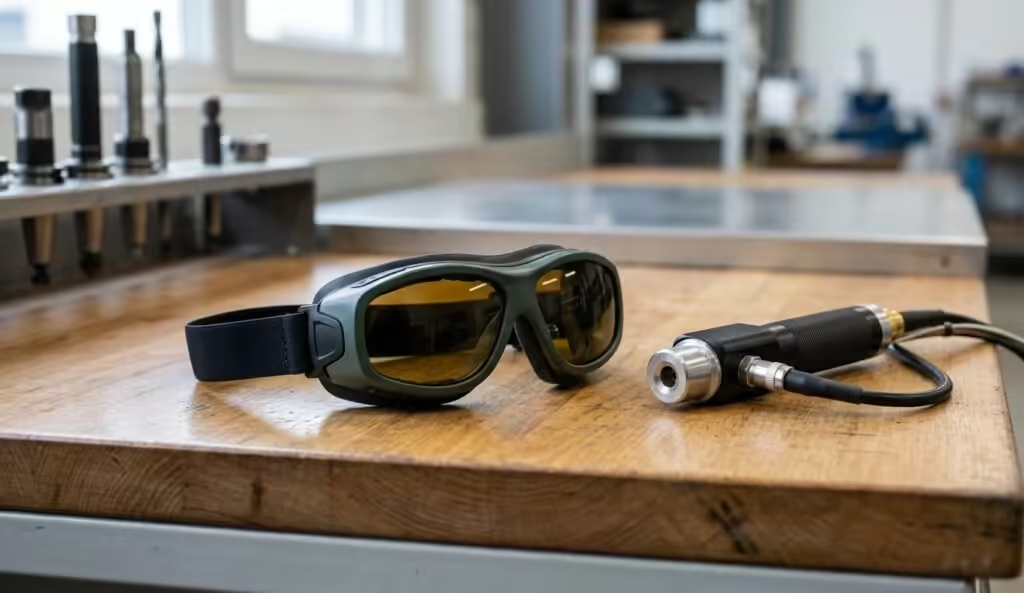
1.Laser Safety Glasses: You must use goggles rated specifically for the wavelength of your laser (typically 1064nm for fiber lasers). Check the Optical Density (OD) rating; for most cleaning systems, an OD6+ rating is the standard.
2.Fume Extraction: Vaporized rust and old paint contain heavy metals and toxic chemicals. Never operate a Laser Rust Remover without a high-volume fume extractor equipped with a HEPA filter.
3.Beam Shielding: In a small shop, you must ensure that the laser beam cannot reflect off a shiny surface and hit a bystander. Use laser-rated curtains or a dedicated “hot zone” to isolate the work area.
Le Occupational Safety and Health Administration (OSHA) provides rigorous standards for the use of Class 4 lasers in a commercial environment. Adhering to these guidelines isn’t just about legal compliance—it’s about ensuring your restoration hobby doesn’t result in a life-altering injury.
Scaling Your Efficiency with a Laser Rust Remover
The ultimate goal of any workshop upgrade is to increase throughput without sacrificing quality. Transitioning to a Laser Rust Remover allows you to take on more complex projects that were previously too labor-intensive to be profitable.
Imagine cleaning a complex wrought iron gate or a vintage engine block. What used to take two days of chemical soaking and manual scrubbing now takes two hours of “painting” with light. The precision of the metal oxidation tool ensures that the final finish is perfectly prepped for primer or powder coating, with a surface profile that promotes superior adhesion.
As the technology continues to mature, the barriers to entry are falling. Whether you are tackling a frame-off car restoration or keeping a fleet of aluminum boats in top condition, the Laser Rust Remover is no longer the future—it is the current standard for high-speed, high-quality metal restoration.
FAQ
Is the laser safe for all types of metal?
Yes, generally. A Laser Rust Remover is highly effective on steel, iron, aluminum, and even copper. However, the settings (power, frequency) must be adjusted for each material to ensure you aren’t applying too much heat to softer metals like aluminum.
Does laser cleaning remove paint as well as rust?
Absolutely. The laser is excellent at stripping old paint, powder coatings, and even thick grease. This makes it an all-in-one prep tool for restoration projects.
How long does a laser cleaner last?
Most high-quality fiber laser sources are rated for approximately 100,000 hours of operation. Since there are no moving parts in the laser source and no consumables like sand or chemicals, the maintenance requirements are extremely low—mostly just keeping the protective lens clean.
Can I use a 200W laser on heavy, thick rust?
You can, but it will be slower. For “flash rust” or light oxidation, a 200W unit is fast. For heavy, crusty scale found on old ship anchors or bridge beams, you would eventually want a higher-wattage unit (500W+) to maintain professional speeds.