

Mastering Laser Surface Prep in Modern Manufacturing: Improving Weld Quality
In the high-stakes world of industrial fabrication, the difference between a structurally sound component and a catastrophic failure often lies in the first few microns of the material surface. As automation scales and tolerances tighten, traditional cleaning methods are struggling to keep pace with the demands of Industry 4.0. This is where Laser Surface Prep has emerged as a disruptive force, offering a level of precision and consistency that chemical solvents and mechanical abrasives simply cannot match.
For manufacturing engineers, the primary goal is always the same: ensuring a perfect bond. Whether you are working with aerospace-grade aluminum or high-strength automotive steel, the presence of surface contaminants is the single greatest threat to metallurgical integrity. By adopting a “clean-by-light” philosophy, facilities are discovering that they can achieve higher throughput while virtually eliminating the most common causes of weld rejection.
Table des matières
How Contaminants Destroy Weld Integrity
One of the most persistent challenges in heavy manufacturing is the occurrence of welding porosity. Porosity occurs when gases—often resulting from the vaporization of surface oils, grease, or hydrated oxides—become trapped within the weld pool as it solidifies. This creates microscopic voids that act as stress concentrators, significantly reducing the fatigue life of the joint.
Why Bonding and Welding Prep is Evolving
The manufacturing sector is under increasing pressure to move away from Volatile Organic Compounds (VOCs) and hazardous chemical baths. Not only are these methods environmentally taxing, but they are also notoriously difficult to standardize in a 24/7 production environment. Solvent tanks degrade over time, and manual wiping introduces human error that can lead to inconsistent bonding and welding prep results.
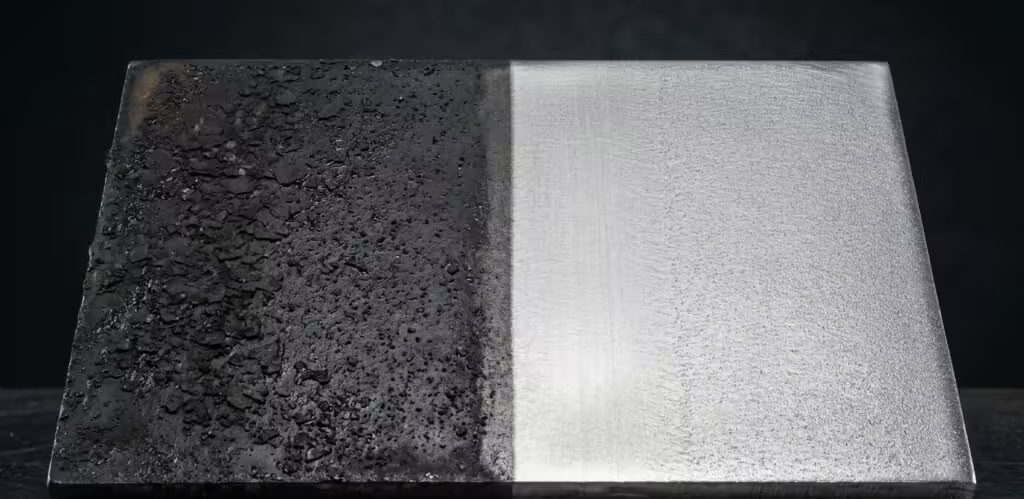
Laser Surface Prep offers a non-contact, dry alternative. By fine-tuning the laser’s pulse duration and frequency, engineers can selectively remove a specific thickness of the oxide layer without affecting the structural properties of the bulk material. This selectivity is critical when working with heat-sensitive alloys where maintaining a narrow Heat Affected Zone (HAZ) is paramount for the component’s final performance.
Improving Weld Quality with Automated Laser Surface Prep Technology
In modern production lines, speed is irrelevant if it comes at the cost of quality. The true value of Improving weld quality with automated laser surface prep technology is found in its ability to be integrated directly into a robotic cell. Unlike sandblasting, which requires a separate enclosure and extensive cleanup, laser systems can be mounted directly alongside a welding torch on a 6-axis robotic arm.
This integration allows for “just-in-time” cleaning. The laser scans the joint path milliseconds before the welding process begins, ensuring that no flash-rusting or airborne contamination can re-settle on the surface. Furthermore, the automated nature of the system allows for real-time monitoring of the ablation process. Modern sensors can detect the plasma plume’s color or intensity to confirm that the surface has reached the required cleanliness level before the arc is struck.
The Micro-Texturing Advantage for Advanced Bonding Prep
While welding relies on metallurgical fusion, adhesive bonding depends on surface energy and mechanical interlocking. A major part of effective bonding and welding prep is the creation of a “functional surface.” Smooth, cold-rolled steel is often too passive to allow for high-strength structural adhesives to take hold.
Laser Surface Prep provides a dual benefit here. Not only does it remove the chemically active contaminants that prevent adhesion, but it can also be programmed to create a specific micro-topography. By “roughing” the surface at a microscopic level, the laser increases the available surface area for the adhesive to grab onto. This “anchor profile” is consistent across every part, ensuring that the bonding strength measured in the lab is exactly what is achieved on the factory floor.
Solving the Aluminum Dilemma in EV and Aerospace Manufacturing
Aluminum is the darling of the EV and aerospace industries due to its strength-to-weight ratio, but it is a nightmare to weld. Aluminum naturally forms a hard, refractory oxide layer (Al2O3) almost instantly upon exposure to air. This oxide has a significantly higher melting point than the aluminum itself, often leading to “lack of fusion” defects.
Utilizing Laser Surface Prep allows manufacturers to strip away this hydrated oxide layer precisely where the weld will be placed. In high-volume EV battery tray production, this is a game-changer. By Improving weld quality with automated laser surface prep technology, manufacturers can achieve the high-integrity, leak-proof seals required for battery enclosures without the massive rework rates typically associated with aluminum welding.
Sustainability and the Zero-Consumable Workflow
The financial case for Laser Surface Prep is built on the elimination of operational expenditures (OPEX). Mechanical grinding requires a constant supply of sanding discs and wire brushes, all of which eventually end up in a landfill. Chemical cleaning requires expensive disposal of spent solvents.
A laser system, by contrast, is a “zero-consumable” technology. Aside from electricity and occasional lens cleaning, the system operates with minimal overhead. When you factor in the reduction in scrap rates and the elimination of secondary cleaning steps, the ROI for a Laser Surface Prep installation often realizes itself within the first 12 to 18 months of operation. This efficiency is a core pillar for companies looking to meet ESG (Environmental, Social, and Governance) targets without sacrificing production speed.
Preparing Your Facility for Laser Technology
Moving to Laser Surface Prep is a strategic shift. It requires an understanding of how light interacts with your specific alloys. Factors such as beam diameter, scan speed, and overlap ratio must be optimized for the specific contaminant—whether it’s a thick layer of rust or a thin film of stamping oil.
However, once these parameters are locked into the PLC (Programmable Logic Controller), the process becomes a “set-and-forget” component of the line. This reliability is why Improving weld quality with automated laser surface prep technology has moved from a niche laboratory curiosity to a standard requirement in Tier 1 automotive and defense manufacturing specifications.
Conclusion
As we push toward more complex assemblies and lighter materials, the margin for error in surface preparation has vanished. Laser Surface Prep is no longer just a “premium” option; it is becoming a necessity for any facility that prides itself on zero-defect manufacturing.
By focusing on the molecular level of bonding and welding prep, and by Improving weld quality with automated laser surface prep technology, manufacturers are finally able to bridge the gap between high-speed automation and uncompromising quality. The future of manufacturing isn’t just faster—it’s cleaner, more precise, and fundamentally more reliable.
FAQ
Does Laser Surface Prep alter the dimensions of the part?
No. Ablation is a surface-level phenomenon. It typically removes between 10 to 50 microns of material—only the contaminant layer. The underlying structural metal remains intact and dimensionally stable.
Is it safe for high-strength steels that are sensitive to heat?
Yes. Because the laser pulses are in the nanosecond or picosecond range, the thermal energy is concentrated on the surface and dissipated almost instantly. This keeps the Heat Affected Zone (HAZ) negligible, preventing hydrogen embrittlement or softening of the steel.
Can the system handle oily parts directly?
Yes. Lasers are highly effective at vaporizing oils. However, for extremely heavy sludge, a primary “rough” wipe is recommended to maintain the longevity of the laser’s fume extraction filters.
How does it improve bonding and welding prep compared to power brushing?
Power brushing often “burnishes” the metal, pushing contaminants deeper into the surface pores. Laser cleaning lifts and vaporizes them away, leaving a chemically pure surface.