

Quel laser choisir ? Graveur laser à fibre ou laser CO2 pour le métal et le bois
Le choix de l'équipement industriel approprié est une décision à fort enjeu pour toute entreprise de fabrication. Le débat porte souvent sur l'opposition entre le laser à fibre et le graveur laser CO2. Bien que les deux machines utilisent la technologie laser pour marquer, graver ou découper des matériaux, elles fonctionnent selon des principes physiques fondamentalement différents. Le choix de la mauvaise source ne se traduit pas seulement par une qualité médiocre, mais aussi par un gaspillage de matériaux et des pertes financières considérables.
Pour comprendre pourquoi une machine excelle dans la gravure de l'acier inoxydable tandis que l'autre est parfaite pour le bois organique, nous devons nous pencher sur la science de l'absorption de la lumière et de l'efficacité de la machine.
Table des matières
La différence fondamentale : Laser à fibre vs Graveur laser CO2
La principale distinction réside dans la longueur d'onde. Un laser à fibre fonctionne généralement à une longueur d'onde de $1,064\\\Nmu\Ntext{m}$, tandis qu'un laser CO2 fonctionne à $10,6\Nmu\Ntext{m}$. D'après le Laser Institute of America (LIA), La longueur d'onde plus courte du laser à fibre est absorbée beaucoup plus efficacement par les surfaces métalliques, ce qui en fait la norme industrielle pour le marquage des métaux à grande vitesse (référence) : LIA - Applications des longueurs d'onde des lasers).
Lorsque vous investissez dans un graveur laser à fibre ou à CO2, vous choisissez entre la précision pour les métaux et la polyvalence pour les matières organiques. La source de fibre est générée par un câble de fibre optique dopé et pompée par des diodes laser, ce qui produit un faisceau environ 100 fois plus intense qu'un faisceau de CO2 de même puissance. Cette intensité permet à un graveur laser à fibre par rapport à un graveur laser à CO2 de marquer des métaux réfléchissants comme le laiton et le cuivre, qui réfléchiraient généralement un faisceau de CO2 et risqueraient d'endommager l'optique.
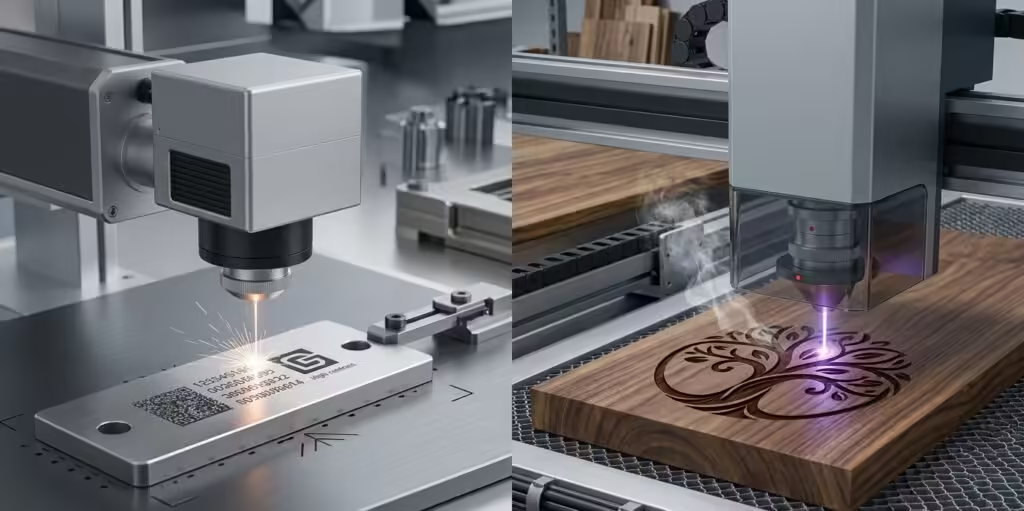
Compatibilité des matériaux : La matrice de décision
Pour la plupart des propriétaires d'ateliers, la question “Quel est le meilleur laser pour l'acier inoxydable ?” est le point de départ. En réalité, si votre flux de travail principal concerne l'acier au carbone, l'aluminium ou les métaux précieux, le choix entre le laser à fibre et le graveur laser CO2 penche fortement en faveur de la fibre.
Cependant, une comparaison entre les lasers à fibre et les graveurs laser CO2 n'est pas complète si l'on ne parle pas des non-métaux. Les lasers CO2 restent le “couteau suisse” du monde de la gravure. Comme leur longueur d'onde est absorbée par presque tous les matériaux non métalliques, ils sont indispensables pour le travail du bois, la fabrication de l'acrylique et la gravure du verre.
| Fonctionnalité | Laser à fibre | Laser CO2 |
| Idéal pour | Métaux et plastiques durs | Bois, acrylique, verre, cuir |
| Longueur d'onde | $1.064\,\mu\text{m}$ | $10.6\,\mu\text{m}$ |
| Source Durée de vie | 100 000 heures | 2 000 - 10 000 heures |
| Entretien | Minimal (état solide) | Haut (alignement gaz/miroir) |
| Investissement initial | Plus haut | Inférieur |
Coûts opérationnels et retour sur investissement
Au-delà du prix d'achat, le coût de maintenance d'un laser à fibre par rapport à un laser CO2 dictera votre rentabilité à long terme. Les lasers à fibre sont des machines à semi-conducteurs. Ils n'ont pas de pièces mobiles dans la source génératrice de lumière et ne nécessitent pas de miroirs qui doivent être constamment alignés.
En revanche, le laser CO2 repose sur un tube de verre rempli de gaz et sur une série de miroirs pour rediriger le faisceau. Ces miroirs doivent être nettoyés et calibrés fréquemment. Des données provenant d'études industrielles suggèrent que l'efficacité électrique d'un laser à fibre et d'un graveur laser à CO2 diffère considérablement : les lasers à fibre convertissent environ 30% de leur consommation électrique en puissance laser, tandis que les lasers à CO2 tournent autour de 10%. (Référence : ScienceDirect - Efficacité énergétique dans le traitement laser).
Sur une période de cinq ans, la consommation d'énergie plus faible et l'absence de tubes à gaz consommables font qu'un graveur laser à fibre par rapport à un graveur laser à CO2 est souvent amorti par la réduction des temps d'arrêt.
Mythes sur les applications spécifiques
Plusieurs idées fausses circulent sur le marché, notamment en ce qui concerne l'utilisation croisée des matériaux.
Un laser à fibre peut-il découper du bois ?
La réponse courte est non. Étant donné que la longueur d'onde de $1.064,\mu\text{m}$ traverse les fibres organiques au lieu d'être absorbée par elles, l'utilisation d'un laser à fibre ou d'un graveur laser CO2 sur du bois entraîne souvent un risque d'incendie ou l'absence totale de marquage. Pour ces matériaux, le laser CO2 pour la découpe du bois reste la seule option viable.
Comparaison des machines de gravure au laser pour les matières plastiques
C'est la “zone grise”. Certains plastiques techniques comme le Delrin ou l'ABS réagissent bien aux deux types de laser. Toutefois, si votre entreprise se concentre sur le laser à fibre pour la gravure des métaux, vous constaterez peut-être que certains plastiques se carbonisent sous le faisceau de la fibre, alors qu'un laser CO2 offrirait une finition plus nette et plus lisse.
Lorsque vous comparez des machines de gravure laser, tenez toujours compte de la “taille du spot”. Les lasers à fibre produisent un spot beaucoup plus petit, ce qui est idéal pour les codes-barres à haute densité et les numéros de série complexes sur les appareils médicaux ou les composants aérospatiaux.
Vitesse et précision : Augmenter votre production
Lorsque l'on compare un laser à fibre à un graveur laser CO2 dans un environnement de production, la vitesse est l'indicateur ultime. Pour le marquage de l'acier inoxydable, un laser à fibre de 30 W peut souvent être quatre fois plus performant qu'un laser CO2 de 100 W. Cela est dû au taux d'absorption et à l'utilisation de scanners galvaudés à grande vitesse dans la plupart des systèmes à fibre.
Si votre objectif est de maximiser le rendement, le choix entre le laser à fibre et le graveur laser CO2 devient évident. Les systèmes à fibre optique à grande vitesse peuvent marquer des centaines de pièces par heure avec une précision inférieure au millimètre. Ce niveau de cohérence est la raison pour laquelle la technologie de la fibre est l'épine dorsale des industries de l'automobile et de l'électronique.
Regardez cette vidéo pour explorer les différences techniques fondamentales entre les technologies laser à fibre et CO2 et voir comment chaque source fonctionne dans des applications réelles pour guider votre décision d'investissement.
Le verdict : Préparer l'avenir de votre atelier
Le débat entre le laser à fibre et le graveur laser CO2 ne porte pas sur la question de savoir quelle technologie est “meilleure”, mais sur celle qui convient le mieux à votre liste de matériaux spécifiques. Si votre feuille de route implique du métal, en particulier des métaux réfléchissants, la fibre est votre avenir. Si vous êtes un artisan travaillant avec des matériaux organiques variés, le CO2 reste le roi.
Investir dans un laser à fibre ou dans un graveur laser CO2 nécessite d'examiner votre plan de croissance sur trois ans. De nombreuses entreprises finissent par se rendre compte que posséder les deux machines est le seul moyen de couvrir tout le spectre du marché de la gravure.
FAQ
Un laser à fibre est-il plus dangereux qu'un laser CO2 ?
Les deux nécessitent des précautions de sécurité, mais la longueur d'onde du laser à fibre est particulièrement dangereuse pour l'œil humain car elle peut traverser la cornée et se concentrer directement sur la rétine. Utilisez toujours des lunettes de sécurité OD6+ lorsque vous utilisez un laser à fibre ou un graveur laser CO2.
Pourquoi l'écart de prix entre le laser à fibre et le graveur laser CO2 est-il si important ?
Le coût reflète la technologie. Les sources laser à fibre sont chères à fabriquer mais ont une durée de vie de 100 000 heures. Les tubes de CO2 sont moins chers à fabriquer mais sont essentiellement des consommables qui doivent être remplacés.
Quel est le meilleur laser pour l'acier inoxydable ?
Pour des marques permanentes et très contrastées sur l'acier inoxydable, le laser à fibre est supérieur. Un laser CO2 ne peut marquer le métal que si un revêtement céramique spécialisé (comme le Cermark) est appliqué au préalable, ce qui ajoute du temps et de l'argent à votre processus.
Est-il possible de passer ultérieurement d'une machine à CO2 à une source de fibres ?
En général, non. Les chemins optiques, les miroirs et les enceintes de sécurité sont conçus spécifiquement pour la longueur d'onde de la source d'origine. Il est plus rentable d'acheter un graveur laser à fibre ou un graveur laser CO2 que de tenter une conversion.