

Comprendre les buses des machines de soudage laser : caractéristiques, types et guide de sélection
Table des matières
Laser welding machine nozzle is the small but critical interface between the laser head, process gas, and the workpiece; its geometry, gas flow and material directly influence weld stability, porosity and productivity.
Why the Laser welding machine nozzle matters
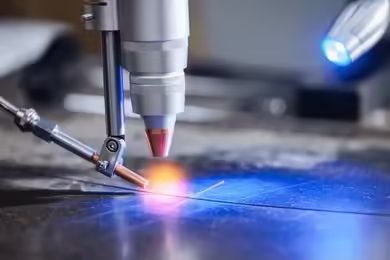
A nozzle shapes the assist/shielding gas, prevents contamination, and controls the local atmosphere where the laser interacts with the melt pool. In many laser welding processes the wrong nozzle or a poorly delivered gas flow will increase plasma formation, reduce penetration and create oxidized or porous seams.
Even in automated lines the nozzle is a frequent root cause of quality variation: wear, clogging or ill-matched orifice size changes gas dynamics and therefore the thermal conditions at the keyhole. For robust production the nozzle must be treated as a consumable that impacts process control and traceability.
Types of Laser welding machine nozzle
Nozzles used in laser welding fall into a few practical families. Each has advantages depending on material, joint geometry and whether filler/powder addition is required.
| Nozzle family | Typical use | Key characteristic |
|---|---|---|
| Coaxial (single-body) | Thin sheet welding, high precision | Gas and beam concentric — best for consistent shielding |
| Off-axis / side-blown | Applications needing angled gas jets | Easier to direct flow to one side; used when access or seam geometry dictates |
| Dual-gas / compound | Mixed assist/protective gas workflows | Separate channels for process and shielding gases, improves stability |
| Powder/coaxial (additive) | Laser cladding or powder-assisted welds | Powder and gas delivered coaxially with beam for deposition control |
Reference studies show that gas delivery geometry (coaxial vs side-blown) can change porosity and weld morphology, so selection should be evidence-based.
Key features to evaluate in a Laser welding machine nozzle
- Orifice geometry and diameter. Orifice size controls gas velocity and coverage; smaller orifices concentrate flow, larger orifices reduce back-pressure.
- Length and stand-off. The distance from nozzle tip to workpiece (stand-off) affects how the gas blankets the seam and how heat dissipates.
- Concentricity / alignment. For high-precision welding the optical axis and gas axis must be concentric; misalignment worsens plume formation and energy coupling.
- Cooling and thermal mass. Nozzles may be actively cooled or mass-heavy to resist distortion; thermal stability preserves orifice shape and repeatability.
- Replaceability and economy. Production lines favor quick-change nozzles with standardized fittings to minimize downtime.
These features interact: for example, a long nozzle with a small orifice may protect the weld well but increases clog risk and may be unsuitable for dirty environments. Practical selection balances protection and maintainability.
Materials and coatings for Laser welding machine nozzle
Common nozzle materials include copper, brass, stainless steel and ceramic inserts. Copper and copper alloys are valued for thermal conductivity and machining precision; ceramics are used where high wear resistance or dielectric isolation is needed. Surface coatings (nickel plating, oxidation-resistant finishes) extend service life in corrosive or high-temperature environments.
When welding reactive metals (e.g., titanium) or reflective materials (e.g., copper), choose nozzles and seals that resist contamination and minimize back-reflections. Material compatibility with cleaning agents and welding fumes should also be checked during supplier qualification.
Shielding and assist gases — nozzle’s influence
The nozzle determines how shielding gases (argon, helium, mixtures) interact with the laser plume and molten pool. Shielding gas in laser welding not only prevents oxidation but also reduces plasma absorption of laser energy — a crucial effect for some wavelengths and laser types. Helium, for instance, has high ionization potential and can mitigate plasma formation in certain CO₂ systems; argon is common due to cost and effectiveness.
Gas flow technique (coaxial vs side-axis) and flow rate are nozzle-dependent parameters that must be tuned for material thickness and laser power. Contemporary literature demonstrates measurable differences in penetration and bead shape between different gas setups, so document gas/nozzle combinations during process qualification.
How to choose the right Laser welding machine nozzle — a practical checklist
1.Match nozzle family to process: coaxial for sealed atmospheres and precise optical alignment; side-blown where seam access requires angled gas.
2.Define gas strategy: identify shielding and assist gases, required flow rates, and whether dual-channel delivery is advantageous.
3.Specify orifice and stand-off: run trials to find the best orifice size and tip-to-work distance for penetration and seam geometry.
4.Material and coating: choose nozzle materials that tolerate heat, spatter and chemical exposure from the welded alloy.
5.Serviceability: prefer modular, easy-to-replace nozzles; plan spare parts inventory by average consumable life.
6.Document process windows: for production control, lock nozzle type, gas settings and stand-off in the manufacturing procedure.
Using this checklist during FAI (first article inspection) reduces rework and accelerates ramp-up of qualified production families.
Practical selection examples
- Thin stainless panels (0.5–2 mm): small coaxial nozzle, argon shield, short stand-off for shallow keyholes.
- Thicker steels (>4 mm): larger orifice, controlled helium/argon mixes in some cases, consider pre-heating and dual-gas nozzle for stable penetration.
- Cladding / powder deposition: use a powder-capable coaxial nozzle with precise powder feeding and gas shaping to contain the melt pool.
These examples are starting points; actual parameters must be validated on process-representative test coupons.
Maintenance, troubleshooting and lifetime considerations for a Laser welding machine nozzle
Inspect nozzles daily in high-volume lines: check for deformation, carbon build-up, or partial clogging. Clean nozzles with appropriate solvents and mechanical methods recommended by suppliers; avoid abrasive actions that change orifice geometry. Track nozzle life versus weld hours and build a replacement cadence into the maintenance plan.
Symptoms and likely causes:
- Increased porosity: check gas flow, replace nozzle if orifice distorted.
- Reduced penetration: verify stand-off, alignment and presence of contamination on or near the cap.
- Excessive spatter adhesion: re-examine gas mix and nozzle cooling.
Summary table — quick selection at a glance
| Scenario | Recommended nozzle family | Gas | Notes |
|---|---|---|---|
| Precision thin sheet | Coaxial small orifice | Argon | Short stand-off, tight alignment |
| High-volume moderate thickness | Coaxial / dual gas | Argon/He mix | Consider cooling and replaceable tips |
| Powder cladding | Powder-coaxial | Argon (carrier gas) | Powder feed control essential |
Closing notes
The Laser welding machine nozzle is a deceptively small component that shapes process repeatability, quality and cost of ownership. Selecting the correct nozzle requires thinking in systems: optics, gas, mechanical alignment, consumable life and the metallurgical response of the welded alloy. Use trials, document the proven settings, and treat nozzle specification as part of your process control plan rather than an afterthought. For detailed nozzle designs and comparative studies, peer-reviewed work and standards (e.g., laser processing handbooks and welding journals) provide empirical backing to practical decisions.
If you want to learn more about Laser Welding Machine Nozzles, please click here.