

Can Laser Mold Cleaning Remove Residue Without Damaging Tooling?
Laser mold cleaning answers a question many tooling managers face: how do you remove rubber residue, resin buildup, carbon deposits, release agents, and oil contamination without wearing down the mold surface itself? For tire and injection mold production, cleaning is not a side task. It affects part quality, downtime, mold texture, cavity accuracy, and long-term tooling life.
This article explains where laser mold cleaning fits, how it compares with chemical cleaning and sandblasting, and why zero-residue maintenance matters for high-value molds.
Table des matières
Why Mold Cleaning Quality Affects More Than Surface Appearance
Mold residue is not just dirt. In tire molds, rubber residue, sulfur compounds, carbon deposits, and release agents can collect inside tread grooves and vent details. In injection molds, resin buildup, oil, carbonized plastic, and release agent film can affect surface finish, filling behavior, part release, and dimensional consistency.
Traditional methods can remove buildup, but they may introduce another problem. Sandblasting can leave abrasive media or gradually alter fine mold texture. Chemical cleaning can require handling, rinsing, waste control, and drying time. Manual scraping depends heavily on operator skill.
Laser mold cleaning changes the maintenance logic because it uses controlled light energy to remove contaminants from the surface. Britannica explains that a laser produces a narrow, amplified beam of radiation, which is why laser processes can deliver energy in a highly focused way.
What Makes Laser Mold Cleaning Different from Traditional Cleaning?
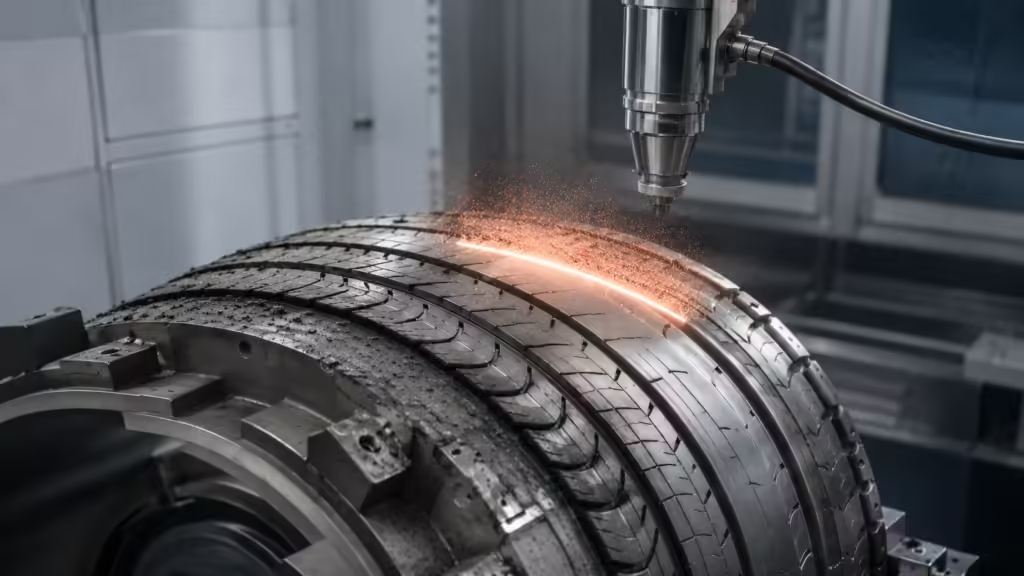
Laser mold cleaning is a non-contact mold cleaning process. Instead of grinding, blasting, or soaking the tooling, the laser beam interacts with the contaminant layer. The goal is to remove deposits while reducing mechanical wear on the mold surface.
The practical advantages are clear:
- No blasting sand, glass beads, or abrasive media
- No chemical film or solvent residue
- Less manual scraping dust
- Controlled cleaning on detailed mold surfaces
- Potentially shorter maintenance windows
- Cleaner work environment when fume extraction is used
Laser mold cleaning should still be parameter-controlled. Power, pulse width, scan speed, spot size, and surface material all affect the result. The right process does not mean “more power.” It means enough energy to remove contamination without overheating, marking, or changing the mold surface.
Laser Mold Cleaning for Tire and Injection Molds
Laser mold cleaning for tire molds is valuable because tire patterns are deep, detailed, and difficult to clean evenly. Residue tends to collect in grooves, lettering, sidewall textures, and vent areas. If these features are worn or rounded by aggressive cleaning, the mold may still look clean but produce lower-quality tire surfaces.
Injection mold cleaning has a different challenge. Injection molds often include polished cavities, fine textures, vents, sliders, and precision parting lines. Resin buildup, carbon deposits, oil, and release agents must be removed without scratching the cavity or changing the surface finish.
For tire and injection mold maintenance teams, the value is not only cleaner tooling. It is cleaner tooling with less risk of texture loss, surface wear, or repeated manual damage.
Zero-Residue Mold Cleaning: What It Really Means
Zero-residue mold cleaning does not mean every molecule disappears from the environment. It means the cleaning process does not add secondary contamination to the mold.
That matters because mold cleaning can create its own quality problems. Abrasive media may remain in fine grooves. Chemical residues may require extra rinsing or drying. Manual scraping may leave scratches or embedded particles. In precision production, those secondary problems can affect the next production run.
Laser mold cleaning supports residue-free mold cleaning because it does not rely on chemical solvents or blasting media. With the right extraction system, removed contamination can be captured instead of spread around the workspace.
How Laser Cleaning Extends Mold Life
Laser mold cleaning can help extend tooling life because it reduces the need for abrasive cleaning cycles. Every time a mold is blasted, scraped, or polished aggressively, a small amount of surface detail may be changed. Over time, that affects fine texture, edge definition, vent geometry, and cavity accuracy.
The biggest lifecycle benefits often come from:
1.Less abrasive wear on mold texture
2.Lower risk of manual scratches
3.Reduced disassembly in some workflows
4.More consistent cleaning across repeated cycles
5.Better protection of fine grooves and edges
6.Lower chance of chemical residue remaining on the surface
The key point is simple: laser mold cleaning is not only about removing residue. It is about reducing the maintenance methods that gradually remove material from the tooling.
Laser Cleaning vs Chemical Cleaning and Sandblasting for Molds
Different methods still have their place. A responsible comparison should focus on mold value, residue type, surface tolerance, and downtime.
| Method | Residue Risk | Surface Wear | Downtime | Best Use |
|---|---|---|---|---|
| Laser cleaning | Low secondary residue | Low when controlled | Often lower | Precision molds and repeat maintenance |
| Chemical cleaning | Possible chemical film | Low mechanical wear | Often longer | Certain soluble residues |
| Sablage | Possible media residue | Higher wear risk | Moyen | Rougher, less precise surfaces |
| Manual scraping | Low chemical residue | Scratch risk | Labor-intensive | Local small-area cleaning |
Laser mold cleaning is strongest where surface detail matters. Tire molds, injection molds, rubber molds, plastic molds, medical molding tools, packaging molds, and automotive component molds are typical examples.
Where Laser Mold Cleaning Delivers the Highest ROI
Laser mold cleaning usually delivers the strongest return when the mold is expensive, the surface is detailed, and downtime is costly.
High-value applications include:
- Tire manufacturing lines with complex tread molds
- Injection molding factories producing visible plastic parts
- Rubber sealing product molds
- Automotive interior and exterior plastic molds
- Medical plastic component molds
- Packaging molds with fine cavity detail
- High-volume production lines with frequent maintenance cycles
Key Buying Questions Before Choosing a Laser Cleaning Machine for Molds
Before investing in a laser cleaning machine for molds, buyers should define the cleaning problem clearly.
Ask these questions:
- Is the mold used for tire, rubber, plastic, medical, or packaging production?
- What residue needs to be removed: rubber, resin, carbon, oil, rust, or release agent?
- Is the surface polished, textured, engraved, or coated?
- Does the mold need online cleaning or offline maintenance?
- Is a handheld, automated, or robotic system more suitable?
- Is pulsed laser cleaning required for precision control?
- What fume extraction and laser safety measures are needed?
- Can the supplier provide sample testing?
- Does the supplier offer operator training and maintenance support?
Buyer Insight: Do not buy only by wattage. For precision mold maintenance, process control, pulse behavior, optics, scanning method, extraction, and support can matter more than headline power.
When Laser Mold Cleaning May Not Be the Right Fit
Laser mold cleaning is not the answer for every facility. If molds are low-value, contamination is very thick, precision is not important, or downtime cost is minimal, a simpler cleaning method may be enough.
It also requires safety planning. Operators need laser protection, controlled work areas, fume extraction, parameter training, and process discipline. Without these, even a good machine can create risk or inconsistent results.
The best candidates are companies that value mold texture, uptime, part appearance, repeatable maintenance, and lower secondary residue.
Conclusion
Laser mold cleaning is most valuable when cleaning quality, mold surface protection, and downtime all matter. For tire molds, injection molds, rubber molds, and precision tooling, the goal is not simply to remove residue. The goal is to clean without adding abrasive media, chemical film, or unnecessary surface wear.
If your mold maintenance process is causing surface damage, longer downtime, inconsistent cleaning, or shorter tooling life, laser mold cleaning is worth evaluating with real samples, real residues, and real production targets.
FAQ
Is laser mold cleaning safe for mold surfaces?
Yes, when parameters are correctly set. It is a non-contact process and can reduce mechanical wear compared with abrasive cleaning methods.
Can laser cleaning remove rubber residue from tire molds?
Yes. It can remove rubber residue, release agent buildup, carbon deposits, and contamination from complex tire mold grooves and textures.
Is laser cleaning suitable for injection molds?
Yes. It is suitable for injection mold cleaning where resin buildup, carbon deposits, oil, or release agent residue must be removed without scratching the cavity.
Does laser mold cleaning leave residue?
It does not use blasting media or chemical solvents, so it can reduce secondary residue compared with sandblasting or chemical cleaning.
Can laser cleaning extend mold life?
It can help extend mold life by reducing abrasive wear, protecting surface texture, and lowering repeated manual cleaning damage.
Is laser cleaning better than sandblasting?
For precision molds, laser cleaning is often safer for detailed surfaces. Sandblasting may be faster for rough surfaces but can alter mold texture over time.