

Soudeur laser 1500W vs 2000W pour la tôle : Puissance, épaisseur, coût et meilleur choix
Pour la plupart des fabricants de tôles standard, une soudeuse laser de 1500 W est tout à fait suffisante pour répondre aux exigences de soudage de tôles fines standard. Cependant, si vos opérations exigent un débit plus élevé, la capacité de traiter des matériaux plus épais, une production continue et ininterrompue, ou une stabilité de soudage sans compromis, passer à un système de 2000 W est le choix le plus judicieux.
Table des matières
En fin de compte, le véritable critère de sélection n'est pas simplement “plus de puissance est mieux”. La décision dépend strictement de vos types de matériaux, de votre gamme d'épaisseurs, de la vitesse de soudage requise, de votre budget et du temps tactic de production global.
-
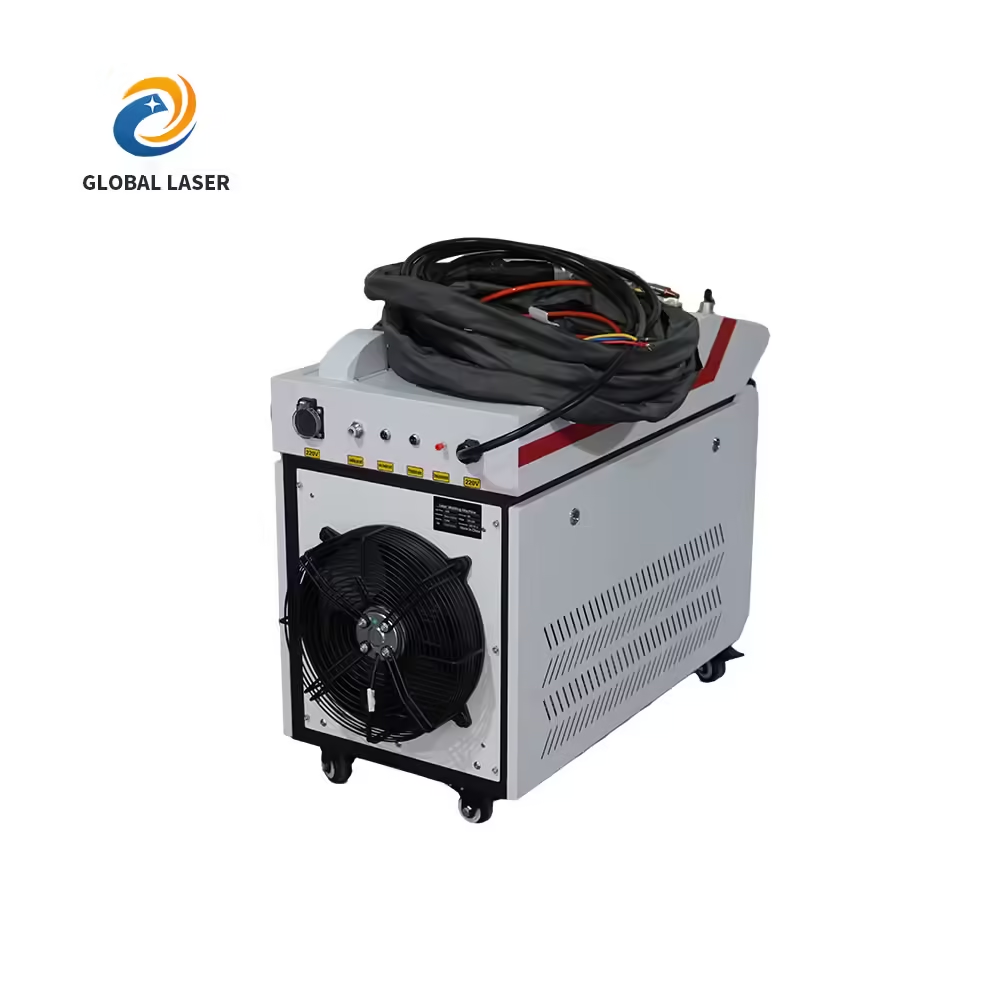 Modèle :GL-HW1500 | 3-en-1Notation :4.77Prix :$3,500 - $5,000
L'amélioration intelligente du soudage TIG/MIG traditionnel Le système laser GlobalLaser 1500W 3-en-1 est l'outil multifonctionnel le plus économique pour la fabrication de métaux légers. Il permet de passer instantanément d'une soudure impeccable à un dérouillage et à une découpe précise. Il ne nécessite aucune expérience professionnelle en matière de soudage, ce qui réduit considérablement votre dépendance à l'égard de la main-d'œuvre tout en produisant des joints propres et sans déformation sur l'acier inoxydable et l'aluminium de faible épaisseur.
-
Capacités essentielles : Souder, nettoyer, couper (3 en 1).
-
Idéal pour : Fabrication de tôles, fabrication d'ustensiles de cuisine, assemblage de portes et fenêtres et réparation de carrosseries.
-
-
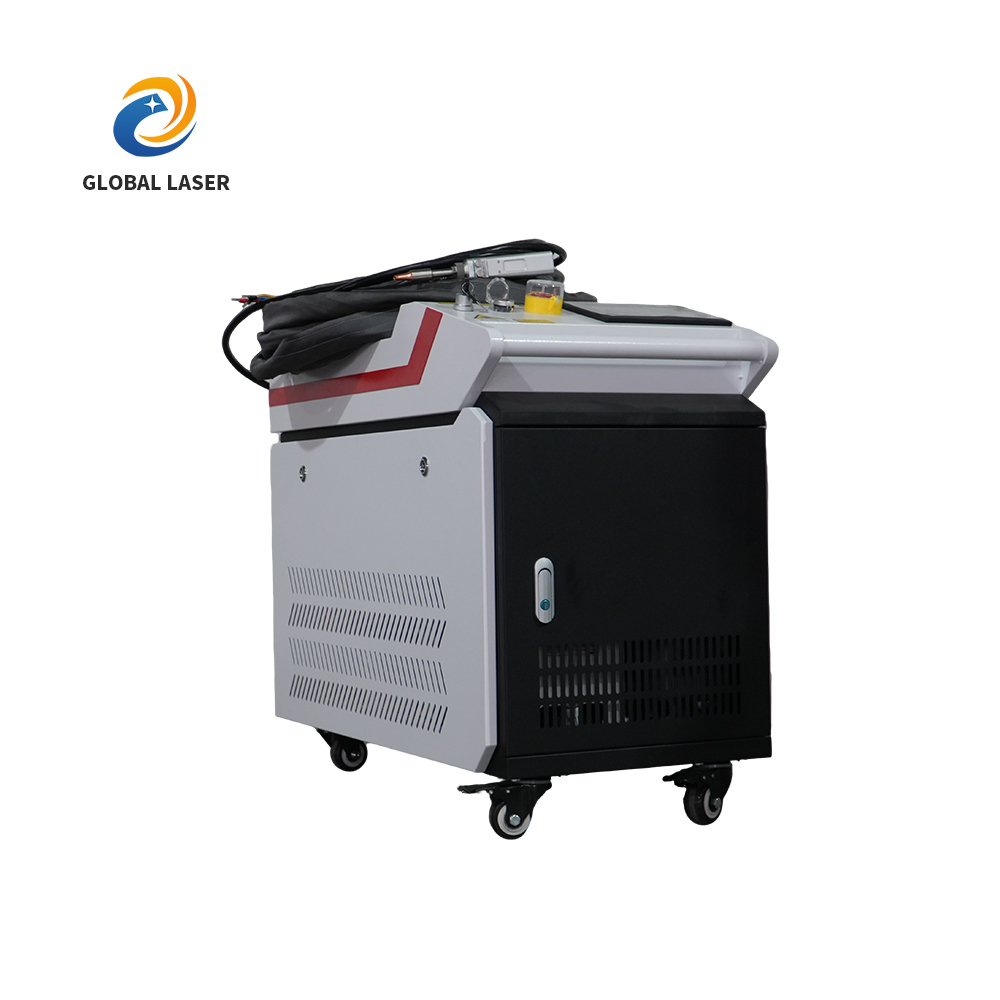 Modèle :GL-HW2000 | 3-en-1Notation :4.82Prix :$4,500 - $6,500
Puissance de qualité commerciale pour des fabrications plus épaisses.
Accédez aux performances robustes Le GlobalLaser GL-HW2000 fournit 2 000 watts de puissance en ondes continues, ce qui vous permet de pénétrer sans effort jusqu'à 6 mm d'acier inoxydable, d'acier au carbone et d'aluminium Ce système portatif commercial 3-en-1 combine un soudage plus profond et à grande vitesse, un nettoyage agressif avant/après soudage et une découpe de précision des métaux dans une seule unité mobile. Il s'agit de la mise à niveau ultime pour les ateliers de fabrication à grand volume exigeant des joints plus solides, des vitesses de déplacement plus rapides et une distorsion thermique nulle.
Pourquoi la puissance est importante dans la tôle Soudage au laser
Ce que 1500W et 2000W signifient réellement
Dans le soudage au laser, la puissance détermine directement l'apport d'énergie dans le métal. Une puissance plus élevée se traduit généralement par une capacité de pénétration plus forte et des vitesses de soudage plus rapides.
Cependant, une puissance élevée n'est pas universellement meilleure dans tous les scénarios. Lors du travail avec des tôles fines, une puissance excessive augmente le risque d'un apport de chaleur élevé, ce qui peut entraîner des déformations thermiques, des perforations et des coûts d'exploitation globaux plus élevés.
Applications de la tôlerie où la sélection de la puissance est la plus importante
Choisir le bon niveau de puissance est essentiel dans les industries où la précision et l'intégrité structurelle se rencontrent. Les applications courantes comprennent :
- Armoires en acier inoxydable
- Équipement de cuisine
- Boîtiers en tôle
- Boîtiers électriques
- Meubles en métal
- Conduits CVC
- Composants de tôlerie pour pièces automobiles
1500W vs 2000W Soudeuse laser : principales différences en un coup d'œil
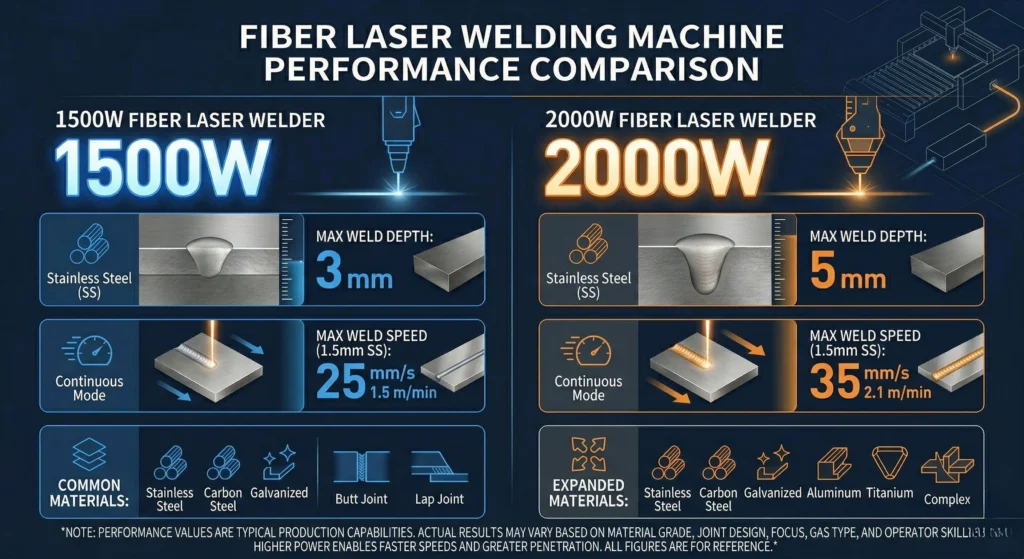
Pour faciliter la comparaison, voici comment ces deux niveaux de puissance se situent l'un par rapport à l'autre dans un environnement de production typique :
| Spécification | QYWL-FC1500 (1500W) | QYWL-FC2000 (2000W) |
| Puissance laser | 1500W | 2000W |
| Type laser | Continu (CW) | Continu (CW) |
| Marque de source laser | MAX | MAX |
| Longueur du câble en fibre optique | 10 m (15 m en option) | 10 m (15 m en option) |
| Contrôleur | SUP-23T | SUP-23T |
| Tête laser / Tête de soudage | SUP23T / Pendule simple | SUP23T / Pendule simple |
| Alimentateur de fil | SUP-AMF-A Simple | SUP-AMF-A Simple |
| Refroidisseur d'eau | S&A CWFL-1500 | S&A CWFL-2000 |
| Consommation d'énergie | 7,7 kW | 10 kW |
| Courant électrique | 35A | 45A |
| Tension | 220 V, monophasé | 220 V, monophasé |
| Plage de réglage de puissance | 10-100% | 10-100% |
| Température de l'eau | 22℃-26℃ | 22℃-26℃ |
| Gaz auxiliaire / Eau de refroidissement | Azote, Argon, Air / Distillé, Plasma | Identique à 1500W |
| Tête de nettoyage (Objectifs et poids) | D18*T2, D20*4.5, D16*5 / 0.8kgs | Identique à 1500W |
| Taille de la machine | 917*490*850mm | 1110*490*850mm |
| Taille du paquet | 109*60*143cm (0,94m³) | 122*60*143cm |
| Poids net | 105kg | 130kg |
| Poids du paquet | 170kg | 200kg |
Gamme d'épaisseur
- 1500W : Plus adapté pour le soudage de tôles fines à moyennement fines standard, gérant la majorité des tâches de fabrication typiques.
- 2000W : Offre une plage d'épaisseurs plus large, offrant un avantage distinct lors du traitement de tôles plus épaisses et fonctionnant dans des scénarios à haute efficacité.
Vitesse de soudage
- 2000W permet généralement un soudage plus rapide sur le même matériau et la même épaisseur.
- 1500W est souvent plus que suffisant pour répondre à des besoins de production modérés sans causer de goulots d'étranglement.
Apport de chaleur et contrôle de soudage
- 1500W est beaucoup plus facile à contrôler lorsqu'on travaille avec des tôles fines, ce qui donne des finitions plus nettes.
- 2000W, Si les paramètres ne sont pas parfaitement ajustés, le risque de brûlure, de déformation thermique ou d'éclaboussures est plus élevé sur les matériaux plus minces.
Prix de la machine et coût d'exploitation
- 2000W nécessite un coût d'achat initial plus élevé. La consommation d'énergie, les besoins en équipements auxiliaires et les budgets d'entretien globaux sont généralement plus élevés.
- Cependant, dans les usines à haute capacité, le 2000W peut permettre une période de retour sur investissement plus rapide en raison d'une production considérablement accrue.
Quelle épaisseur peuvent supporter 1500W et 2000W pour la tôle ?
J'ai rassemblé quelques vidéos sur Youtube : sur les machines de soudage laser de différentes puissances
Capacité d'épaisseur pour soudeuse laser 1500W
Un système de 1500W est le cheval de bataille pour la majorité des pièces en tôle communes. Il offre une excellente adaptabilité pour les matériaux standard tels que l'acier inoxydable, l'acier au carbone et la tôle galvanisée. Il est particulièrement idéal pour les plaques fines qui nécessitent des cordons de soudure fins et une apparence esthétique de haute qualité sans meulage post-soudure.
Capacité de soudage au laser de 2000W
Le système de 2000W gère une gamme de matériaux beaucoup plus épaisse et atteint des vitesses de soudage notablement plus rapides à égalité d'épaisseur par rapport aux modèles de puissance inférieure. Il est conçu pour les charges lourdes, les exigences de cadence élevée et la production en série continue.
La matière compte autant que l'épaisseur
On ne peut pas juger des exigences de puissance à la seule épaisseur ; le métal lui-même importe :
- Acier inoxydable et acier au carbone : Les deux machines gèrent bien cela, mais la 2000W est plus rapide sur les coupes épaisses.
- Aluminium : Parce que l'aluminium est très réfléchissant et conduit la chaleur rapidement, il nécessite des performances de machine plus élevées. Un système de 2000W fournit souvent la puissance supplémentaire nécessaire.
- Tôle galvanisée Nécessite une attention stricte à l'apport de chaleur et à la stabilité du soudage pour gérer la vaporisation du zinc.
Lequel est le meilleur pour différents travaux de tôlerie ?
Pour tôle d'acier inoxydable mince
1500W est généralement suffisant. Il facilite le contrôle et permet d'obtenir des soudures plus propres et sans distorsion pour les applications de faible épaisseur telles que les ustensiles de cuisine ou les boîtiers électriques.
Pour une tôle d'acier au carbone plus épaisse
2000W peut offrir une meilleure vitesse et une pénétration plus profonde, ce qui le rend très adapté aux chaînes de production à plus haute efficacité pour les composants structurels.
Pour le soudage de tôles d'aluminium
L'aluminium est notoirement exigeant. En raison de sa réflectivité, 2000W peut fournir des performances plus stables dans certains cas en délivrant une énergie de crête plus élevée. Cependant, le résultat réel dépend toujours de l'épaisseur, de la conception de la jonction et de la compétence de l'opérateur.
Pour des ateliers avec des commandes mixtes
- Si vos commandes couvrent une large gamme d'épaisseurs et de matériaux divers, 2000W est plus flexible.
- Si vos commandes sont principalement axées sur des produits courants en tôles fines, 1500W offre le meilleur rapport coût-performance.
Soudeuse laser 1500W vs 2000W : Coût, retour sur investissement et décision commerciale
Investissement initial
Un système de 1500W représente un coût d'entrée plus faible, le rendant accessible aux plus petites boutiques. Un système de 2000W nécessite un budget initial plus élevé mais apporte des capacités plus importantes.
Productivité et efficacité du travail
Bien qu'une soudeuse de 2000 W puisse réduire les temps de cycle et permettre d'économiser de la main-d'œuvre par pièce, un système de 1500 W répond déjà parfaitement aux exigences de production des ateliers de petite et moyenne taille sans qu'il soit nécessaire de surinvestir.
Lequel offre le meilleur retour sur investissement ?
- Si vous êtes un petit atelier de tôlerie avec des commandes personnalisées, des prototypes et de petites séries, le retour sur investissement d'un 1500W est souvent beaucoup plus réaliste et plus rapide à réaliser.
- Si vous exécutez une production en lots continue et que vous visez un rendement maximal, le retour sur investissement à long terme d’un 2000W sera probablement supérieure malgré le coût initial plus élevé.
Comment choisir la bonne soudeuse laser pour votre L'affaire de la tôlerie
Choisissez 1500W si…
- Vous traitez principalement de tôles fines.
- Vous avez un volume de production modéré.
- Vous travaillez avec un budget plus serré.
- Vous vous concentrez sur une utilisation facile et un aspect de soudure stable.
- C'est votre premier investissement dans la soudure laser portative.
Choisissez 2000W si…
- Vous traitez une gamme de feuilles plus épaisses.
- Une vitesse de production plus élevée est strictement nécessaire.
- Vous gérez un mélange de matériaux plus exigeant (par exemple, des métaux très réfléchissants).
- Vous menez des opérations quotidiennes de longue haleine.
- Vous souhaitez une meilleure évolutivité future pour le développement de votre entreprise.
Questions à poser avant d'acheter
- Quels matériaux soudez-vous le plus souvent ?
- Quelle est votre gamme d'épaisseur courante ?
- Privilégiez-vous un budget initial plus bas ou un débit plus élevé ?
- Votre production est-elle basée sur des ateliers (sur mesure) ou de la production par lots ?
- Anticipez-vous le besoin d'une capacité d'expansion future pour des métaux plus épais ?
Erreurs courantes lors du choix de la puissance d'une soudeuse laser
- En supposant qu'une puissance plus élevée soit toujours meilleure : Plus de puissance sur des tôles fines ne signifie qu'une plus grande distorsion et un gaspillage d'électricité.
- En ignorant le type de matériau et la plage d'épaisseur réelle : Acheter une machine pour une épaisseur que vous ne soudez que 2% du temps est un gaspillage de capital.
- Choisir en se basant uniquement sur le prix de la machine : Une machine bon marché qui ralentit votre chaîne de production est la machine la plus chère que vous puissiez acheter.
- Sans tenir compte de la compétence de l'opérateur et du réglage des paramètres : Une puissance élevée nécessite un opérateur qualifié pour ajuster les bons paramètres afin d'éviter de brûler le métal.
- Anticiper les besoins de production futurs : Acheter aujourd'hui un appareil de 1500W lorsque vous prévoyez d'accepter des contrats lourds l'année prochaine vous obligera à acheter deux fois.
FAQ sur les soudeuses laser de 1500W vs 2000W pour la tôle
1500W est-ce suffisant pour la plupart des applications de tôlerie ?
Oui. Pour la fabrication standard d'acier fin à moyen et d'acier inoxydable, la puissance de 1500 W offre une pénétration, une vitesse et une finition excellentes.
2000W est-il meilleur pour le soudage de tôles d'aluminium ?
En général, oui. La puissance plus élevée aide à surmonter la réflectivité élevée de l'aluminium et sa dissipation thermique rapide, ce qui se traduit par un bain de soudure plus stable.
2000W causera-t-il plus de déformation sur une tôle fine ?
Cela peut arriver si les paramètres ne sont pas réglés correctement. Un apport de chaleur excessif sur du métal fin entraîne une déformation, c'est pourquoi 1500 W est souvent préféré pour les applications de très fine épaisseur.
Qu'est-ce qui est le mieux pour les armoires et les boîtiers en acier inoxydable ?
1500W est généralement le meilleur choix, car ces produits nécessitent des finitions esthétiques irréprochables et limitent strictement la distorsion thermique.
La différence de prix en vaut-elle la peine ?
Si la machine de 2000W élimine un goulot d'étranglement de production et vous permet de conclure des contrats plus rémunérateurs avec des matériaux plus épais, oui. Si elle reste inactive, non.
Lequel est le meilleur pour un petit atelier ?
Pour un petit atelier qui passe à la soudure laser, 1500W est fortement recommandé en raison de son prix abordable, de sa facilité d'utilisation et de sa polyvalence.
Les deux peuvent-ils être utilisés pour le soudage laser manuel ?
Oui, les modèles de 1500W et 2000W sont tous deux des configurations standard pour les machines de soudage laser portatives modernes.
Conclusion : Lequel devriez-vous choisir ?
1500W est le meilleur choix pour de nombreuses entreprises de tôlerie standard qui traitent principalement des tôles fines à moyennes et souhaitent une solution rentable et facile à contrôler.
2000W est le meilleur choix pour les usines qui ont besoin d'une vitesse plus élevée, d'une couverture d'épaisseur plus large et d'une capacité de production continue plus forte.
La meilleure machine dépend finalement de vos matériaux réels, de votre gamme d'épaisseur, de votre volume de production et de votre budget.
Vous n'êtes pas sûr que 1500W ou 2000W convienne à votre production de tôles ?
Envoyez-nous votre type de matériau, votre plage d'épaisseur et vos exigences d'application. Notre équipe d'ingénieurs évaluera vos données et vous recommandera la solution de soudage laser la plus adaptée et la plus rentable pour votre entreprise.
Envoyez-nous votre type de matériau, votre plage d'épaisseur et vos exigences d'application. Notre équipe d'ingénieurs évaluera vos données et vous recommandera la solution de soudage laser la plus adaptée et la plus rentable pour votre entreprise.