

Laser Weld Seam Quality Explained: Defects, Root Causes, and How to Improve Welding Results
Laser welding looks controlled on paper. In production, it rarely behaves that way.
A small drift in focus, a slightly contaminated surface, or unstable shielding gas can immediately show up as porosity, spatter, or inconsistent penetration. That is why laser weld seam quality is not just a machine setting issue—it is a process stability problem.
This guide focuses on how weld seam quality actually fails in real manufacturing lines, and how engineers correct it using parameter logic instead of trial-and-error.
Tabla de contenido
What defines laser weld seam quality in real manufacturing, not theory?
In industrial production, weld seam quality is not subjective. It is measurable and repeatable.
Core evaluation signals:
- Bead geometry stability (width fluctuation control)
- Penetration consistency (no intermittent lack of fusion)
- Porosity ratio (internal void formation)
- Surface stability (spatter + oxidation level)
- Heat affected zone (HAZ control)
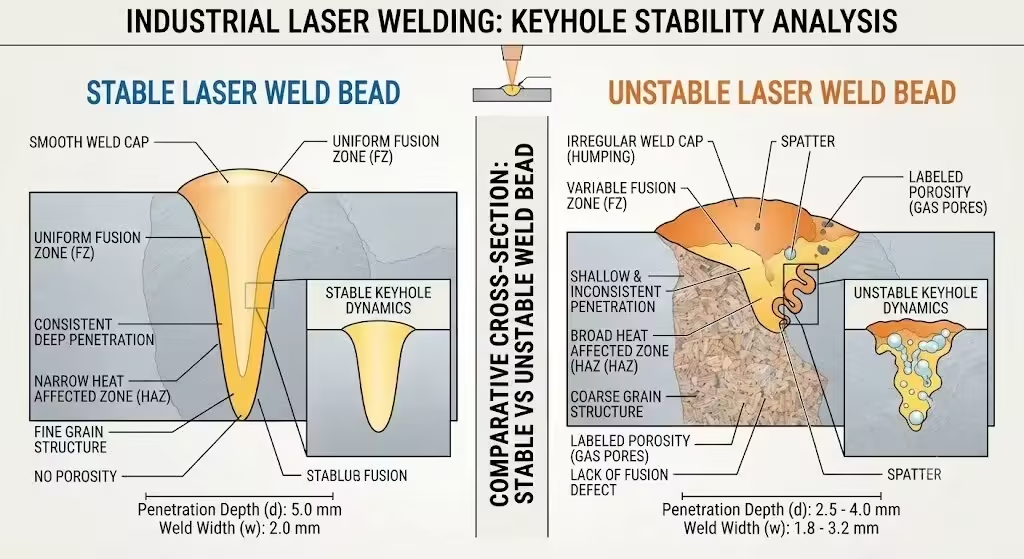
Why laser weld seam quality becomes unstable in production lines
Most weld defects are not random. They follow system-level failure patterns.
1.Energy input imbalance (most common root cause)
Laser welding is extremely sensitive to energy density.
- Too high → spatter, vapor explosion, unstable keyhole
- Too low → incomplete fusion, weak joint strength
Research from ScienceDirect laser beam welding fundamentals shows that melt pool behavior is dominated by energy distribution, not nominal power value.
2.Surface condition sensitivity is underestimated
Even thin contamination changes absorption rate dramatically.
- Oil film → unstable melt pool
- Oxide layer → inconsistent penetration
- Coating residue → porosity formation
3.Shielding gas instability (hidden defect source)
Shielding gas is often treated as “set and forget”, but it directly affects oxidation and porosity.
- Low flow → oxidation + porosity
- Turbulent flow → unstable molten pool
- Wrong gas type → inconsistent arc interaction
Porosity in laser weld seam quality (gas entrapment mechanism)
Porosity occurs when gas cannot escape before solidification.
Root causes:
- Contaminated surface layer
- Fast welding speed (insufficient escape time)
- Unstable shielding gas coverage
- Clean surface using acetone or plasma
- Reduce travel speed slightly
- Stabilize gas flow pattern
Cracking (thermal stress accumulation failure)
Cracking is not a material defect alone—it is thermal stress imbalance.
Why it happens:
- High cooling rate
- High carbon or brittle alloy structure
- Poor joint stress distribution
Fix strategy:
- Preheating to reduce thermal gradient
- Reduce peak energy density
- Improve joint design geometry
Spatter and burn-through (keyhole instability event)
Spatter is caused by unstable vapor pressure inside the keyhole.
Main triggers:
- Excess energy density
- Incorrect focal position
- Rapid keyhole collapse
Correction:
- Adjust focus slightly above surface
- Reduce peak power
- Aumentar la velocidad de desplazamiento
Engineering model for laser weld seam quality control
Instead of adjusting single parameters, production engineers use ratio control.
Core model:
laser weld seam quality = f(power / speed ratio, focus position, shielding stability)
Practical adjustment logic:
- Power ↑ + speed ↑ → stable penetration
- Power ↑ only → spatter risk increases
- Focus too deep → burn-through
- Focus too shallow → incomplete fusion
Parameter response table
| Defect | Root cause | Correction logic |
|---|---|---|
| Porosidad | gas entrapment | reduce speed + stabilize shielding gas |
| Cracking | thermal stress | preheat + reduce peak energy |
| Spatter | excess energy | adjust focus + reduce power |
| Fusión incompleta | low penetration | increase energy density |
What production engineers check before blaming machine failure
Most laser welding issues are not equipment faults.
Daily inspection logic:
- Lens contamination (beam distortion source)
- Gas flow stability (not pressure only)
- Fixture rigidity (gap variation control)
- Material surface condition
- Focus calibration drift
A practical maintenance guide from TRUMPF laser welding knowledge base highlights that process instability is often caused by setup drift rather than hardware failure.
In industrial laser welding, process variability is rarely the result of a single hardware failure. According to the technical analysis provided by the TWI Technical Knowledge Library, process instability is frequently caused by ‘setup drift’—such as thermal expansion in fixtures or optical misalignment—which directly disrupts the energy density distribution required for a stable keyhole. To further mitigate such risks, we align our process monitoring protocols with the engineering standards for weld consistency established by EWI (Edison Welding Institute), ensuring that both mechanical and environmental variables are proactively controlled.
Laser welding process optimization in real manufacturing environments
Common mistake:
Trying to fix defects by only adjusting power.
Real engineering approach:
Adjust system balance:
- energy input stability
- material condition contro
- shielding gas consistency
- mechanical fit-up precision
This is why weld quality improvements usually come from process control, not machine upgrades.
Laser welding stability is not achieved by increasing power or slowing down blindly. It comes from controlling energy distribution, material surface condition, and shielding stability as one system.
When those three remain balanced, laser weld seam quality becomes predictable instead of reactive.
Preguntas frecuentes
Why does porosity still appear after cleaning?
Because shielding gas coverage or keyhole collapse is unstable, not only surface contamination.
What is the fastest way to reduce spatter?
Adjust focal position first before changing power.
Why does penetration fluctuate during welding?
Energy density is unstable due to speed variation or focus drift.
Is higher laser power always better?
No. It increases keyhole instability if speed and focus are not adjusted together.