

1500W Laser Welding Machine: A 3-in-1 Upgrade for Small Shops
A 1500W laser welding machine is often the right starting point for small metal shops that want cleaner sheet metal welding without investing in a large automated production line. If your workshop handles stainless steel sheet, carbon steel, galvanized sheet, light aluminum parts, cabinets, kitchen equipment, metal furniture, or custom fabrication, this power range can offer a practical balance of cost, flexibility, and performance.
This guide explains where a 1500W laser welding machine fits, how it compares with TIG/MIG, why a 3-in-1 laser welder can improve equipment utilization, and what buyers should check before upgrading.
Tabla de contenido
Why Small Metal Shops Are Rethinking TIG and MIG
Many small factories still rely on TIG or MIG because those processes are familiar, flexible, and widely available. The issue is not that traditional welding no longer works. The issue is that light fabrication shops now face tighter delivery schedules, thinner materials, higher appearance requirements, and fewer experienced welders.
TIG welding can produce excellent welds, but it depends heavily on operator skill. MIG welding is productive, but it may create spatter, wider heat input, and more post-processing. In thin sheet metal welding, heat distortion, burn-through, and grinding time can quickly reduce profit.
Laser beam welding uses a concentrated heat source, and the process is known for high welding speed and a narrow heat-affected zone in suitable applications, according to the laser beam welding overview on Wikipedia. For small shops, that technical difference becomes a business question: can the workshop finish more parts with less rework?
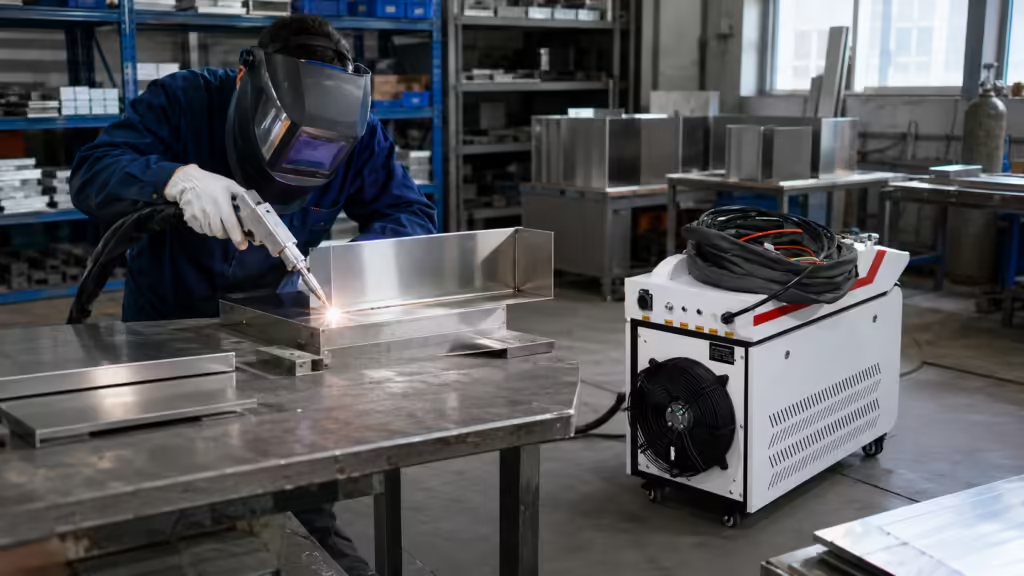
Is a 1500W Laser Welding Machine Enough for Sheet Metal?
A 1500W laser welding machine is not a universal solution for every metal thickness, but it is a strong fit for many light sheet metal jobs. It is commonly considered for stainless steel sheet welding, carbon steel sheet, galvanized sheet, and some aluminum sheet applications.
A 1500W laser welding machine should be judged by material type, joint design, fit-up gap, shielding gas, wire feeding, travel speed, and operator control. Thin stainless steel usually shows the advantage clearly because lower heat input can help reduce deformation and improve weld appearance. Aluminum can also be welded, but it needs more careful parameter control because of higher thermal conductivity and reflectivity.
For many small shops, a 1500W laser welding machine sits in a useful middle zone: more capable than low-power entry units, but easier to justify than high-power systems when the main work is light metal fabrication.
Where a 1500W Laser Welding Machine Works Best: Stainless Steel, Aluminum, and Thin Sheet
A 1500W laser welding machine is especially useful where weld appearance and reduced finishing time matter. Common applications include stainless steel kitchen equipment, electrical cabinets, metal enclosures, advertising letters, doors and windows, metal furniture, light frames, and small custom sheet metal parts.
For a shop producing stainless steel cabinets, the value may come from a cleaner seam and less grinding. For an aluminum workshop, the value may come from faster joining on suitable thin components. For a repair or custom fabrication shop, the value may come from switching between small orders without relying on one highly skilled TIG operator for every visible weld.
This is where a 1500W laser welder becomes more than a welding tool. It becomes part of a workshop upgrade.
1500W Handheld Laser Welding Machine vs TIG/MIG: What Changes?
A 1500W laser welding machine changes the workshop mainly through speed, heat control, and operator learning curve. It does not remove the need for training, but it can reduce dependence on highly experienced welders for repeated thin sheet work.
| Factor | 1500W Handheld Laser Welding Machine | TIG/MIG |
|---|---|---|
| Learning curve | Easier for many basic sheet metal jobs | More skill dependent |
| Heat input | More concentrated | Wider heat-affected area |
| Deformation | Often lower on thin sheet | Higher risk if poorly controlled |
| Weld appearance | Cleaner in many light applications | Depends strongly on operator |
| Post-processing | Less grinding in many cases | More cleanup may be needed |
| Best fit | Thin sheet, light fabrication, small shops | Structural welding, thick parts, special joints |
The Fabricator has reported that handheld laser welding has gained attention in metal fabrication because it can improve speed and reduce reliance on traditional manual welding in suitable applications. Their article Hand-held laser welding’s time has come in metal fabrication is useful for understanding why more shops are evaluating this process.
The point is not that a 1500W laser welding machine replaces every TIG or MIG job. It is more accurate to say that it can reduce TIG/MIG dependence in thin sheet, visible welds, and repeatable light fabrication tasks.
Why a 3-in-1 Laser Welder Makes Sense for Small Factories
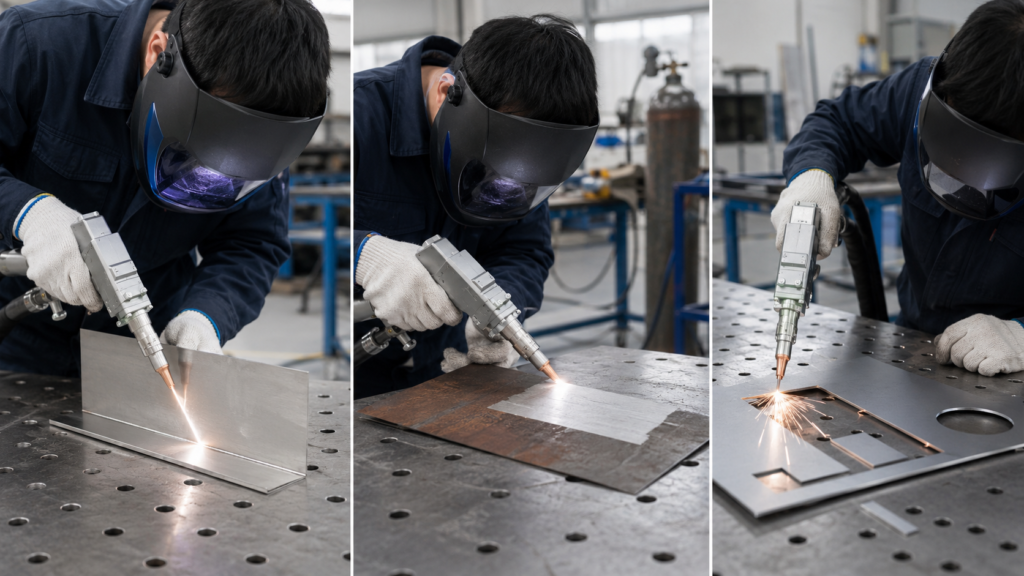
A 1500W laser welding machine becomes more valuable when it is built as a 3-in-1 laser welder. Small factories often do not have enough space, labor, or budget for separate machines for every process. Combining welding, cleaning, and simple cutting can increase equipment utilization.
The three functions usually support different daily tasks:
- Welding: sheet metal joints, stainless steel products, cabinet frames, light metal structures
- Cleaning: rust removal, oxide removal, weld pre-cleaning, post-weld surface cleaning
- Cutting: thin sheet trimming, small repair cuts, temporary fabrication needs
A 1500W laser welding machine with 3-in-1 capability is not meant to replace a full-scale laser cutting system. Its cutting function is more suitable for light auxiliary work. But for small shops handling varied orders, this flexibility can be useful.
How a 1500W Laser Welding Machine Reduces Skilled Labor Dependence
A 1500W laser welding machine can help reduce skilled labor dependence because many parameters are easier to standardize. Operators still need training, safety awareness, and material understanding, but they may not need the same long TIG learning curve for repeated light sheet metal welding.
This matters for small workshops. A skilled welder can spend more time on complex welds, fixture setup, quality control, or special materials, while trained operators handle repeatable laser welding tasks.
The goal is not to say “no skill is required.” That would be misleading. The real value is more stable output across operators, shorter training time for common jobs, and less rework caused by heat distortion or inconsistent manual technique.
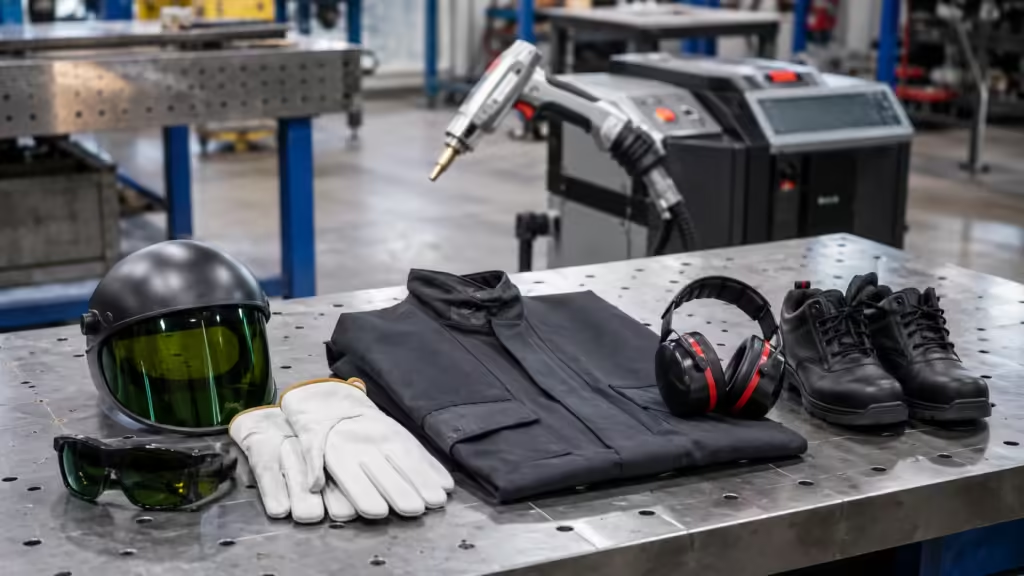
Safety Cannot Be Treated as an Accessory
What Buyers Should Check Before Choosing a 1500W Laser Welding Machine
Before buying a 1500W laser welding machine, buyers should compare the complete system, not only the power number.
Check these points:
1.Laser source quality
2.Welding head weight and handling comfort
3.Wire feeder compatibility
4.Cooling system
5.Cleaning mode and cutting mode
6.Parameter library
7.Material thickness range
8.Safety configuration
9.Fume extraction setup
10.Spare parts availability
11.Training support
12.Warranty and after-sales service
If you are comparing power levels, welding thickness, safety configuration, and supplier support, this laser welding machine buying guide can help you evaluate the key factors before purchasing.
Buyer Insight: Ask for test welding on your real materials before making a decision. A polished demo sample is useful, but your own stainless steel, aluminum sheet, or galvanized part will tell you more.
When a 1500W Laser Welding Machine May Not Be the Right Choice
A 1500W laser welding machine is not ideal for every shop. It may not be the right choice if your main work is thick structural welding, heavy machinery fabrication, load-bearing welds, or large components that require certified welding procedures beyond the machine’s intended range.
It is also not a good fit for workshops that cannot manage laser safety. Without proper PPE, curtains, warning systems, operator training, and fume extraction, the productivity benefit is not worth the risk.
For heavy plate work, structural welding, or specialized code welding, TIG, MIG, arc welding, or higher-power industrial laser systems may still be more appropriate.
How to Decide If a 1500W Laser Welding Machine Fits Your Shop
A 1500W laser welding machine is a strong option if your shop mainly handles thin sheet metal, stainless steel products, light aluminum parts, cabinets, enclosures, and small custom fabrication.
It is especially worth considering if you want to:
- Reduce TIG/MIG post-processing
- Lower dependence on highly skilled welders
- Improve weld appearance on visible parts
- Combine welding, cleaning, and cutting
- Upgrade without buying a large automated line
- Handle varied small-batch orders faster
If your production depends mostly on thick structural welds, the same system may not be the right choice. The better decision is to match the machine to your real parts, not to the most impressive demo video.
Conclusión
A 1500W laser welding machine can be a practical upgrade for small shops that want faster sheet metal welding, cleaner seams, less post-processing, and more flexible use of labor. It is not a universal replacement for TIG or MIG, and it should not be used without proper laser safety management.
For light metal fabrication, the real value of a 1500W laser welding machine comes from balance: welding performance, cleaning and cutting flexibility, lower skill dependence, and better workflow for thin sheet metal jobs. When matched to the right materials and supported by training, a 1500W laser welding machine can become a smart first step into laser-based fabrication.
Preguntas frecuentes
Is a 1500W laser welding machine enough for sheet metal?
Yes. It is suitable for many light sheet metal welding jobs, but actual capacity depends on material, thickness, joint type, fit-up, and welding parameters.
Can a 1500W laser welder replace TIG or MIG?
It can replace TIG/MIG in many thin sheet and light fabrication tasks, but not every structural or thick-plate welding job.
What materials can a 1500W laser welding machine weld?
It is commonly used for stainless steel, carbon steel, galvanized sheet, and some aluminum sheet applications, depending on configuration and settings.
What is a 3-in-1 laser welder?
A 3-in-1 laser welder usually combines welding, cleaning, and cutting functions in one machine, helping small workshops handle more tasks with one system.