

Laser Welding Machine for Door and Window Fabrication: How Shops Reduce Grinding and Frame Distortion
A Laser Welding Machine for Door and Window Fabrication is useful when the shop’s real problem is not “can we weld it?” but “can we weld it without spending too much time fixing it afterward?”
Door and window frames often fail the workshop test after welding: corners pull out of shape, aluminum profiles warp, stainless seams turn dark, and visible welds need grinding before the frame looks acceptable. This article explains where those problems come from, when laser welding helps, and what buyers should check before choosing a machine for aluminum door welding, window frame welding, and metal frame welding.
جدول المحتويات
Why Does Door and Window Frame Welding Create So Much Rework?
Frame welding looks simple from a distance. Four sides, several corners, a few joints, and then the frame moves to grinding, polishing, powder coating, or assembly.
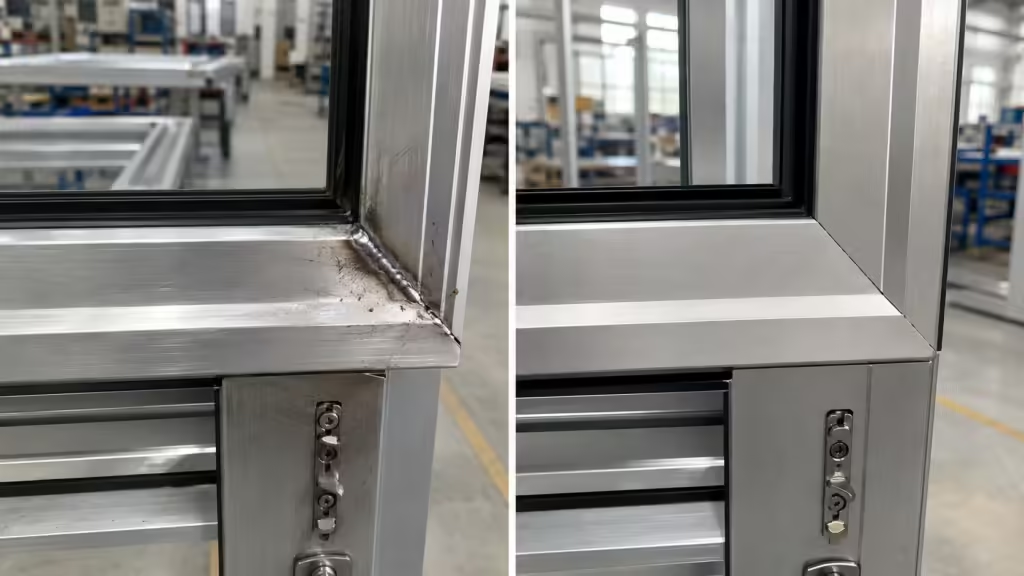
The problem is that door and window frames are not heavy structural beams. Many frames use thin aluminum profiles, stainless steel sections, or light-gauge metal parts. They have long straight edges and visible corners. Small movement during welding can become obvious after assembly.
Common rework problems include:
- corner gaps after welding;
- weld beads that sit too high;
- heat discoloration on stainless steel;
- aluminum profile distortion;
- frame twist after cooling;
- extra grinding before finishing;
- poor fit with glass, seals, hinges, rollers, or locks.
This is why shops should not only measure welding speed. They should measure finishing time. A weld that takes five seconds but needs several minutes of grinding is still expensive.
Can a Laser Welding Machine for Door and Window Fabrication Reduce Frame Distortion?
Yes, it can reduce distortion when the frame material, joint fit-up, clamping, and welding parameters are controlled.
Laser welding uses concentrated heat. Compared with arc welding methods that spread heat over a wider area, laser welding can create a smaller heat-affected zone and lower distortion in suitable metal joints. TWI’s article on laser welding aluminium alloys using different laser sources describes laser welding as a high-energy-density process capable of producing low-distortion welds with a small heat-affected zone.
For door and window fabrication, that matters because the frame is judged after cooling, not during welding. If the corner pulls, the profile twists, or the straight edge bends slightly, the next process becomes harder.
A laser welding machine does not remove the need for fixtures. It gives the shop a better chance to control heat input. The frame still needs clean material, tight joints, steady hand movement, and proper clamping.
Why Is Aluminum Door Welding Harder Than It Looks?
Aluminum door welding can be more difficult than many buyers expect because aluminum conducts heat quickly and reacts strongly to surface condition. A dirty surface, oxide layer, wide joint gap, or unstable wire feeding setup can affect weld consistency.
Aluminum also expands and contracts during heating and cooling. On a door frame, that movement can change the shape of the corner or pull a long profile out of line. This is why aluminum frame welding should be treated as a process, not only a machine-power question.
For shops working with 6061 profiles, material behavior is especially important. This article on لحام سبيكة الألومنيوم 6061 is useful before choosing parameters for aluminum door and window frames because it explains why heat input, oxidation, cracking risk, and distortion need closer control.
The main takeaway is practical: a laser welder for aluminum doors and windows can reduce heat spread, but it cannot compensate for poor preparation. Before welding aluminum frames, check:
- whether the surface is clean;
- whether the joint gap is consistent;
- whether wire feeding is needed;
- whether the profile is firmly clamped;
- whether the operator has tested the actual frame material;
- whether the required weld appearance is realistic.
A clean-looking seam starts before the arc or laser beam touches the part.
Why Does Window Frame Welding Need Cleaner Seams, Not Just Stronger Welds?
Window frame welding has a different standard from many hidden structural welds. A window frame is often visible after installation, especially on commercial shopfronts, stainless trim, aluminum windows, and decorative metal frames.
That means the weld must hold the frame together, but it also needs to look acceptable after finishing.
If the seam is too wide, too dark, or too raised, the shop spends more time grinding. If the grinding is uneven, the surface may show marks after coating or polishing. If the frame moves during welding, the glass, seal strip, sliding rail, or hardware may not fit smoothly.
For window frame welding, the better question is:
Can the weld be made with less heat, less bead buildup, and less finishing work?
Laser welding is attractive here because the seam can be narrow and clean when the parameters are right. The Fabricator’s article on hand-held laser welding in metal fabrication notes that manufacturers have adopted handheld laser welding for speed and reduced post-weld processing in many fabrication settings.
That does not mean every window frame will come out perfect. Joint design, operator technique, shielding gas, surface cleaning, and fixture accuracy still decide the final result.
Where Does a Metal Frame Laser Welding Machine Fit Best?
A metal frame laser welding machine fits best where the weld is visible, the material is not too thick, and the shop wants to reduce grinding time.
Typical frame-related work includes:
- aluminum door frames;
- aluminum window frames;
- stainless steel door frames;
- thin carbon steel frames;
- metal partitions;
- shopfront frames;
- decorative metal trim;
- cabinet and equipment frames;
- railing or guard frame accessories.
The key is not the product name. The key is the shape and finishing requirement.
Metal frame welding often involves long profiles and corner joints. These parts can move if heat is too high. They can also look rough if the weld bead is too large. Laser welding gives the shop a way to concentrate heat into the joint area and reduce the amount of weld material that needs to be removed later.
A metal frame laser welding machine is most valuable when the shop repeatedly welds similar frames. Once the fixture, settings, wire feeding, and operator method are stable, the process becomes easier to repeat.
Laser Welding vs TIG Welding for Door and Window Frames: What Actually Changes?
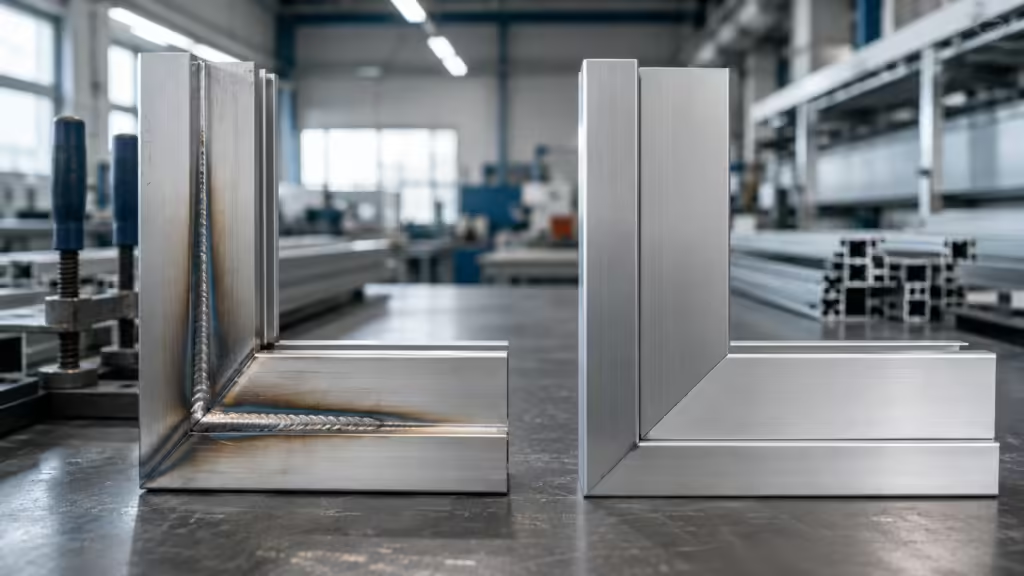
TIG welding is still useful. It gives skilled welders strong control, and it can be a good choice for repair work, small batches, and complex manual welding.
The issue is that door and window frame shops often need repeatability and cleaner finishing, not just a weld that passes strength requirements. That is where laser welding often gets attention.
| Welding Factor | TIG Welding | اللحام بالليزر |
|---|---|---|
| Heat input | Wider heat spread | More concentrated heat |
| Frame distortion | Higher risk on thin profiles | Easier to control when clamped well |
| Weld appearance | Often needs more finishing | Narrower seam when settings are correct |
| Grinding time | Usually higher | Often lower |
| Operator dependence | Requires strong TIG skill | Easier after parameters and fixtures are set |
| Best use | Repair, small batches, flexible manual work | Repeated frames, visible seams, low finishing targets |
| Welding Factor | TIG Welding | اللحام بالليزر |
|---|---|---|
| Heat input | Wider heat spread | More concentrated heat |
| Frame distortion | Higher risk on thin profiles | Easier to control when clamped well |
| Weld appearance | Often needs more finishing | Narrower seam when settings are correct |
| Grinding time | Usually higher | Often lower |
| Operator dependence | Requires strong TIG skill | Easier after parameters and fixtures are set |
| Best use | Repair, small batches, flexible manual work | Repeated frames, visible seams, low finishing targets |
This comparison does not mean TIG should disappear from a frame shop. It means buyers should look at the full workflow.
If the shop loses time on grinding every aluminum door, correcting window frame corners, or polishing stainless steel seams, laser welding may reduce the work after welding.
Is a 1500W Laser Welder Enough for Door and Window Fabrication?
For many thin metal frames, a 1500W system is a practical starting point. It is often considered for stainless steel, carbon steel, and aluminum frame work where the goal is controlled welds, manageable heat input, and less post-weld grinding.
The exact answer depends on:
- material type;
- profile thickness;
- joint type;
- weld speed;
- filler wire requirement;
- seam appearance standard;
- production batch size;
- whether the frame is aluminum, stainless steel, or carbon steel.
For many thin metal frames and daily fabrication tasks, a 1500W laser welding machine is often considered because it balances welding capacity, workshop use, and finishing requirements.
For workshops evaluating a machine for aluminum doors, window frames, stainless steel frames, and general metal fabrication, this جهاز لحام بالليزر 1500 واط can be reviewed after material thickness, joint design, and finishing requirements are confirmed.
Do not choose power by guessing. If possible, test the actual frame profile, not just a flat sample plate. Door and window profiles may have corners, hollow sections, coating requirements, and visible faces that change the welding result.
What Should Buyers Check Before Choosing a Laser Welder for Aluminum Doors and Windows?
A laser welder for aluminum doors and windows should be selected around the shop’s real workflow.
Before buying, check these points:
1.Frame material:Aluminum, stainless steel, carbon steel, and galvanized steel behave differently. Aluminum needs special attention to surface preparation and heat control.
2.Thickness range:A machine that performs well on one thickness may need different settings for another profile.
3.Joint design:Butt joints, lap joints, corner joints, and miter joints do not weld the same way.
4.Gap control:Laser welding is not a magic fix for poor cutting accuracy. Large or uneven gaps can still cause defects.
5.Fixture accuracy:For window frame welding, the fixture often decides whether the frame stays square after welding.
6.Wire feeding requirement:Some joints and aluminum applications may need filler wire for better gap bridging or joint appearance.
7.Shielding gas setup:Gas type, flow, and coverage affect oxidation and weld appearance.
8.Operator training:Handheld laser welding is easier to learn than some traditional methods, but it still needs safe handling and parameter discipline.
9.Finishing target:Decide whether the goal is no grinding, light brushing, polishing, coating preparation, or structural joining.
10.Safety setup:Laser welding needs proper safety controls. OSHA’s laser hazard guidance explains that high-power lasers can create serious eye and skin hazards, especially when exposure is uncontrolled.
If you are still comparing power levels, cooling methods, wire feeding options, and handheld configurations, this laser welding machine buying guide can help narrow the machine specification before purchase.
What Safety Details Should Frame Shops Not Ignore?
Laser welding safety should be part of the purchase decision, not an afterthought.
Frame shops often weld reflective materials such as aluminum and stainless steel. These surfaces can create reflection risks. AWS discusses handheld laser welding safety concerns, including specular reflections that can create eye and skin hazards. Their article on handheld laser welding safety is worth reading before setting up a shop-floor process.
Ventilation also matters. Welding and laser processes can produce airborne contaminants, especially when surface coatings, oils, or residues are present. OSHA’s guidance on laser hazards and laser-generated airborne contaminants recommends local exhaust ventilation or smoke evacuation in laser applications where contaminants may be generated.
A frame fabrication shop should prepare:
- laser safety eyewear matched to wavelength;
- controlled welding area;
- warning signs and restricted access;
- fume extraction;
- fire-safe surroundings;
- operator training;
- shielding for nearby workers;
- safe handling rules for reflective materials.
When Laser Welding May Not Fix the Whole Problem
Laser welding can reduce heat distortion and finishing time, but it will not repair a weak production process.
If the cutting is inaccurate, the frame will still have gaps. If the fixture is loose, the frame can still move. If the aluminum surface is dirty, the weld may still show defects. If the operator uses the wrong parameters, the seam may still be inconsistent.
Laser welding may not solve the problem when:
- miter cuts are inaccurate;
- frame profiles have large joint gaps;
- clamping is weak;
- aluminum oxide is not removed;
- the shop expects perfect appearance without surface preparation;
- the wrong filler wire is used;
- the operator is not trained;
- the workshop has no safety-controlled welding area.
Research on aluminum laser joining also shows that aluminum welding can still face challenges such as joint performance and process control, especially in more complex or dissimilar metal conditions. A review in MDPI Metals on recent developments in laser welding of aluminum to steel discusses why laser joining of aluminum remains technically important but not automatically simple.
That is why a serious buyer should ask for sample welding. Send real frame profiles, not only flat coupons. Test the corner joint, visible face, polishing requirement, and frame straightness after cooling.
How Can Shops Measure Whether Laser Welding Actually Saves Labor?
Do not judge the machine only by weld speed. Measure the full route from cutting to final inspection.
A simple test can include:
- welding time per frame;
- grinding time per corner;
- polishing or brushing time;
- number of rejected frames;
- corner squareness after cooling;
- visible seam quality;
- coating preparation time;
- operator training time;
- fixture setup time.
For door and window shops, the strongest saving often appears after welding. Less grinding, fewer warped corners, cleaner seam lines, and lower rework can matter more than raw welding speed.
If a metal frame laser welding machine saves 30 seconds on the weld but five minutes on finishing, the real value is in the finishing department.
What Should Door and Window Shops Decide Before Buying?
A door and window shop should not buy a welder only because it looks fast in a short demo.
The useful question is more specific:
Can the machine help this shop reduce grinding, keep frames straighter, improve visible seams, and lower rework on real aluminum doors, window frames, and metal frame products?
Before buying, confirm the frame material, thickness, joint style, fixture plan, wire feeding need, operator training, safety setup, and finishing target. Then test the actual frame profile.
That is how a Laser Welding Machine for Door and Window Fabrication becomes more than a new welding tool. It becomes a way to control the work that usually happens after the weld.
التعليمات
Can laser welding be used for aluminum doors and windows?
Yes. It can be used for aluminum doors and windows, but the material must be clean, the joint gap should be controlled, and parameters must match the aluminum profile.
Is laser welding better than TIG for window frame welding?
It can be better when the goal is lower distortion, cleaner seams, and less grinding. TIG can still be useful for repair work, very small batches, or complex manual joints.
What power is suitable for door and window frame welding?
Many shops consider 1500W for thin metal frames, but the right power depends on material, thickness, joint design, weld speed, and finishing requirements.
Does laser welding remove the need for grinding?
Not always. It can reduce grinding when the settings, joint fit-up, and clamping are correct, but visible decorative parts may still need light finishing.
What materials can a door and window laser welding machine handle?
Common materials include aluminum alloy, stainless steel, carbon steel, and some galvanized metal parts. Each material needs different preparation and parameters.
What is the biggest mistake when buying a laser welder for aluminum doors and windows?
The biggest mistake is testing only flat samples. Buyers should test real frame profiles, corner joints, visible surfaces, and post-weld finishing requirements.
Is a metal frame laser welding machine good for small shops?
Yes, if the shop regularly welds thin frames and spends too much time on grinding or distortion correction. For occasional repair work, the buying decision should be more careful.