

Laser Welding Porosity: Causes, Prevention, and Parameter Fixes
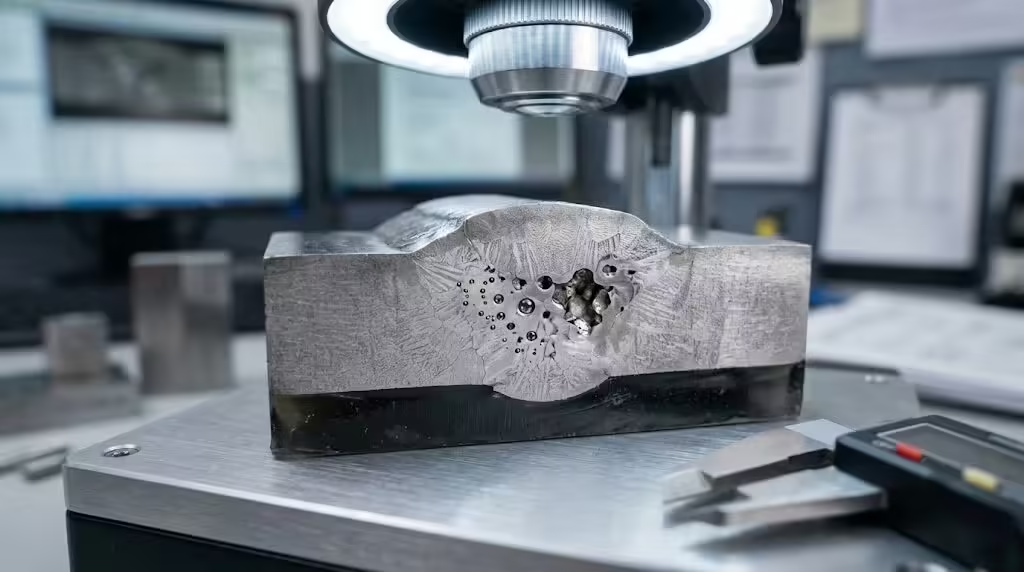
You pull a completed part off the line, run a cross-section test, and find it riddled with tiny holes. That is laser welding porosity. It compromises joint strength, ruins hermetic seals, and guarantees a failed leak test. If you are dealing with high scrap rates, guessing at focal points or gas flow won’t help.
This guide bypasses the guesswork. We will break down exactly what causes gas entrapment, how to prep your materials, and which machine settings you need to change right now to eliminate holes in your weld seams.
Оглавление
Why Does Laser Welding Porosity Happen?
Before changing machine parameters, you need to know how the holes get there. In fiber and solid-state systems, gas bubbles get trapped in the molten pool before the metal solidifies.
There are two primary mechanisms behind this failure:
1.Keyhole Instability
Deep penetration welding creates a vapor cavity known as a keyhole. If your heat input fluctuates or your travel speed is misaligned, the walls of this keyhole collapse. When the liquid metal crashes in on itself, it traps metallic vapor and shielding gas at the root of the weld. According to an article on laser welding defects by IPG Photonics, managing keyhole stability is the single most critical factor in deep penetration applications.
2.Metallurgical Contamination
If dirt, oil, moisture, or heavy oxide layers remain on the metal surface, the intense heat of the beam instantly vaporizes them. This rapid off-gassing creates bubbles. If the weld pool freezes rapidly—which is common in high-speed applications—those bubbles cannot escape. This aligns with the fundamental welding defect classifications on Wikipedia, which identifies trapped hydrogen and surface contaminants as primary drivers of metallurgical porosity.
How Do You Prevent Porosity Before Firing the Laser?
Most porosity issues are solved before the beam ever hits the metal. Mechanical and chemical preparation dictate the outcome of the melt pool.
- Remove Machining Fluids: Coolants and cutting oils are packed with hydrocarbons. When hit by a 2kW beam, they instantly turn into trapped gas. Wipe joints with acetone or use a dedicated laser cleaning pass before welding.
- Control Joint Fit-up: A massive gap forces the laser to melt more base material to bridge the joint, disrupting the keyhole. Maintain a gap tolerance of less than 10% of the material thickness.
- Strip Oxide Layers: For materials like aluminum, the porous oxide layer absorbs moisture from the air. A detailed breakdown by TWI Global regarding porosity defects highlights that trapped hydrogen from moisture is the leading cause of porosity in aluminum alloys. Wire brushing or laser ablation just before clamping is mandatory.
Does Shielding Gas Flow Rate Cause Weld Defects?
Yes. A common operator error is cranking up the shielding gas pressure, assuming more protection equals a better weld.
Pushing Argon or Nitrogen at 40-50 CFH (Cubic Feet per Hour) through a narrow nozzle creates turbulent flow. This turbulence acts like a vacuum, pulling surrounding atmospheric oxygen and nitrogen directly into the weld pool.
- The Fix: Lower the flow rate. A smooth, laminar flow between 15 to 25 CFH is typically sufficient to protect the weld without causing turbulence.
- Angle Matters: Keep the gas nozzle at a 30 to 45-degree angle trailing the melt pool. Blowing gas directly down (90 degrees) pushes the gas forcefully into the keyhole, forcing a collapse.
What Laser Parameters Fix Keyhole Instability?
If your parts are perfectly clean and your gas is dialed in, the porosity is coming from your machine settings. Here is how to adjust your parameters to keep the keyhole open long enough for gas to escape.
1.Adjust Travel Speed
Running the head too fast forces the molten metal to freeze instantly, locking bubbles inside. Slowing down the travel speed gives the melt pool more time in a liquid state, allowing trapped gas to float to the surface.
- Action: Reduce travel speed by 10-15% and inspect the root.
2.Shift the Focal Position (Defocusing)
Pinpoint focus creates a narrow, aggressive keyhole that collapses easily. By slightly defocusing the beam (moving the focal point above or below the material surface), you widen the keyhole opening.
- Action: Apply a positive defocus (+1mm to +3mm). This broadens the top of the weld pool, creating a wider escape channel for vapors.
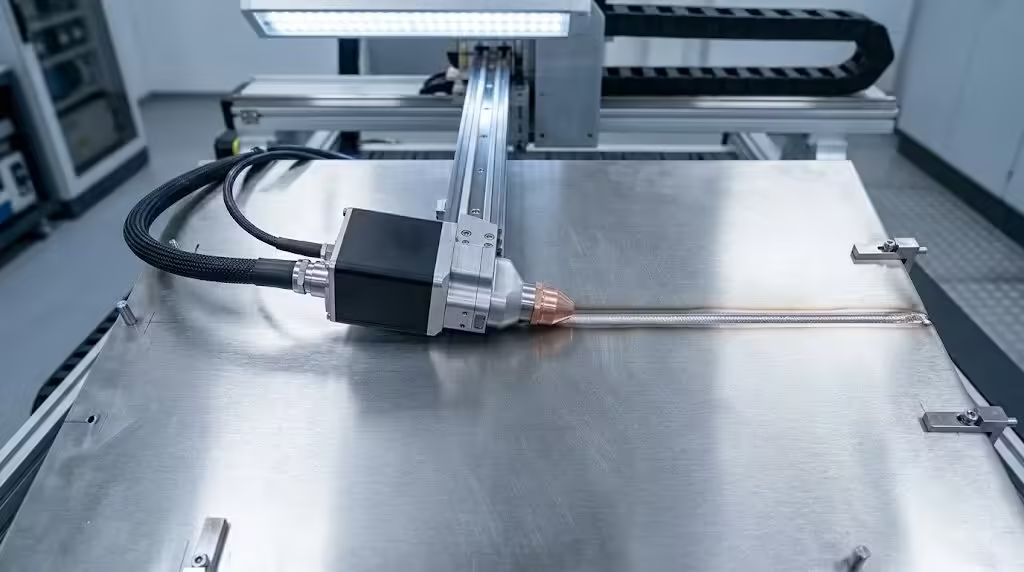
3.Implement Beam Wobble (Oscillation)
If you are welding aluminum or galvanized steel, static beams struggle. Activating a beam wobble (circular or figure-eight pattern) physically stirs the molten pool. This agitation breaks up trapped bubbles and forces them out. Research published in the TWI archives on porosity formation proves that circular beam oscillation significantly reduces pore volume in highly reflective alloys.
Are Certain Metals More Prone to Holes?
Your parameters must adapt based on the metallurgy. You cannot use mild steel settings on aerospace-grade aluminum.
- Galvanized Steel: The zinc coating vaporizes at 906°C, but the steel melts at 1500°C. The zinc boils off violently while the steel is molten, injecting massive amounts of gas into the pool. Solution: Leave a micro-gap (0.1mm) between the sheets to let the zinc vapor vent out the sides instead of through the melt pool.
- Aluminum Alloys (5xxx and 6xxx series): Highly susceptible to hydrogen porosity. Real-world operators frequently discuss this exact pain point; a highly active discussion on laser welding aluminum porosity confirmed that combining a figure-eight wobble with strict pre-weld acetone wiping drops scrap rates from 40% to near zero.
Troubleshooting defects is a process of elimination. Start with mechanical cleaning, verify your gas flow is laminar, and then adjust your focal position and travel speed. By systematically addressing these variables, you can permanently eliminate laser welding porosity from your production line.
ЧАСТО ЗАДАВАЕМЫЕ ВОПРОСЫ
Can pulse shaping fix holes in spot welding?
Yes. If you use a square wave pulse, the laser shuts off instantly, causing the pool to freeze aggressively. Change to a “ramp-down” pulse shape. Gradually reducing the laser power at the end of the weld allows the pool to cool slowly, letting the final gas bubbles escape.
What is the best shielding gas to prevent pores in aluminum?
While pure Argon is standard, adding Helium (e.g., a 70% Argon / 30% Helium mix) increases the heat input and broadens the melt pool. This wider pool stays liquid longer, allowing hydrogen bubbles to vent out.
How do you test for hidden internal porosity?
Visual inspection only catches surface blowholes. To detect internal voids, you must use destructive testing (cutting, polishing, and acid-etching a cross-section) or Non-Destructive Testing (NDT) like X-ray radiography or ultrasonic scanning.