

Laser Welding Machine for Metal Furniture: Neat Welds for Frames, Cabinets, and Shelves
If you run a floor manufacturing steel shelves, desks, or industrial racks, look at your time-tracking sheets. Your skilled operators are likely spending 20% of their shift striking arcs and the remaining 80% with an angle grinder in hand. Post-weld cleanup is the silent bottleneck eating your margins.
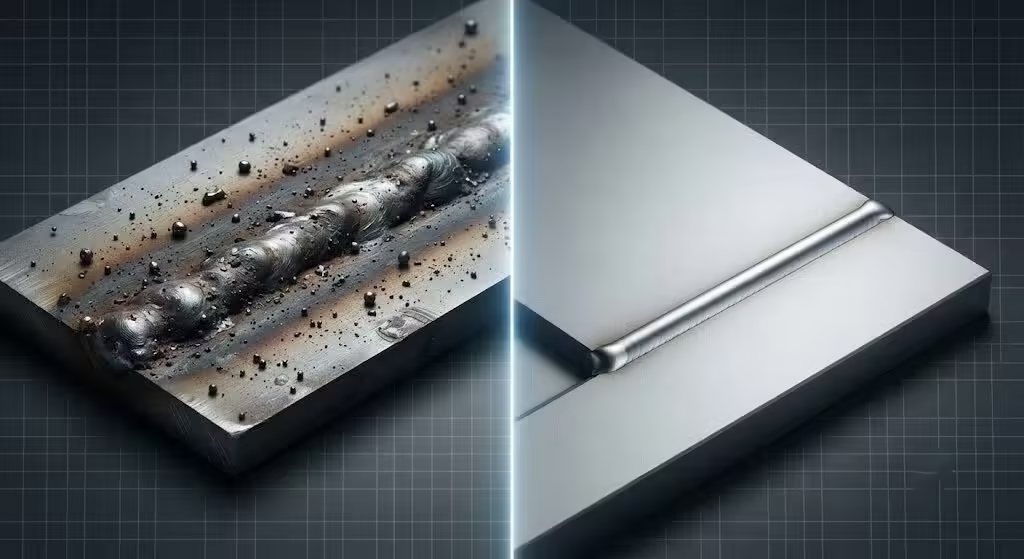
Powder coating demands a perfectly flush, defect-free surface. Traditional TIG or MIG leaves thick, spattered beads that require heavy manual leveling. Switching to a laser welding machine for metal furniture changes this equation. By drastically reducing the heat-affected zone (HAZ) and producing a naturally smooth bead, you bypass the grinding station almost entirely, moving parts straight from the welding fixture to the powder-coating line.
Оглавление
The Hidden Tax on Metal Furniture Welding
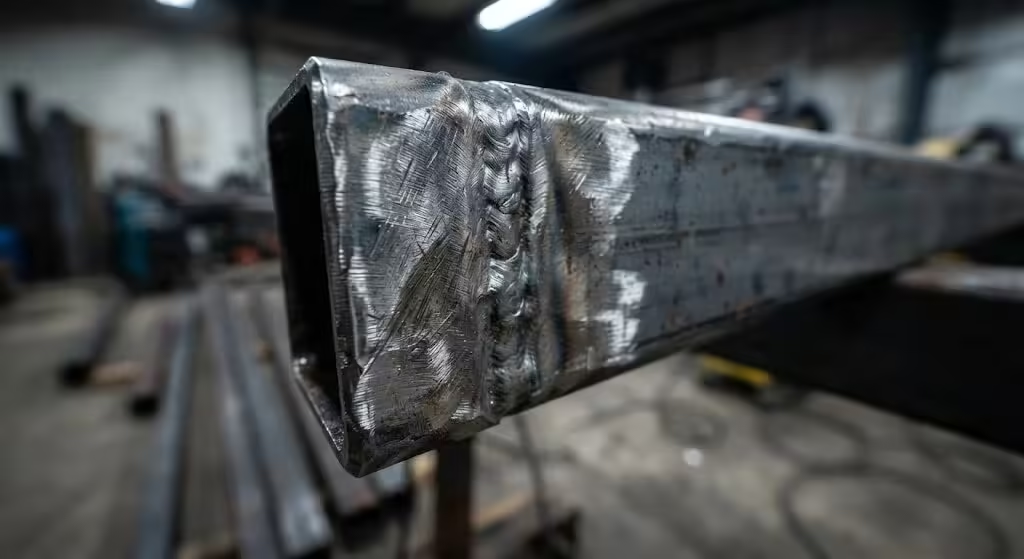
Walk onto any floor using manual TIG for aesthetic joints, and you’ll see the problem: heat.
TIG relies on a wide electrical arc cone that slowly melts the base metal and the filler rod. This slow travel speed pumps excessive thermal energy into the surrounding metal. According to an analysis on production bottlenecks by The Fabricator, the labor spent on secondary grinding and finishing often exceeds the cost of the actual welding process itself.
When you grind down a TIG bead on a chair leg or a shelf bracket:
- You thin out the base material, weakening the structural joint.
- You create airborne metallic dust, requiring extensive ventilation.
- You rely on the operator’s physical feel to get a flat surface, leading to severe batch inconsistency.
Can a laser welding machine prevent sheet metal from warping?
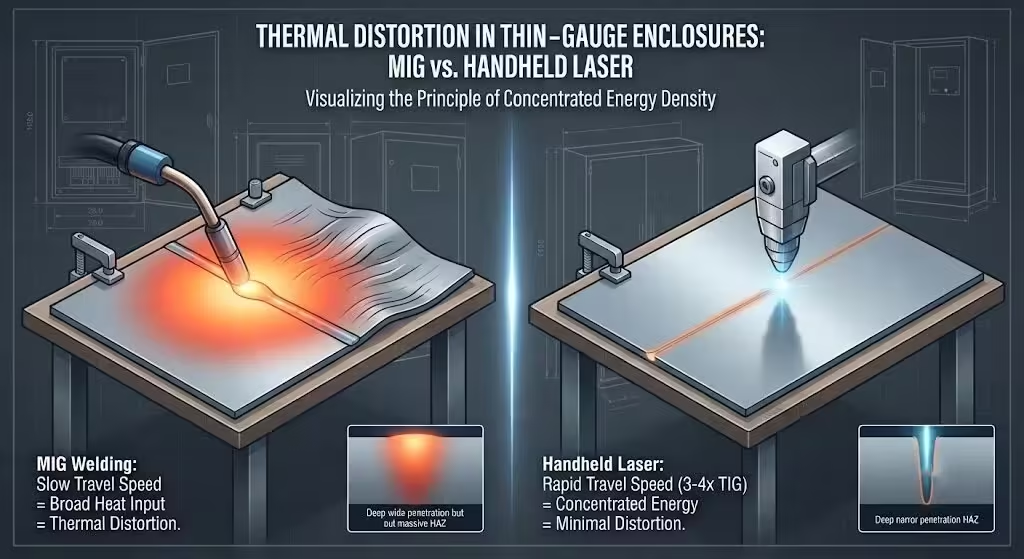
When fabricating thin-gauge enclosures (typically 0.8mm to 1.5mm cold-rolled steel), thermal distortion is your biggest enemy. If you’ve ever seen the side of a metal locker look wavy or “oil-canned,” that is the result of uncontrolled heat input during cabinet welding.
When thin steel is heated unevenly by a MIG torch, it expands and buckles. As it cools, the metal traps that stress, creating a permanent ripple. Handheld lasers solve this through concentrated energy density. The photon beam creates a “keyhole” effect, penetrating the metal instantly while moving at speeds three to four times faster than TIG.
As explained by TWI Global in their breakdown of industrial laser principles, this rapid travel speed means the surrounding metal simply doesn’t have time to absorb the heat and warp.
We apply the exact same logic here as we do in highly precise automotive sheet metal repair
: control the heat, and the metal will hold its shape. A laser welding machine for metal cabinets ensures that the side panels remain dead-flat, meaning the subsequent assembly gaps line up perfectly without needing a hammer and dolly to fix distortion.
Frame Welding: Getting Seamless Joints on Tubular Steel
Frame welding presents a different challenge. Merging a square tube into a round tube (or creating a sharp 90-degree mitered corner for a premium desk frame) requires extreme precision. A bulky MIG gun cannot easily navigate these tight inside corners without leaving a massive blob of wire.
Lasers utilize a non-contact beam. As long as the laser has a line of sight to the joint, it will fuse the metal. This allows operators to easily sweep the beam across mitered corners, leaving a smooth, slightly concave bead that requires zero flap-disc sanding. The structural integrity is uncompromising. Just as we see in heavy-duty door and window fabrication, deep penetration laser welds provide the rigidity required for load-bearing frames.
If you are curious about the learning curve on tubing, working welders frequently discuss this transition online. For instance, in this r/Welding community thread, operators note that while laser requires strict fit-up, the actual speed on tubular frames makes traditional TIG look incredibly slow.
The “Zero-Grind” Workflow: Setting Up a Laser Welder for Metal Furniture Production
You cannot simply unbox a laser, hand it to a MIG operator, and expect perfect furniture. A laser welder for metal furniture production demands a shift in how you prepare your materials.
To achieve a zero-grind finish, you must control three variables:
1.Gap Tolerance (The Golden Rule): Laser beams are narrow (often 1mm to 2mm in wobble mode). If your band saw or laser tube cutter leaves a 2mm gap between parts, the laser will simply shoot through the hole. Your fit-up tolerance must be kept under 0.5mm.
2.Dedicated CNC Jigging: The jig is just as important as the machine. Because you aren’t spending time grinding, you can afford to spend an extra 10 seconds clamping the part perfectly into a pneumatic fixture.
3.Shielding Gas Selection: While argon is standard for TIG, laser welding often utilizes Nitrogen when welding stainless steel furniture to prevent oxidation and maintain a bright, polish-free finish. Linde Gas provides a detailed breakdown on how choosing the right process gas directly impacts the cosmetic finish of the weld pool.
This stringent preparation is exactly how manufacturers meet the flawless visual standards required in kitchenware manufacturing, where any porosity is an instant rejection.
Real-World Application
To understand the financial impact, let’s look at a standard production floor transitioning to this technology. The industry shift is well documented; as noted by Industrial Laser Solutions, handheld lasers are rapidly displacing traditional arc setups in fabrication environments precisely due to these downstream cost savings.
Consider a floor producing custom retail display shelves from 1.2mm carbon steel.
- The Old Method: Three TIG welding stations producing parts, followed immediately by two dedicated grinding stations using 80-grit flap discs to flush the joints before powder coating. Cycle time per rack was roughly 14 minutes.
- The Integration: The shop replaced the TIG setups with a single 1500W laser welding machine and heavily invested in pneumatic clamping tables.
- The Result: The laser operator utilized wobble-mode without filler wire to autogenously fuse the tight joints. The weld bead profile was naturally flat. The two grinding stations were completely eliminated. Cycle time per rack dropped to 4.5 minutes.
The Bottom Line on Production Costs
Stop looking at welding speed and start looking at the finishing department. If your business model relies on paying operators to grind away excess weld metal, you are bleeding margin on every single unit shipped. Integrating a laser welding machine for metal furniture forces your shop to improve its cutting and fit-up tolerances, but the reward is the complete elimination of post-weld cleanup. The parts come out of the jig ready for the paint booth.
ЧАСТО ЗАДАВАЕМЫЕ ВОПРОСЫ
Can a laser welder handle different wall thicknesses on the same piece of furniture?
Yes. You can save specific parameters on the machine’s CNC controller. If you are welding a 3mm heavy base plate to a 1mm decorative side panel, the operator simply taps a saved preset on the screen to instantly adjust the laser power and wobble width, preventing burn-through on the thin side.
What happens if my tube cutting isn’t perfect and leaves gaps?
If you have gaps exceeding 0.5mm, you must use an automatic wire feeder attached to the laser gun. While this bridges the gap, it deposits a slightly raised bead. You will likely have to do a light pass with a grinder to get it perfectly flat, which diminishes the “zero-grind” advantage. Strict cutting tolerances are heavily advised.
Do I need a specialized environment for this equipment?
Class 4 lasers present serious eye hazards from scattered light. You cannot operate them in an open shop where fork-lift drivers are walking by. You must install a dedicated welding booth surrounded by laser-safe, light-tight enclosures or curtains, and the operator must wear specific optical density (OD) safety glasses.