

Laser Paint Stripping: Why It Removes Coatings Without Substrate Damage
Mechanical workshops and precision fabrication facilities face a constant dilemma: removing tough industrial coatings without grinding away the underlying substrate. Traditional methods like abrasive blasting, harsh wire wheels, and chemical solvents inevitably scar the surface metal, alter tight tolerances, or induce micro-cracking. Implementing Laser Paint Stripping changes this paradigm completely, offering a non-contact, moisture-free alternative that leaves the base material pristine. By reading this guide, you will understand the exact physics behind how laser energy isolates coatings, how to calibrate parameters for sensitive metals like aluminum and thin steel, and how to eliminate the hidden costs of substrate damage in your shop.
Оглавление
The Physics Behind Laser Paint Stripping and the Ablation Threshold
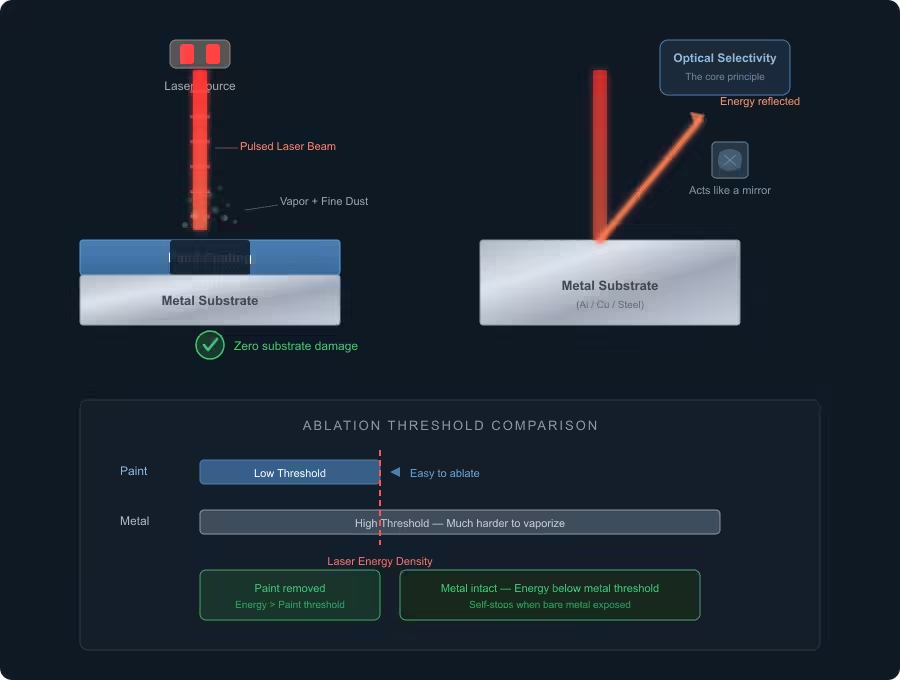
To understand why this technology guarantees zero substrate damage, one must look at the underlying optical physics. The entire process relies on a phenomenon known as the Laser ablation threshold. Every material, whether it is an organic epoxy paint, a polyurethane topcoat, or a solid steel substrate, possesses a specific energy density limit at which it vaporizes.
During Laser Paint Stripping, a high-frequency pulsed laser beam scans across the coated surface. The paint layer absorbs the intense optical energy rapidly, causing its temperature to skyrocket to vaporization levels within nanoseconds. Because the coating’s Laser ablation threshold is significantly lower than that of the underlying metal, the paint instantly sublimates into gas and fine dust.To examine the underlying mathematical models governing energy absorption and phase explosion during this process, engineers can reference the peer-reviewed thermodynamic study on substrate thermal balance available via the National Center for Biotechnology Information (NCBI) Database.
Conversely, when the laser beam hits the bare metal underneath, the metal acts like a mirror. Highly reflective and thermally conductive substrates like aluminum, copper, and mild steel reflect the majority of the laser energy or rapidly dissipate the minor heat. The energy density applied remains safely below the metal’s ablation limit, causing the laser action to stop automatically the moment the bare substrate is exposed. This optical selectivity is the core secret behind Laser Paint Stripping.
Achieving Heat-Affected Zone (HAZ) Mitigation on Sensitive Metals
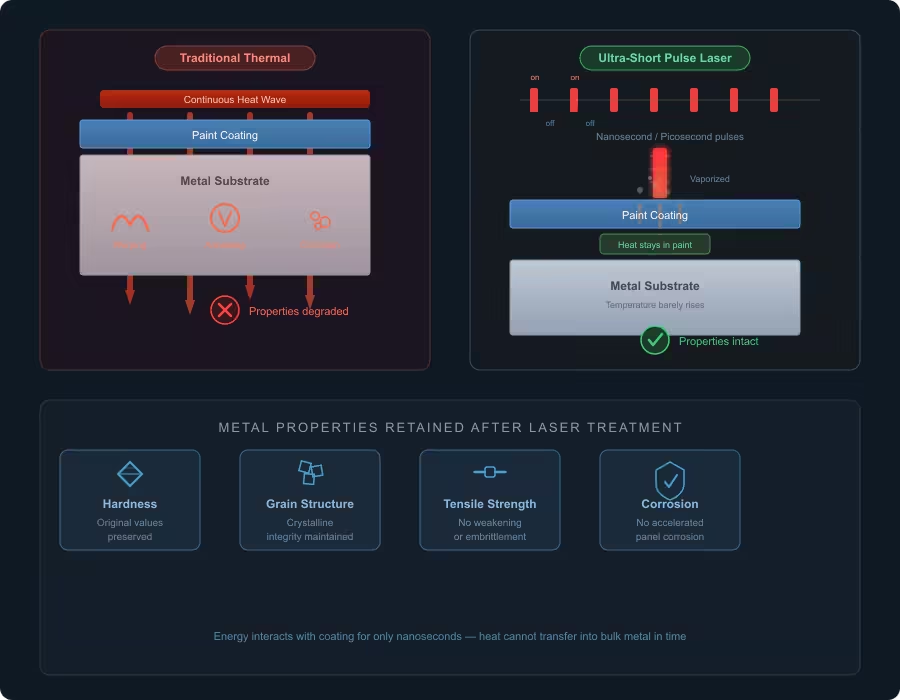
A common concern among workshop managers is whether the thermal energy of a laser will alter the mechanical properties of the workpiece. In traditional thermal stripping or aggressive welding, intense heat can anneal metals, warp thin sections, or trigger localized panel corrosion over time due to structural degradation. However, advanced systems achieve excellent Heat-affected zone (HAZ) mitigation through short-pulse duration technology.
Instead of firing a continuous wave of heat, industrial Laser Paint Stripping utilizes nanosecond or picosecond pulses. This ultra-short pulse delivery means the laser energy interacts with the paint coat for only a tiny fraction of a second. The paint is vaporized so quickly that the heat does not have enough time to transfer down into the bulk metal structure.
This localized energy containment ensures that the temperature of the substrate barely rises during the process. By securing Heat-affected zone (HAZ) mitigation, the metal retains its original hardness, crystalline grain structure, and tensile strength. This makes the process completely safe for high-precision components, molds, and delicate assemblies where even a microscopic shift in material properties could cause mechanical failure or accelerate atmospheric panel corrosion during storage.
From Thin Sheets to Selective Coating Removal
Moving away from theoretical physics, the practical versatility of Laser Paint Stripping shines brightest on the shop floor when handling diverse, complex surface preparation jobs.
Workshops dealing with automotive restoration or sheet metal enclosures frequently struggle with Thin-gauge sheet metal rust and paint removal. Using mechanical sanders on a 0.8mm steel panel introduces intense friction and localized heat, which inevitably warps the panel out of specification. Sandblasting can dimple or stretch the metal sheet beyond repair. A pulsed laser system bypasses these physical forces entirely. Because there is zero mechanical contact, performing Laser Paint Stripping ensures that rust and paint layers are vaporized across wide surface areas without introducing warping, thinning, or micro-scratches.
Furthermore, the process excels at Selective laser coating removal. In many refurbishment projects, operators do not need to strip the asset down to raw metal. They might only need to remove a degraded topcoat while leaving a high-quality primer intact. By precisely adjusting the laser’s pulse frequency and power output, operators can perform Selective stripping of automotive e-coat or remove top layers layer-by-layer. This level of control prevents unnecessary re-priming costs and drastically cuts down on processing times.
| Stripping Parameter | Mechanical Grinding / Sanding | Pulsed Laser Ablation |
| Substrate Surface Wear | High (Removes 5–20 microns of metal) | Zero (Operates below metal threshold) |
| Process Force Profile | Heavy Friction & Radial Stress | Non-Contact / Zero Mechanical Stress |
| Geometric Precision | Poor (Alters micro-tolerances & edges) | Micron-Level (Maintains sharp geometries) |
| Environmental Byproducts | Massive Dust / Hazardous Scraps | Dry Solid Residue (Vacuum Filtered) |
This precision is particularly useful when reclaiming parts suffering from early-stage panel corrosion. Instead of scrapping an entire assembly, the laser can target the exact zone of rust and paint failure, neutralizing the oxidation and preparing the clean surface for immediate recoating without affecting the adjacent healthy panels.
Avoiding the Unseen Chemical Pitfalls of Legacy Coating Removal
To truly appreciate why industrial facilities are transitioning to Laser Paint Stripping, one must examine the hidden operational and structural liabilities of old-school chemical stripping tanks. Chemical solvents rely on aggressive acids or chlorinated compounds to break down cross-linked polymers. While effective at loosening paint, these liquids often trap themselves within microscopic surface pores, seams, and joints.
Once trapped, residual chemicals continue to react long after the new paint coat is applied. This hidden chemical activity frequently causes severe panel corrosion from the inside out, causing the new coating to blister and fail prematurely. The severe catastrophic structural risks associated with chemical cleaning agents, specifically regarding hydrogen absorption and micro-pitting in high-strength metal alloys, are extensively documented in the comparative study hosted on the NCBI Materials Science Database.
Transitioning to a dry, mechanical-force-free Laser Paint Stripping workflow completely eliminates these chemical risks. There are no secondary liquid wastes to neutralize, no hazardous fumes requiring massive ventilation investments, and zero risk of chemical-induced panel corrosion inside tight lap joints or bolted connections.
How Parameters Impact the Safety of Your Substrates
While Laser Paint Stripping is inherently safer for base metals than grinding, achieving a flawless, risk-free finish still requires operators to properly calibrate their machinery. A laser is a highly precise tool, and its safety margin depends directly on the combination of power, scan speed, and beam focus.
If an untrained operator sets the pulse overlap too high or moves the laser gun too slowly over a single spot, excess thermal energy can accumulate. While this still may not cross the ablation limit of thick steel, it can cause slight surface discoloration or minor oxidation on sensitive alloys. Modern systems mitigate this risk by integrating computerized scanning heads that ensure the laser spot moves at a perfectly uniform velocity across the workpiece, guaranteeing predictable Laser Paint Stripping outcomes every single time.
For extensive engineering benchmarks regarding how varying laser wavelengths and pulse widths interact with diverse metal oxides and industrial polymers, specialists can consult the peer-reviewed empirical data available via the Europe PMC Industrial Open-Access Archive
, which provides precise laser parameter optimization curves for coating removal. Additionally, to analyze structural metallurgical safety after thermal ablation, you can review the full laboratory study hosted on the National Center for Biotechnology Information (NCBI) Database, which details the post-cleaning microhardness and surface integrity of sensitive metal substrates. These external studies confirm that when parameters are correctly matched to the substrate’s optical reflectivity, the physical integrity of the base metal remains fully uncompromised.
Investing in Long-Term Substrate Protection
Relying on legacy grinding disks and toxic chemical washes is an expensive way to risk the structural dimensions of your valuable components. Embracing Laser Paint Stripping allows your workshop to eliminate the secondary costs of rework, scrap, and unexpected material fatigue. By harnessing the precise physics of the ablation threshold, your facility can safely strip the most stubborn industrial coatings while keeping the underlying metal structure intact, reliable, and perfectly protected against future panel corrosion. Implementing automated or manual Laser Paint Stripping is the ultimate technical upgrade to elevate your surface preparation standards from the ground up.
ЧАСТО ЗАДАВАЕМЫЕ ВОПРОСЫ
Does Laser Paint Stripping change the original roughness of a metal substrate?
No. Because the laser energy operates strictly within the coating’s ablation limits and stays below the metal’s melting point, it removes the paint layer without altering the underlying metal’s original surface profile or roughness.
Can a laser system handle varying paint colors efficiently?
Yes. Different colors absorb laser wavelengths differently (e.g., dark colors absorb more energy than light colors). Modern industrial units resolve this by utilizing high-peak-power pulsed lasers that rely on rapid plasma expansion rather than pure color-dependent thermal absorption, ensuring consistent stripping efficiency.
What happens to the vaporized paint waste during the cleaning process?
The sublimated paint is immediately captured at the nozzle by a heavy-duty fume extraction system equipped with multi-stage HEPA and activated carbon filters, turning hazardous coatings into a dry, easily manageable solid residue.