

High-Precision Curved Surface Engraver: Mastering Spherical and Irregular Metal Parts
In the high-stakes world of industrial manufacturing and luxury craftsmanship, the transition from 2D planar marking to 3D volumetric engraving represents a significant leap in both hardware complexity and software intelligence. For decades, engineers struggled with the inherent limitations of flat-bed laser systems, where any deviation in surface height resulted in beam defocusing and catastrophic loss of energy density. The emergence of the specialized Curved Surface Engraver has fundamentally solved this challenge, allowing for micron-level precision on spherical, sloped, and highly irregular metal components.
Tabla de contenido
¿Qué es un/una Curved Surface Engraver?
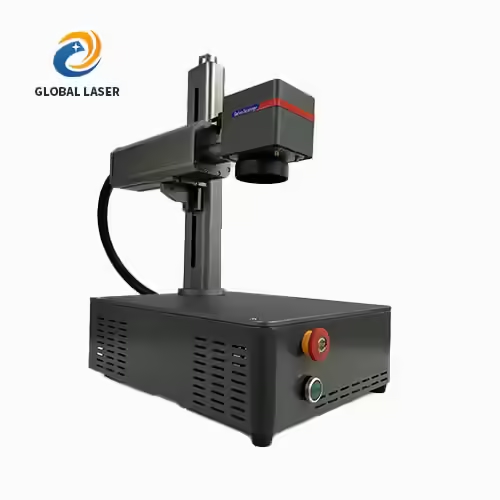
In the evolving landscape of industrial identification, the Curved Surface Engraver represents the bridge between traditional 2D marking limits and the complex reality of 3D manufacturing. While standard laser systems are confined to flat, two-dimensional planes, this technology is specifically engineered to navigate the “valleys and peaks” of modern metal components.
Think of a Curved Surface Engraver as a smart optical system that can “see” and “feel” the depth of a part. Whether you are dealing with the perfect radius of a spherical bearing or the rugged, uneven surface of a sand-cast engine block, this equipment ensures that your branding and traceability codes remain undistorted. It is the essential tool for manufacturers who refuse to let geometry dictate their quality standards.
The Physics of Focus: Rayleigh Length y Beam Divergence
To understand why a Curved Surface Engraver is essential, one must first look at the optics involved. In a standard laser setup, the “focus” is only valid within a very narrow range known as the Rayleigh Length ($Z_R$). According to ISO 11146—the international standard for laser beam characterization—the Rayleigh length is the distance along the propagation direction where the beam’s cross-sectional area is doubled.
Mathematically, this is expressed as:
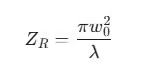
(Where $w_0$ is the beam waist and $\lambda$ is the wavelength).
On a spherical or irregular surface, the Z-axis height often exceeds this $Z_R$ value within millimeters. A traditional 2D laser cannot adjust its focal point fast enough to compensate, leading to “blurring” at the edges of a curve. This is where the 3D Dynamic Focus Fiber Laser Marking Machine becomes critical. It utilizes a high-speed voice coil motor to adjust the lens position in real-time, matching the beam waist precisely to the material’s topography.
Wide-Ranging Applications: What Can a Curved Surface Engraver Actually Do?
The core advantage of a Curved Surface Engraver lies in its ability to maintain constant energy density regardless of the surface’s angle of incidence. This is particularly evident in two distinct but equally demanding sectors.
Scenario A: High-Precision Industrial Bearings
In aerospace and automotive engineering, spherical roller bearings require permanent traceability codes. Because these surfaces are curved in multiple directions, a standard laser would produce a distorted mark as it moves away from the zenith of the sphere. The Curved Surface Engraver uses 3D software to “unwrap” the vector graphic and map it onto the spherical mesh. By adjusting the Z-axis focal length at microsecond intervals, the system ensures that every character of the UDI (Unique Device Identification) code is etched with identical depth and clarity, even on the steep “shoulders” of the ball.
Scenario B: Luxury Crafts and Lifestyle Goods
Commonly encountered items like customized stainless steel tumblers, curved watch casings, and hemispherical trophies present immense difficulty for traditional marking. For instance, a full-wrap design on a tapered metal flask cannot be achieved by a 2D laser without significant distortion at the edges. By employing a Curved Surface Engraver, artisans can apply intricate patterns that flow seamlessly over the curvature. Unlike mechanical rotary jigs that can scratch polished finishes, the 3D Dynamic Focus Fiber Laser Marking Machine provides a contact-free solution, preserving the aesthetic integrity of high-end crafts while delivering 4k-resolution detail.
Processing Irregular Metal Geometries and Steep Slopes
Irregular metal parts—such as sand-cast engine housings or custom medical implants—often feature jagged transitions that are impossible to mark in a single 2D pass. For these applications, the Curved Surface Engraver eliminates the need for complex, multi-axis mechanical jigs.
1.3D Surface Mapping: The operator imports an STL or STP file of the irregular part.
2.Dynamic Compensation: As the laser fires, the Curved Surface Engraver calculates the exact height variance.
3.Uniform Energy Delivery: Whether the laser hits a peak or a valley in the metal casting, the system compensates for the distance, preventing the “fading” effect common in 2.5D setups.
This capability makes the Curved Surface Engraver the only viable option for marking curved dental abutments or irregular aerospace valves where the surface height might vary by up to 100mm.
Why This Beats Traditional Methods
Many B2B buyers mistake a rotary axis for a true 3D solution. However, a rotary attachment only handles perfect cylinders. If the part is an irregular oval or has multiple varying heights, a rotary axis will fail. The Curved Surface Engraver handles these “impossible” geometries by moving the focus internally, not the part itself. This leads to:
- Higher Throughput: No mechanical rotation means faster cycle times.
- Zero Distortion: Patterns are mathematically corrected for the curve.
- Safety for Delicates: Contact-free marking for sensitive medical or jewelry pieces.
Investing in a Curved Surface Engraver ensures that your production line is equipped to handle the increasingly complex designs demanded by modern industrial and consumer markets.
Conclusión
Mastering these mechanical properties and logistical benefits is essential for driving efficiency in modern manufacturing and luxury craftsmanship. By precisely matching material grades to specific project dimensions, engineers can guarantee structures that remain both fiscally responsible and fundamentally sound. When durability and rapid on-site assembly of complex components are the primary objectives, utilizing a high-performance Curved Surface Engraver stands as the most practical solution for meeting global infrastructure and design demands.
Preguntas frecuentes
How does a Curved Surface Engraver maintain precision on steep angles?
The system uses 3D mapping software to adjust the pulse frequency and scan speed relative to the slope. This ensures that the energy density ($J/cm^2$) remains constant as the laser moves from the peak to the edge of an irregular part.
What is the maximum height variance a Curved Surface Engraver can handle?
Typically, standard industrial systems manage a height variance of 60mm to 100mm. For deeper irregular parts, specialized wide-field lenses can be integrated, though this may slightly increase the laser spot size.