

Metal Fabrication Trends 2026: Why Shops Are Switching to Handheld Laser Welding
Metal fabrication trends in 2026 are being shaped by one practical question: how can shops keep output stable when skilled labor is harder to find, orders are smaller, and quality expectations are higher? This article explains why handheld laser welding is moving from a “new machine” discussion into a shop-floor strategy. You will see the data behind labor pressure, where a laser welding machine fits, what fabrication automation really means for smaller shops, and when laser welding is worth serious ROI review.
Tabla de contenido
What Is Driving Metal Fabrication Trends in 2026?
The biggest metal fabrication trends are not only about newer equipment. They are about pressure on the shop floor.
Manufacturers need to ship faster, quote shorter runs, and deliver cleaner welds with fewer experienced hands. That pressure explains why many shops are now looking at handheld laser welding, welding automation, and more repeatable digital settings.
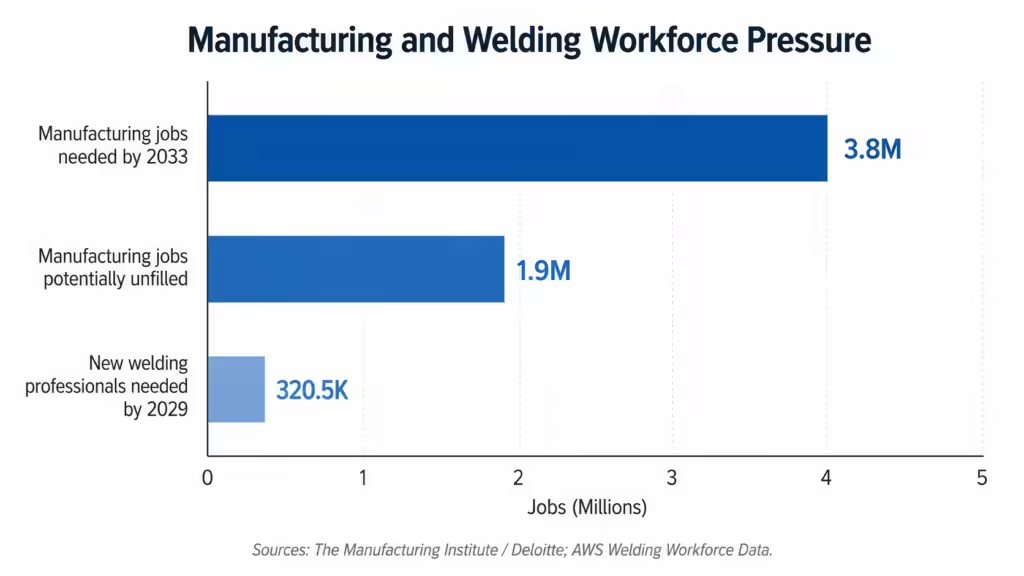
The labor data behind these metal fabrication trends is difficult to ignore. The Manufacturing Institute and Deloitte reported that U.S. manufacturing may need as many as 3.8 million new employees by 2033, and 1.9 million of those jobs could go unfilled if workforce challenges are not addressed.
Welding faces its own pressure. The AWS-backed welding workforce data projects that 320,500 new welding professionals will be needed in the U.S. by 2029. At the same time, the BLS page for welders, cutters, solderers, and brazers lists a median annual wage of $51,000 in May 2024.
Those numbers matter because metal shops do not make equipment decisions in a vacuum. They make them when labor, delivery time, quality, and rework start affecting profit.
Note: This chart should be marked as a practical evaluation score, not an industry statistic.
Metal fabrication trends are pushing shops to look at total cost, not only equipment price. Grinding time, rejected parts, customer complaints, slow training, and missed delivery dates all belong in the ROI calculation.
Where Does a Laser Welding Machine Fit Best?
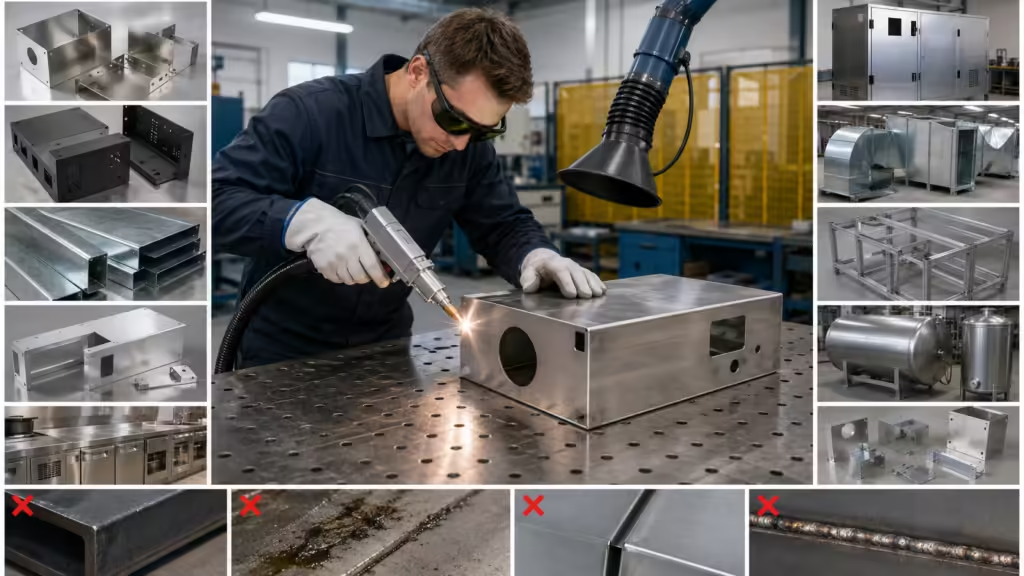
A laser welding machine usually fits best where the shop needs speed, appearance, and repeatability on suitable materials.
Common applications include:
- stainless steel sheet
- carbon steel sheet
- galvanized sheet
- thin aluminum parts
- kitchen equipment
- cabinets and enclosures
- HVAC components
- light frames
- tanks and containers
- sheet metal fabrication
- small-batch custom parts
But buyers should be careful with certified structural welding, very thick sections, dirty or oily surfaces, poor fit-up, and jobs without proper laser safety control.
OSHA’s page on laser hazards standards notes that laser hazards are addressed in specific OSHA standards, while its welding, cutting, and brazing hazards page highlights risks such as metal fumes, UV radiation, burns, eye damage, electrical shock, and other safety issues. For handheld laser welding, safety planning is not optional.
The American Welding Society article on handheld laser welding safety also warns that high-power Class 4 lasers present serious hazards, including direct and reflected beam risks.
What Should Buyers Check Before Choosing a Handheld Laser Welding Machine?
Before buying, shops should check the work, not only the brochure.
A useful checklist includes:
1.Material type and thickness range
2.Joint fit-up quality
3.Required weld appearance
4.Laser power level
5.Welding head and wobble function
6.Wire feeder stability
7.Cooling system capacity
8.Parameter presets
9.Operator training support
10.Safety interlock and PPE
11.Consumables and spare parts
12.Test weld samples
13.After-sales support
14.Realistic ROI calculation
This is where metal fabrication trends connect with purchasing discipline. A trend may explain why shops are interested, but the buying decision still depends on parts, people, process, and safety.
What Do These Trends Mean for 2026 Shop Decisions?
Metal fabrication trends in 2026 point toward practical automation, not blind automation.
The smart move is to review the shop’s real pain points first. In practice, metal fabrication trends only matter when they connect to real production losses:
- Are skilled welders hard to hire?
- Is grinding taking too much time?
- Are visible welds causing rework?
- Are small orders interrupting production flow?
- Are customers asking for cleaner weld appearance?
- Are operators struggling to repeat settings?
- Is outsourcing welding work reducing margin?
If the answer is yes, handheld laser welding may deserve a serious trial. If the shop mostly welds thick structural parts, has poor joint preparation, or cannot control laser safety, it may need a different solution.
That balanced approach is what makes metal fabrication trends useful for decision-making. Trends should guide questions, not replace engineering judgment. That is the difference between chasing metal fabrication trends and making a controlled investment.
Conclusión
Metal fabrication trends are making handheld laser welding more relevant because shops are under pressure from labor shortages, small-batch orders, quality demands, delivery speed, and ROI expectations. A laser welding machine is not a universal replacement for MIG, TIG, or robotic welding. But for the right materials, weld types, and production mix, it can become a practical step toward fabrication automation. The best decision starts with data, test
Preguntas frecuentes
What are the biggest metal fabrication trends in 2026?
The biggest trends include skilled labor shortages, rising labor costs, high-mix low-volume orders, faster delivery pressure, quality consistency, fabrication automation, and more interest in laser welding.
Why are metal shops switching to laser welding?
Many shops are switching to improve weld appearance, reduce grinding, lower rework, speed up suitable jobs, and reduce dependence on highly skilled manual welding for every task.
Is handheld laser welding easy to learn?
It can be easier to learn for some repeatable thin-sheet jobs, but operators still need training, parameter control, material preparation, and laser safety procedures.
Will laser welding replace MIG and TIG?
No. Laser welding will replace or support some applications, but MIG and TIG remain important for many materials, thicknesses, field jobs, and certified welding tasks.
Is a laser welding machine worth it for small shops?
It depends on labor cost, weld volume, material thickness, fit-up quality, rework rate, grinding time, safety setup, and whether the shop has enough suitable applications.
What materials are common for handheld laser welding?
Common materials include stainless steel, carbon steel, galvanized sheet, and aluminum, depending on thickness, power, joint design, surface condition, and parameters.