

Laser Safety and Standards: The 2026 Global Compliance Guide for Engravers
The rapid proliferation of high-power diode and fiber lasers has transformed the manufacturing sector. However, as of 2026, the regulatory landscape has become significantly more stringent. For any business integrating a النقش بالليزر machine into their workflow, adhering to international laser safety and standards is no longer optional—it is a prerequisite for market entry and operational insurance.
Navigating the complexities of laser safety and standards requires a dual focus on hardware engineering and administrative controls. Whether you are a hobbyist or an industrial plant manager, understanding how these regulations protect both the operator and the enterprise is critical for a sustainable production environment.
جدول المحتويات
The Foundation: IEC 60825-1 Standard 2026
The global benchmark for laser products is the IEC 60825-1 standard 2026 edition. This document dictates how manufacturers must classify their devices based on the Accessible Emission Limit (AEL). When evaluating a new laser engraving machine, the first step in verifying laser safety and standards compliance is checking for a valid IEC certificate.
This standard ensures that the biological risk—specifically to the retina and skin—is mitigated through engineering controls. A machine that fails to meet these laser safety and standards risks being seized by customs or failing local workplace safety audits.
Laser Safety Classes Explained
Understanding the hierarchy of risk is central to any laser safety and standards framework. Lasers are categorized into classes ranging from 1 to 4, with Class 1 being the safest and Class 4 posing the highest risk of fire and immediate eye injury.
| Laser Class | Risk Level | Requirement | أفضل حالة استخدام |
| Class 1 | Negligible | Fully Enclosed / Interlocks | Home workshops & Schools |
| Class 2 | قليل | Visible light only (Blink reflex) | Pointing & Alignment |
| Class 3B | واسطة | Direct beam hazard | Industrial sensing |
| Class 4 | عالي | Diffuse reflection hazard | Metal cutting & Engraving |
For most professional settings, an enclosed vs open laser engraver safety comparison reveals that Class 1 enclosures are the gold standard for reducing administrative overhead. By utilizing a Class 1 enclosure, the laser safety and standards burden on the facility is significantly lowered.
North American Regulations: CDRH Laser Compliance
In the United States, the Food and Drug Administration (FDA) regulates laser products through the Center for Devices and Radiological Health (CDRH). Achieving CDRH laser compliance is mandatory for selling any النقش بالليزر machine in the US market.
A key component of this process is the FDA accession number for laser machines, which serves as proof that the manufacturer has submitted the required safety reports. Without this, importers may face significant legal hurdles. These laser safety and standards ensure that every device sold meets federal performance standards, including the presence of warning labels, aperture covers, and safety interlocks.
بحسب FDA’s Laser Products Performance Standards (21 CFR 1040), failure to comply can result in product recalls and heavy fines for the distributor.
Industrial Workplace Safety: OSHA Requirements
Beyond the machine’s build quality, OSHA requirements for industrial laser engraving focus on the environment in which the machine operates. Employers must appoint a Laser Safety Officer (LSO) if they operate Class 3B or Class 4 systems. These laser safety and standards require the implementation of Controlled Access Areas (CAA) to prevent unauthorized personnel from entering the hazardous zone.
Furthermore, laser engraving safety regulations in industrial settings demand rigorous training for all operators. It is not enough to have a safe machine; the operational protocol must reflect the highest laser safety and standards to mitigate human error.
Critical Safety Hardware and Accessories
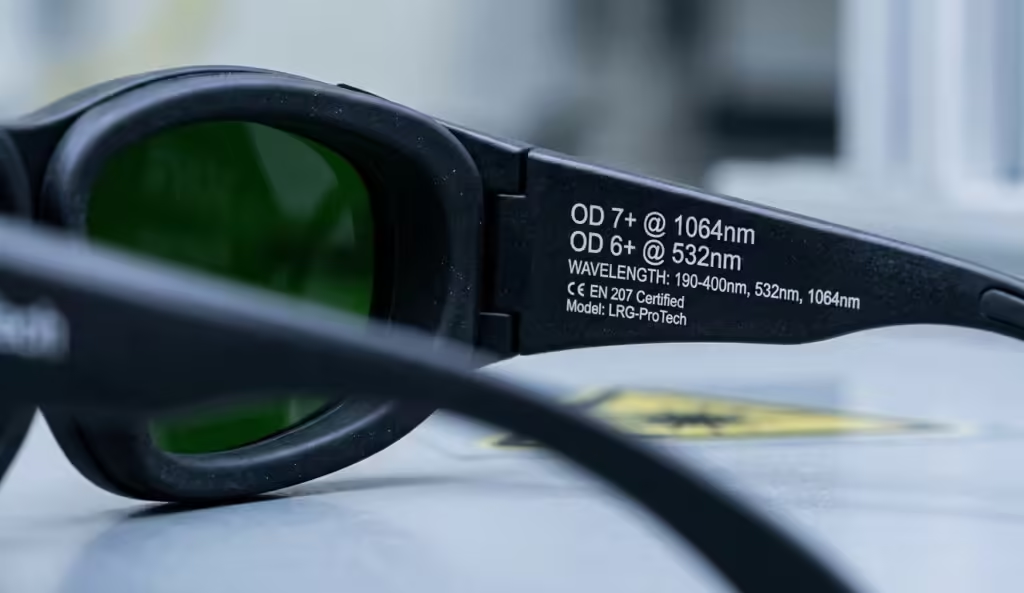
One of the most overlooked aspects of laser safety and standards is secondary protection. For instance, laser safety eyewear requirements for fiber lasers are different from those for CO2 lasers. The eyewear must have an Optical Density (OD) rating that corresponds to the specific wavelength of the beam (typically 1064nm for fiber or 10600nm for CO2).
- Interlock Switches: Automatically shut off the laser if the door is opened.
- Flame Retardant Housings: Essential for high-power cutting operations.
- OD-Rated Viewports: Filter out harmful radiation while allowing safe observation.
Maintaining these components is a vital part of upholding laser safety and standards over the machine’s lifecycle.
Is Class 1 Laser Engraver Safe for Home Use?
A common question among desktop users is: Is Class 1 laser engraver safe for home use? The answer is yes, provided the enclosure is not modified. A Class 1 system is engineered so that humans cannot access harmful radiation during normal operation.
However, users must remain vigilant regarding laser safety and standards even with “safe” machines. Proper fume extraction is a crucial part of safety, as the gasses produced during engraving can be toxic if not vented correctly. In 2026, many homeowners are opting for Class 1 systems to avoid the complexities of the more dangerous Class 4 open-frame alternatives.
خاتمة
The evolution of laser safety and standards will continue as beam power increases and new applications emerge. By prioritizing CDRH laser compliance and international IEC norms today, businesses can avoid costly retrofits in the future. Investing in a machine that exceeds current laser safety and standards is the most effective way to ensure long-term operational success and operator safety.
التعليمات
What is an FDA accession number for laser machines?
It is a unique identifier issued by the FDA after a manufacturer submits a product report, confirming that the device meets federal laser safety and standards.
Do I need a Laser Safety Officer (LSO) for a Class 1 engraver?
Generally, no. Class 1 systems are designed for safe operation without a designated LSO, provided the enclosure remains intact.
Where can I find OSHA requirements for industrial laser engraving?
Detailed workplace guidelines are available on the OSHA TechnicalManual – Laser Hazards page.
Are all laser goggles the same?
No. Eyewear must be matched to the specific wavelength and power of your laser to comply with laser safety and standards.