

Pulsed vs Continuous Laser Cleaning: Which One Fits Your Material?
Pulsed vs Continuous Laser is not just a question of machine type. For laser cleaning, it decides how heat enters the surface, how fast contamination is removed, and whether the substrate stays safe after cleaning.
In this article, Pulsed vs Continuous Laser will be compared from a practical material-selection angle: carbon steel, stainless steel, aluminum, molds, thick rust, thin coatings, and heat-sensitive surfaces. By the end, you should know when speed matters most, when substrate protection matters more, and why wattage alone is a poor buying guide.
Table of Contents
The Real Difference Behind Pulsed vs Continuous Laser
The real difference is heat delivery.
Pulsed laser cleaning delivers energy in short bursts. Each pulse has high peak energy, but the average heat input can be controlled more precisely. This makes it useful when the goal is to remove rust, paint, oxide, or oil without overheating the base material.
Continuous wave laser cleaning, also called CW laser cleaning, delivers energy continuously. It can remove thick rust and heavy contamination quickly, but heat accumulation becomes easier if the beam stays too long on one area.
For buyers, Pulsed vs Continuous Laser should not start with the question, “Which one has higher power?” A better question is, “How much heat can my material accept before surface damage, discoloration, warping, or metallurgical change becomes a problem?”
Research on laser cleaning of severely corroded steel members shows that laser cleaning can remove corrosion products and salts effectively, while surface morphology and composition still need to be evaluated after cleaning. That is exactly why cleaning performance and substrate condition must be judged together.
Cleaning Efficiency Comparison: Pulsed vs Continuous Laser in Heavy Rust
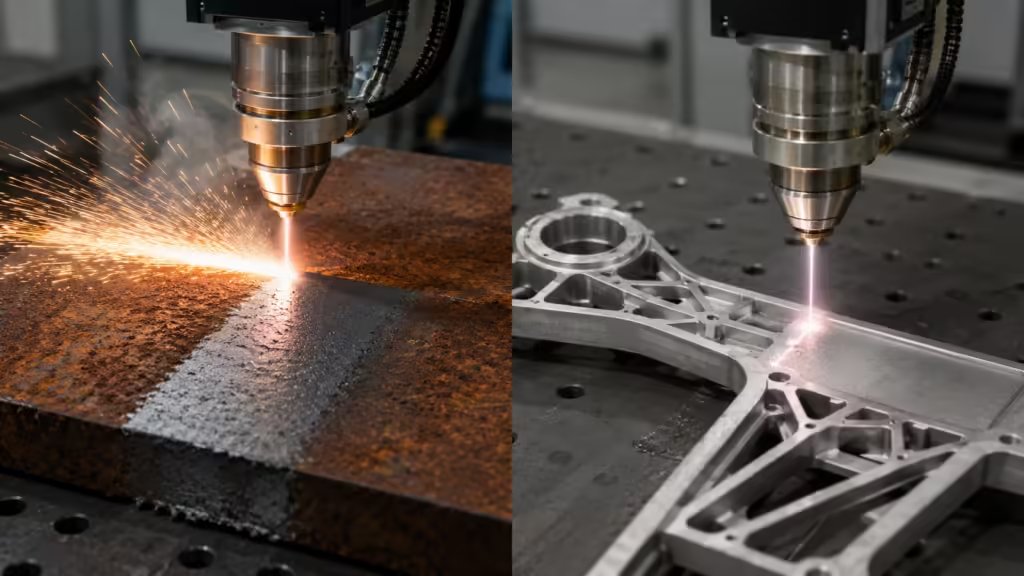
For heavy rust on carbon steel, continuous wave laser cleaning often has the advantage. The continuous beam keeps delivering energy into the rust layer, which helps remove thick corrosion faster over large surfaces.
This is why CW laser cleaning is often considered for:
- Steel structures
- Shipyard parts
- Construction machinery
- Large carbon steel plates
- Thick rust and scale removal
- Rough surfaces where speed matters more than fine surface finish
In this case, Pulsed vs Continuous Laser becomes a Cleaning efficiency comparison. If the steel is thick, the contamination is heavy, and the surface does not require precision finishing, CW can be a practical choice.
But faster does not always mean better. If the surface is thin, polished, coated, or dimensionally sensitive, thermal accumulation can create a new problem after the old contamination is removed.
Why Pulsed vs Continuous Laser Decisions Change with Sensitive Materials
Sensitive materials change the decision. Aluminum, stainless steel, molds, thin sheet metal, and precision parts often need lower thermal impact rather than maximum cleaning speed.
Here, Pulsed vs Continuous Laser usually favors pulsed laser cleaning. Short pulse duration helps limit heat diffusion into the substrate. This makes it easier to clean thin contamination layers while protecting surface quality.
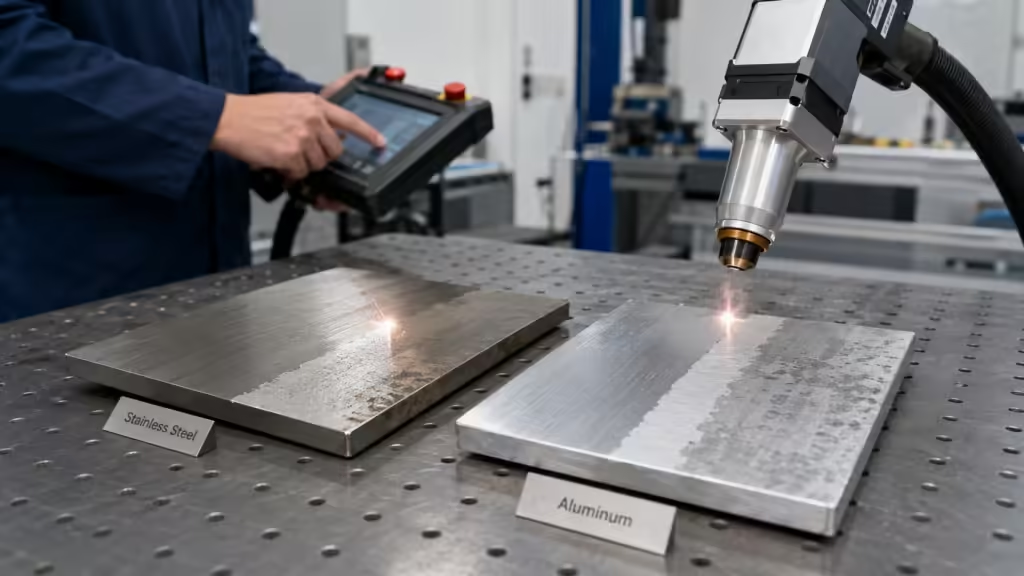
For aluminum, Pulsed vs Continuous Laser is especially important because aluminum is reflective, thermally conductive, and easy to affect if parameters are poorly controlled. For stainless steel, the issue is often surface color, oxide tint, and local heat marks. For molds, the risk is texture loss, dimensional change, or surface roughness variation.
Pulsed vs Continuous Laser Choices by Surface Type
Different materials need different cleaning logic.
For carbon steel, Pulsed vs Continuous Laser usually depends on rust thickness. Heavy rust and large areas lean toward continuous wave laser cleaning. Light rust, surface preparation before coating, or controlled cleaning near edges may favor pulsed laser cleaning.
For stainless steel, Pulsed vs Continuous Laser often favors pulsed cleaning when surface appearance matters. Stainless steel can show heat tint or oxidation if excessive energy is applied. Pulsed cleaning gives better control over the heat affected zone.
For aluminum, pulsed laser cleaning is usually safer. Aluminum responds quickly to heat, and the cleaning window can be narrow. When removing paint, oxide, or thin coatings, lower heat accumulation is valuable.
For molds, Pulsed vs Continuous Laser usually points toward pulsed technology. Mold cleaning requires protecting texture, polished areas, edges, and fine surface geometry.
For thick painted steel, the answer depends on coating thickness and final surface requirements. CW laser cleaning can improve productivity on rough, large areas. Pulsed laser cleaning is better when the coating must be removed selectively or when the substrate finish cannot be changed.
Does Laser Cleaning Damage the Substrate?
Laser cleaning can damage the substrate if parameters are wrong. The risk is not caused by laser cleaning itself, but by excessive energy density, slow scanning speed, poor focus, repeated passes, or choosing the wrong laser type for the material.
Typical substrate damage may include:
1.Surface discoloration
2.Melting or micro-pitting
3.Roughness change
4.Oxide layer formation
5.Thin metal warping
6.Loss of polished or textured surface quality
A review on laser-controlled cleaning notes that laser cleaning has strong potential for removing oxide films and paint layers on aluminum alloy surfaces, but parameter control and substrate response remain important technical challenges.
This is why thermal effect in laser cleaning should always be discussed before equipment selection. Cleaning efficiency comparison is useful, but it should include rework cost, surface safety, and post-cleaning quality—not only square meters per hour.
Pulsed Laser Cleaning vs Continuous Wave Laser Cleaning for Rust Removal
For rust removal, both technologies can work. The better choice depends on rust thickness, material value, and final surface requirements.
Choose continuous wave laser cleaning when:
- Rust is thick
- The part is large
- The substrate is carbon steel
- Surface appearance is not critical
- Productivity is the main target
- Slight thermal effect is acceptable
Choose pulsed laser cleaning when:
- Rust is light or moderate
- The material is thin
- The surface must remain clean and smooth
- The substrate is stainless steel or aluminum
- The part is high value
- Heat marks or surface damage are unacceptable
A recent study on nanosecond pulsed laser cleaning of FEP materials notes that pulsed lasers are widely studied because of small heat-affected zones and reduced thermal damage to substrates compared with continuous lasers.
That does not mean pulsed laser cleaning is always better. It means pulsed technology gives more control when surface protection is part of the cleaning goal.
How to Choose Between Pulsed and Continuous Laser Cleaning
The best selection method is to match the laser to the material and the contamination layer.
Use continuous wave laser cleaning if:
- The job is heavy rust removal
- The workpiece is thick carbon steel
- Large-area cleaning speed matters
- The surface will be painted or coated afterward
- Small surface roughness changes are acceptable
Use pulsed laser cleaning if:
- The material is aluminum, stainless steel, or a mold surface
- The part is thin or high value
- Surface appearance matters
- Heat damage would create scrap
- Selective coating removal is required
- Precision cleaning is more important than raw speed
This is where many buyers make a mistake. They compare laser cleaning machine wattage only. A 1000W pulsed system and a 1000W CW system do not behave the same way. Pulse width, peak power, repetition rate, spot size, scan speed, focus distance, and absorption behavior all affect the result.
Final Buying Advice: Don’t Choose by Wattage Alone
A high-wattage machine can clean quickly, but it can also create heat problems if it is used on the wrong material. A lower-power pulsed system may look slower on paper, but it may save time if it avoids discoloration, rework, masking, or surface repair.
Before buying, test the actual material. Use real rust, real paint, real oil, or real oxide from your production environment. Check the cleaned surface under proper lighting. If needed, measure roughness, color change, coating adhesion, or microscopic surface condition.
The right laser cleaning method is not the strongest one. It is the one that removes the unwanted layer while keeping the base material inside the safe processing window.
Conclusion
Pulsed vs Continuous Laser should be decided by material, contamination thickness, heat tolerance, and final surface requirements. Continuous wave laser cleaning is useful when heavy rust and cleaning speed are the main priorities. Pulsed laser cleaning is the stronger option when substrate protection, surface quality, and heat control matter more than raw speed.
For buyers, the safest rule is simple: choose CW for large, rough, heat-tolerant steel cleaning; choose pulsed for aluminum, stainless steel, molds, thin materials, and high-value parts. That is how Pulsed vs Continuous Laser becomes a practical material decision instead of a confusing equipment comparison.
FAQ
Is pulsed laser cleaning better than continuous wave laser cleaning?
Not always. Pulsed laser cleaning is better for heat-sensitive and precision surfaces. Continuous wave laser cleaning is often faster for thick rust on large steel parts.
Which laser cleaning method is faster?
Continuous wave laser cleaning is usually faster for heavy rust and large carbon steel surfaces. Pulsed laser cleaning is better when control and substrate protection matter.
Does laser cleaning damage the substrate?
It can if parameters are wrong. Excessive energy, slow scanning, or too much heat accumulation can damage the substrate.
Can continuous wave laser cleaning be used on stainless steel?
Yes, but it must be carefully controlled. Pulsed laser cleaning is often safer when color, finish, or heat marks matter.