

Laser Welding Stainless Steel: Applications, Benefits, Challenges & Machine Selection
If your fabrication shop is still relying exclusively on manual TIG welding for thin to medium stainless steel parts, you are likely losing money in the grinding and polishing department.
The industrial reality is simple: laser welding stainless steel has fundamentally disrupted traditional sheet metal fabrication. It offers vastly superior speeds, minimizes heat distortion, and can drastically reduce the costly post-weld processing that eats into your profit margins. However, it is not a magic solution that ignores the laws of metallurgy. Success requires understanding material behavior, joint fit-up, gas shielding, and exact machine parameters.
This comprehensive guide breaks down the true industrial logic behind stainless steel laser welding. We will strip away the exaggerated marketing claims and analyze the applications, the real-world benefits, the hidden challenges, and exactly how to specify the right [laser welding machine category page] for your production line.
Table of Contents
Why Laser Welding Stainless Steel Matters in Modern Metal Fabrication
Metal fabricators are facing a severe shortage of skilled TIG welders, coupled with rising labor rates. To maintain a competitive edge, factories must find ways to increase throughput without compromising the pristine aesthetic required by stainless steel buyers. This is where laser technology steps in, transforming a labor-intensive craft into a highly controllable, repeatable process.
What Makes Stainless Steel Suitable for Laser Welding
Unlike highly reflective and thermally conductive metals such as aluminum or copper, stainless steel is practically built for the 1070–1090nm wavelength emitted by modern fiber lasers. It boasts a relatively low thermal conductivity and a high absorption rate for laser energy.
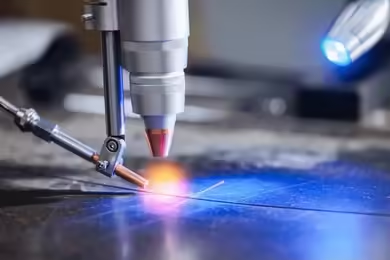
When the laser beam hits the stainless steel surface, the energy is absorbed rapidly, creating a deep, narrow melt pool (keyhole effect) rather than spreading heat across the entire plate. This localized energy transfer is exactly what makes the process so efficient.
Below is an instructional video from Youtube
When Laser Welding Stainless Steel Is a Better Choice Than Traditional Methods
A [stainless steel laser welding machine] becomes the superior choice when your production demands any of the following:
- High-volume throughput: You need to produce hundreds of identical parts per shift and takt time is your primary bottleneck.
- Strict aesthetic requirements: Your parts are visible to the end-user (e.g., appliances, architectural panels) and you cannot afford the labor hours required to grind down heavy TIG beads.
- Thin-gauge materials: You are welding materials under 3mm (approx. 11 gauge) where traditional arc welding carries a massive risk of burn-through or severe thermal warping.
Main Applications of Laser Welding Stainless Steel
Because of its clean finish and low thermal distortion, this technology has been rapidly adopted across multiple high-end manufacturing sectors.
Laser Welding Stainless Steel for Sheet Metal Parts
In general job shops and sheet metal fabrication, precision is everything. Whether processing 304, 316, or 430 series alloys, a [laser welder for stainless steel] excels at joining thin sheets. Common outputs include architectural cladding panels, elevator doors, and HVAC ductwork. Because the heat-affected zone (HAZ) is remarkably narrow, flat sheet metal panels remain flat after welding, eliminating the need for secondary straightening processes.
Laser Welding Stainless Steel for Cabinets, Enclosures and Fabricated Components
Electrical enclosures (such as NEMA-rated boxes), server racks, and industrial control cabinets demand continuous, leak-proof seams to protect sensitive internal components from dust and moisture. Handheld laser welding stainless steel provides operators with the agility to maneuver around complex box geometries, laying down fast, hermetically sealed joints that rarely require secondary grinding to meet IP-rating standards.
Laser Welding Stainless Steel in Kitchen Equipment, Automotive and Industrial Manufacturing
The commercial food equipment industry relies heavily on this technology. Commercial sinks, countertops, and refrigeration units require sanitary, pore-free welds to prevent bacterial growth. Laser welding produces incredibly smooth joints that meet strict food-grade regulations right off the torch.
In the automotive and industrial sectors, it is widely used for exhaust systems, heat exchangers, and fluid handling pipes, where the combination of high strength and low distortion is non-negotiable. For deep dives into industry-specific solutions, visit our [stainless steel application/solution page].
Key Benefits of Laser Welding Stainless Steel
To justify the capital expenditure of laser equipment, factory owners must look beyond the machine’s price tag and evaluate the total return on investment (ROI).
Higher Precision and Better Weld Appearance
Traditional arc welding often leaves a wide, convex bead that requires aggressive flap-disc grinding to achieve a brushed or polished finish. Laser welding yields a highly concentrated, visually seamless joint. For outer-facing cosmetic parts, this “weld and done” capability alone can cut production time per part by up to 50%.
Lower Heat Input and Reduced Post-Processing
Because the laser beam travels at high speeds (often 2 to 4 times faster than TIG) and focuses energy into a pinpoint spot, the surrounding stainless steel does not have time to heat up and expand. This drastically reduces thermal distortion (warping). You save money not only on grinding labor but also on the scrap metal generated by irreparably warped assemblies.
Improved Efficiency for Stainless Steel Production
Time is money. A factory replacing a manual TIG station with a high-quality [handheld laser welder] often sees an immediate spike in output. Furthermore, because the process is more automated via wire-feeders and pre-set parameters, operators can achieve consistent, high-quality results with significantly less training time than required for master-level TIG certification.
Common Challenges in Laser Welding Stainless Steel
If a supplier tells you laser welding is foolproof, they are lying. Stainless steel has specific metallurgical quirks that must be respected. Failing to control the environment or parameters will result in rejected paCommon Challenges in Laser Welding Stainless Steelrts.
Discoloration in Laser Welding Stainless Steel
Stainless steel is highly susceptible to oxidation at high temperatures. If the weld pool is exposed to oxygen before it cools, it will undergo severe discoloration (sugaring), turning black, dark blue, or purple. This destroys the metal’s corrosion resistance. Discoloration is a direct symptom of inadequate shielding gas coverage or welding at too slow of a travel speed, which allows excessive heat buildup.
Warping and Heat Control in Thin Stainless Steel
While laser input is lower than TIG, applying too much laser power to a 1mm stainless sheet will still cause it to warp—or worse, instantly burn a hole through the joint. Operators often make the mistake of assuming “more power is better,” using high-wattage settings on delicate parts instead of properly modulating the laser frequency and duty cycle.
Porosity, Cracks and Weld Consistency Issues
Lasers are unforgiving when it comes to joint fit-up. If your press brake operator leaves a 2mm gap between two plates, a pure laser beam cannot bridge that gap without filler wire. Attempting to force the weld will result in severe undercutting. Additionally, any oil, cutting fluid, or dirt left on the stainless surface will vaporize instantly under the laser, trapping gas in the fast-freezing melt pool and causing porosity (internal bubbles) that compromises structural integrity.
How to Improve Laser Welding Stainless Steel Quality
Achieving flawless results requires a strict adherence to process control. Here is how top-tier fabricators guarantee their yields.
Choose the Right Power for Laser Welding Stainless Steel
Match your machine to your reality. If your factory processes 1mm to 3mm stainless steel exclusively, do not overspend on power. A well-configured [1500W laser welder] is more than sufficient and provides excellent control to prevent burn-through. Conversely, if you are welding 4mm to 6mm structural stainless steel brackets or require maximum travel speeds for continuous mass production, upgrading to a [2000W laser welder] or higher is the commercially viable choice.
Prepare the Stainless Steel Surface Properly
Surface contamination is the enemy of the laser. Before welding, all stainless steel joints must be wiped free of drawing oils, fingerprints, and moisture using a dedicated solvent. Furthermore, ensure your cutting and bending tolerances are tight. The rule of thumb for autogenous (no-wire) laser welding is that the gap between parts should not exceed 10% of the material’s thickness.
Optimize Parameters, Shielding Gas and Welding Speed
Gas selection is critical. While Argon is the industry standard for general welding, pure Nitrogen is often the superior shielding gas for stainless steel laser welding. Nitrogen helps maintain the austenitic structure of the steel and provides an incredibly bright, silver weld seam with virtually no oxidation. Additionally, operators must utilize the machine’s “wobble” (beam oscillation) settings to slightly widen the melt pool, which helps bridge minor gaps and allows gases to escape, thereby preventing porosity.
Laser Welding Stainless Steel vs Traditional Welding Methods
To make an informed business decision, you must objectively compare laser technology against the incumbent processes on your shop floor.
Laser Welding Stainless Steel vs TIG Welding
Gas Tungsten Arc Welding (TIG) is renowned for high quality, but it is punishingly slow and injects massive amounts of heat into the part. Laser welding easily outpaces TIG in travel speed and drastically minimizes the heat-affected zone. However, TIG remains necessary for highly complex, heavy-wall pipe welding or applications requiring strict, radiographed code compliance where the rapid cooling rate of a laser weld might pose metallurgical concerns.
Laser Welding Stainless Steel vs MIG Welding
Gas Metal Arc Welding (MIG) is fast and excellent at bridging large gaps. But when applied to stainless steel, MIG often produces excessive spatter, a bulky weld profile, and requires extensive post-weld cleanup to restore the metal’s cosmetic appearance. Laser welding eliminates the spatter problem entirely, delivering a clean, precise seam that MIG simply cannot replicate on aesthetic parts.
Which Method Is Better for Thin Stainless Steel Parts
For thin stainless steel parts (0.5mm to 3mm), laser welding stainless steel is undeniably the superior method. It eliminates the burn-through risks of MIG and the thermal distortion nightmares of TIG, allowing fabricators to produce lightweight, highly aesthetic components profitably.
How to Choose the Right Machine for Laser Welding Stainless Steel
Procuring a machine based solely on the lowest price is a fast track to production bottlenecks. You must spec the equipment based on hard engineering data.
Choose by Material Thickness and Part Type
Your daily material gauge should dictate your power source.
- 0.5mm – 3mm: 1000W to 1500W systems provide the fine control needed for thin-gauge enclosures and kitchenware.
- 3mm – 6mm: 2000W systems provide the necessary penetration depth and speed for thicker brackets and industrial tanks. If you process a highly varied mix of parts, ensure the machine features an integrated automatic wire feeder to help bridge inconsistent gaps on lower-quality fit-ups.
Choose by Production Volume and Output Requirements
If your production consists of custom job-shop work, high-mix/low-volume parts, or large, unwieldy assemblies, a handheld laser welder offers the ultimate flexibility. If you are manufacturing hundreds of identical automotive exhaust components per day, you should invest in automated, robot-mounted laser welding cells to remove human fatigue from the equation.
Choose by Budget, Automation Needs and Future Expansion
Look beyond the initial capital layout. Consider the operating costs (electricity, shielding gas consumption, and protective lens replacements). Furthermore, if your business plan involves scaling up to thicker materials in the next two years, do not box yourself into an underpowered 1000W machine today. Buy for your future capacity.
-
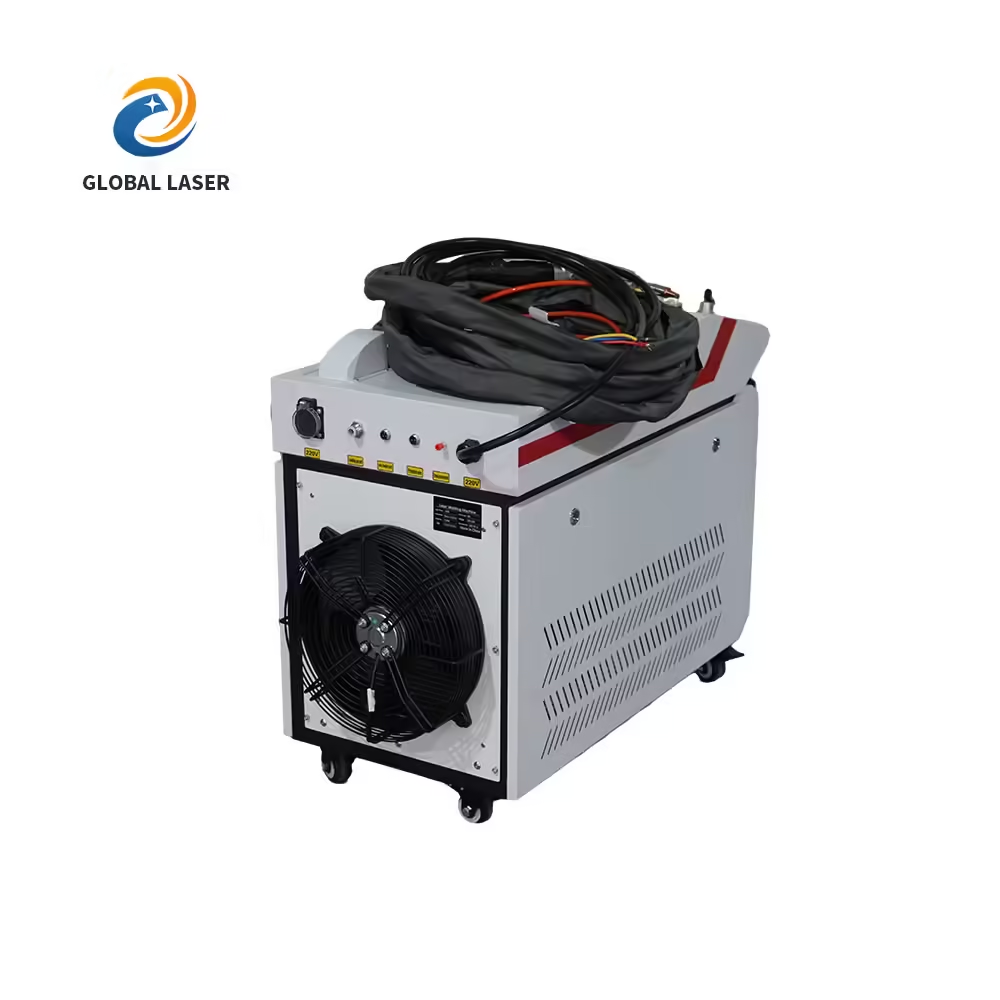 Model :GL-HW3000 | 3-in-1Rating :4.80Prices :$6,500 – $9,000
The Smart Upgrade from Traditional TIG/MIG Welding The GlobalLaser 1500W 3-in-1 Laser System is the ultimate cost-saving multi-tool for light metal fabrication. Instantly switch between flawless welding, rust removal, and precise cutting. It requires zero professional welding experience, drastically reducing your labor dependency while delivering clean, deformation-free joints on thin stainless steel and aluminum.
-
Core Capabilities: Weld, Clean, Cut (3-in-1).
-
Ideal For: Sheet metal fabrication, kitchenware manufacturing, window/door assembly, and auto body repair.
-
-
Model :GL-HW1500 | 3-in-1Rating :4.77Prices :$3,500 – $5,000
The Smart Upgrade from Traditional TIG/MIG Welding The GlobalLaser 1500W 3-in-1 Laser System is the ultimate cost-saving multi-tool for light metal fabrication. Instantly switch between flawless welding, rust removal, and precise cutting. It requires zero professional welding experience, drastically reducing your labor dependency while delivering clean, deformation-free joints on thin stainless steel and aluminum.
-
Core Capabilities: Weld, Clean, Cut (3-in-1).
-
Ideal For: Sheet metal fabrication, kitchenware manufacturing, window/door assembly, and auto body repair.
-
-
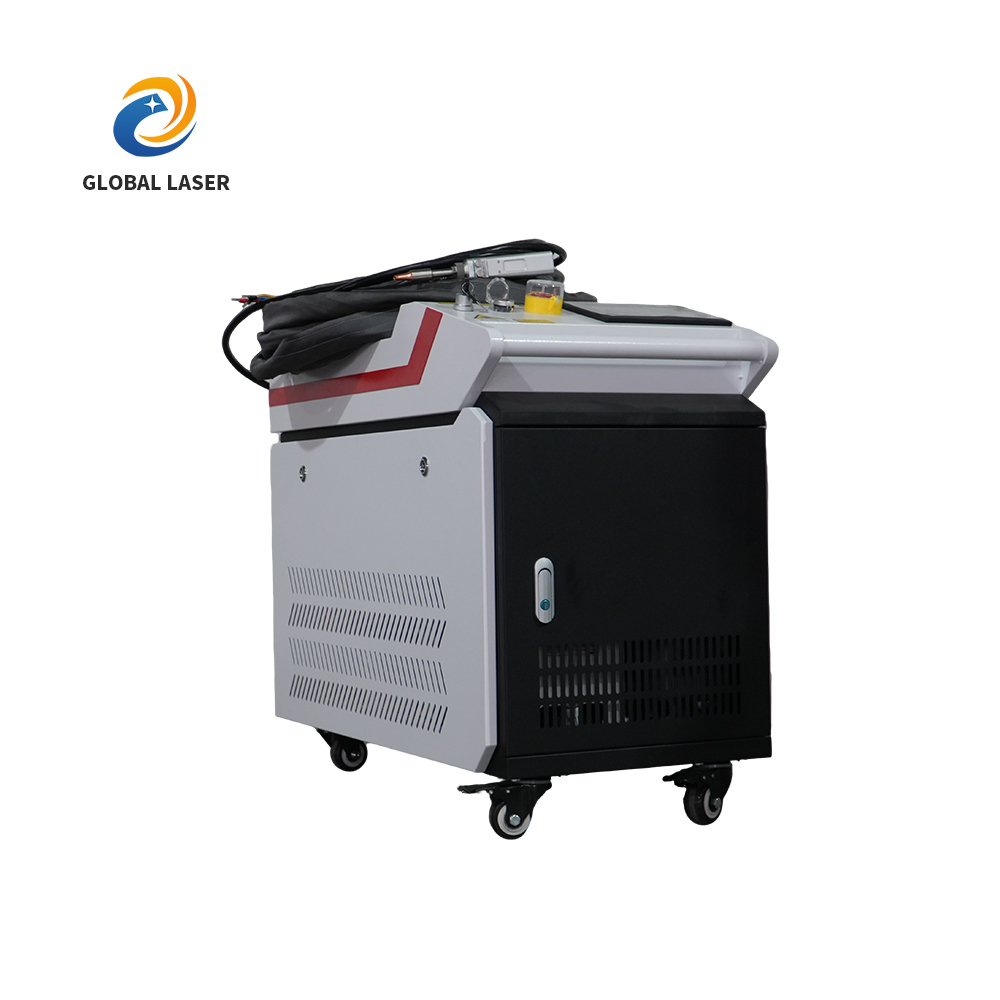 Model :GL-HW2000 | 3-in-1Rating :4.82Prices :$4,500 – $6,500
Commercial-Grade Power for Thicker Fabrications.
Step up to heavy-duty performance. The GlobalLaser GL-HW2000 delivers 2,000 watts of continuous-wave power, allowing you to effortlessly penetrate up to 6mm of stainless steel, carbon steel, and aluminum. This commercial 3-in-1 handheld system combines deeper, high-speed welding, aggressive pre/post-weld cleaning, and precision metal cutting into a single mobile unit. It is the ultimate upgrade for high-volume fabrication shops demanding stronger joints, faster travel speeds, and zero thermal distortion.
FAQ About Laser Welding Stainless Steel
Can handheld laser welders weld stainless steel effectively?
Absolutely. Handheld systems are specifically engineered to replace manual TIG welding in sheet metal shops, offering exceptional mobility and producing highly aesthetic, structurally sound joints on stainless steel.
What thickness is suitable for laser welding stainless steel?
Depending on the laser power, it typically ranges from 0.5mm up to 6mm. A 1500W system comfortably handles up to 3mm, while a 2000W or 3000W system can penetrate up to 6mm or more.
Is laser welding stainless steel better for thin sheet metal?
Yes. The highly concentrated energy beam drastically reduces the heat-affected zone, mitigating the warping, buckling, and burn-through that plague traditional arc welding on thin materials.
How can I reduce discoloration when laser welding stainless steel?
Discoloration is caused by oxidation. To eliminate it, ensure absolute coverage with a high-purity shielding gas (Argon or Nitrogen), check your gas flow rates, use proper trailing gas nozzles if necessary, and optimize your travel speed to prevent the metal from overheating.
Conclusion: Is Laser Welding Stainless Steel Right for Your Business?
Laser welding stainless steel is not just a technological upgrade; it is a strategic business decision. It fundamentally changes how you quote jobs, allocate labor, and manage finishing costs.
If your factory produces thin to medium stainless steel enclosures, commercial kitchen equipment, or precision sheet metal parts, the transition to laser technology will likely yield a rapid and substantial ROI by eliminating grinding bottlenecks and multiplying your output speed. However, to realize these gains, you must select the correct power level, demand proper joint fit-up, and train your operators to respect the parameters.
Stop guessing which machine will solve your production bottlenecks. Take the guesswork out of your capital investment. Send us your stainless steel material grades, your daily thickness ranges, and your specific application requirements. Our engineering team will analyze your data and recommend the exact equipment configuration you need to dominate your market.
If your factory produces thin to medium stainless steel enclosures, commercial kitchen equipment, or precision sheet metal parts, the transition to laser technology will likely yield a rapid and substantial ROI by eliminating grinding bottlenecks and multiplying your output speed. However, to realize these gains, you must select the correct power level, demand proper joint fit-up, and train your operators to respect the parameters.
Stop guessing which machine will solve your production bottlenecks. Take the guesswork out of your capital investment. Send us your stainless steel material grades, your daily thickness ranges, and your specific application requirements. Our engineering team will analyze your data and recommend the exact equipment configuration you need to dominate your market.