

Handheld Fiber Laser Cleaner for On-Site Maintenance & Machine Reviews
The industrial world is moving away from the era of stationary, cumbersome cleaning stations. Today, the ability to bring professional-grade restoration directly to the job site is a competitive necessity. The handheld fiber laser cleaner has emerged as the definitive solution for this shift, offering a level of flexibility that traditional media blasting or chemical stripping simply cannot match. Whether you are dealing with oxidized bridge supports or sensitive aerospace components, the transition to light-based maintenance is drastically reducing downtime across the globe.
For decades, maintenance crews were forced to choose between the mess of sandblasting or the environmental hazards of chemical baths. Now, the practical reality of portable industrial cleaning means that surface preparation can happen in-situ. This technological leap doesn’t just improve safety; it fundamentally changes the financial math of asset preservation.
Table of Contents
Why Mobility is the New Standard in Industrial Maintenance
The true power of a portable laser cleaner lies in its lack of secondary waste. Unlike traditional methods that leave behind piles of contaminated grit or toxic sludge, laser technology utilizes high-frequency light pulses to sublimate contaminants directly into gas. This is particularly critical for on-site maintenance where environmental containment is difficult or expensive to set up.
When we look at the physics of the process, we refer to “Laser Ablation.” According to research published by the Laser Institute of America (LIA), laser cleaning works by delivering concentrated energy that exceeds the bond strength of the surface contaminant but stays below the damage threshold of the base metal. You can explore the foundational science of these laser-material interactions through their official technical resources. This precision is why a handheld fiber laser cleaner is rapidly replacing grinders and needle guns in high-stakes environments like refineries and power plants.
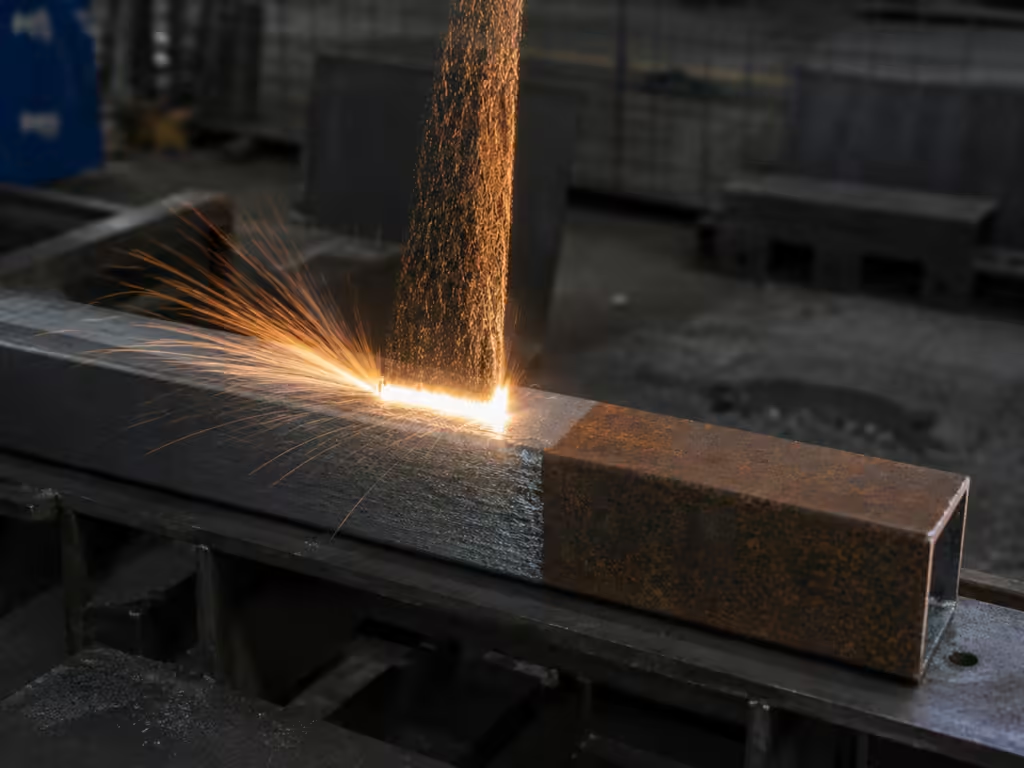
2026 Best Handheld Fiber Laser Cleaner for Sale Reviews
As we enter 2026, the market has segmented into highly specialized tools. Choosing the right handheld fiber laser cleaner depends entirely on the balance between your need for speed and your requirement for surface delicacy. Below are the top-rated configurations currently redefining the industry.
- The High-Efficiency Workhorse: 1500W CW Laser Cleaning Machine For large-scale laser rust removal, the 1500W Continuous Wave (CW) model is the industry benchmark. It provides the thermal energy necessary to strip heavy oxidation from structural steel at a pace that rivals industrial sandblasting but without the cleanup.
- The Precision Specialist: 200W Pulsed Laser Cleaning Machine If you are working with sensitive molds, historical artifacts, or thin-gauge aluminum, this specific handheld fiber laser cleaner is essential. Unlike CW lasers, pulsed light offers “cold” cleaning, ensuring zero heat-affected zones (HAZ).
- Ultimate Site Agility: 200W Trolley Pulsed Laser Cleaner Designed for technicians who are constantly on the move, this trolley-style portable laser cleaner fits into a form factor similar to a rugged suitcase. It is perfect for aircraft maintenance or remote pipeline inspections.
- Heavy Industrial Power: 2000W CW Laser Cleaner and 3000W Industrial Laser Cleaner
When dealing with thick marine anti-fouling paint or decades of industrial buildup, wattage is king. These systems are built for 24/7 duty cycles and represent the most powerful handheld fiber laser cleaner options available for infrastructure projects.
Selecting Your Handheld Fiber Laser Cleaner
One of the most common questions from procurement managers is: “Is more power always better?” The answer is a definitive no. While a high-wattage handheld fiber laser cleaner will strip material faster, it also introduces more heat. If you are cleaning a delicate injection mold, a 3000W laser could warp the precision tolerances.
Conversely, using a 200W pulsed unit to clean a 500-square-foot steel tank is an exercise in futility. To maximize your ROI, you must match the laser source to the coating thickness and substrate sensitivity. Investing in a handheld fiber laser cleaner requires a strategic look at your most frequent job types.
| Application | Recommended Wattage | Laser Type | Key Advantage |
| Precision Mold/Tooling | 100W – 200W | Pulsed | Zero damage to base metal |
| Light Rust & Prep | 500W – 1000W | CW/Pulsed | Versatility for workshops |
| Industrial Descaling | 1500W – 2000W | CW | High-speed area coverage |
| Heavy Paint & Marine | 3000W+ | CW | Maximum penetration power |
Why Professionals are Swapping Sandblasting for a Handheld Fiber Laser Cleaner
The shift toward handheld fiber laser cleaner technology is often driven by a realization of the “hidden costs” of sandblasting. Beyond the cost of the grit itself, sandblasting requires massive air compressors, extensive PPE, and hours of post-work cleanup. Most importantly, it is often destructive, removing a microscopic layer of the base metal with every pass.
In contrast, laser rust removal is a non-contact process. It is “selective,” meaning it can be tuned to react with the dark color of rust while reflecting off the shiny surface of the steel beneath. If you are still debating the two methods, this sandblasting vs laser cleaning truth
reveals that while laser has a higher upfront cost, the break-even point is reached much faster through reduced labor. Furthermore, when analyzing the laser rust removal cost and operating expense, the long-term savings on consumables become staggering.
Maintenance and Safety for the Handheld Fiber Laser Cleaner
Because the handheld fiber laser cleaner is a Class 4 laser device, safety cannot be an afterthought. When performing portable industrial cleaning in the field, you must establish a “Controlled Laser Area.” This prevents passersby from being exposed to direct or reflected beams.
The advanced safety features of a handheld fiber laser cleaner often include ground sensors and double-action triggers that prevent accidental firing. However, the maintenance of the protective lens and the cooling system is what truly determines the lifespan of your investment. A well-maintained handheld fiber laser cleaner can serve a fleet for over a decade with minimal parts replacement.
Conclusion
As we look toward the future of infrastructure management, the “carry-on” approach to maintenance will only grow. The handheld fiber laser cleaner is no longer a luxury for specialized labs; it is a frontline tool for the modern technician. By eliminating the logistical nightmare of waste disposal and providing a precision that mechanical tools cannot replicate, these machines are ensuring that our world’s assets last longer and cost less to maintain.
Whether you are looking to upgrade a small automotive shop or manage a fleet of industrial service vehicles, the investment in a handheld fiber laser cleaner represents a commitment to the highest standards of modern engineering. The transition is clear: the future is light, and that light is portable. Every modern workshop should evaluate how a handheld fiber laser cleaner can streamline their operations for the decade to come.
FAQ
Does a handheld fiber laser cleaner damage the metal underneath?
If the settings are correct, no. Pulsed lasers are specifically designed to leave the substrate untouched. CW lasers can cause minor surface heating, but they generally do not remove base material like abrasive methods do.
How long does the laser source last?
Most modern fiber laser sources are rated for 100,000 hours. If you used the handheld fiber laser cleaner for 8 hours a day, 5 days a week, the source would theoretically last over 40 years.
Can it remove oil and grease as well as rust?
Yes. The laser is exceptionally good at vaporizing hydrocarbons. This makes a portable laser cleaner an excellent tool for pre-welding preparation, as it leaves the surface chemically clean.