

Is Laser Rust Removal Cost Actually Saving You a Fortune?
For decades, the industrial world has accepted a “messy tax”: the endless purchase of grit, the hazardous disposal of chemical runoff, and the grueling labor of manual grinding. But in 2026, a paradigm shift has occurred. The conversation among facility managers and shop owners has moved from “Can light clean steel?” to a much more practical financial inquiry: “What is the true Laser Rust Removal Cost compared to my current overhead?”
If you are still calculating your restoration budget based on the price of sandbags and solvent drums, you are likely bleeding money every hour. Laser rust removal isn’t just a high-tech novelty for the aerospace elite; it is a surgical financial instrument designed to slash operating expenses while delivering a finish that traditional methods simply cannot replicate.
Table of Contents
How Much Does a Laser Rust Removal Cost?
The first hurdle in any procurement meeting is the capital expenditure (CAPEX). To give an honest answer to how much does a laser rust removal cost, we have to categorize equipment by power output and beam stability. As of 2026, the market has stabilized into three distinct performance tiers.
- Entry-Level (1000W – 1500W): Typically ranging from $8,000 to $15,000. These units are the standard for handheld laser rust removal in automotive restoration and light fabrication.
- Mid-Range (2000W): Ranging from $18,000 to $28,000. This is the “sweet spot” for continuous industrial use, offering the necessary thermal management for 8-hour shifts.
- High-Output (3000W+): $35,000 and up. These are high-speed systems often integrated into automated production lines or heavy-duty laser rust removal equipment for maritime and infrastructure projects.
While the sticker price is undeniably higher than a $500 sandblasting pot, looking at the initial price in isolation is a rookie mistake. The real story is told through the Operation expense per hour, where the laser begins to “pay back” its own purchase price from the very first minute of use.
handheld laser rust removal Operation Expense Per Hour Explained
The genius of rust removal with laser technology lies in its lack of consumables. In traditional cleaning, your hourly cost is a variable mountain: you pay for the media, the disposal of that media, and the intensive PPE required for operators.
When we calculate the Operation expense per hour for a 2000W fiber laser, the numbers are surprisingly lean:
| Expense Category | Estimated Cost (USD/Hour) | Notes |
| Electricity | $0.80 – $1.50 | Based on 2026 industrial rates and 75% duty cycle. |
| Protective Lenses | $0.20 – $0.40 | Consumable lenses last 80-150 hours depending on dust extraction. |
| Shield Gas (Optional) | $0.50 – $1.00 | Nitrogen/Air usage for preventing oxidation on sensitive alloys. |
| Maintenance | $0.30 | Primarily filter replacements for the fume extractor. |
| Total OPEX | ~$1.80 – $3.20 | Excludes labor. |
Compare this to sandblasting, where the media alone can cost $15–$30 per hour, plus the skyrocketing costs of hazardous waste disposal. The Laser Rust Removal Cost per hour is effectively a fraction of traditional methods, allowing the machine to pay for its own depreciation through operational savings.
Metal Surface Restoration
Beyond the raw numbers, the quality of Metal surface restoration provided by a laser is fundamentally superior. Traditional abrasives are “dumb” tools—they remove rust by brute force, often pitting the underlying substrate or embedding particles into the metal.
Laser cleaning is a selective process. By adjusting the pulse frequency and power density, an operator can evaporate oxides without increasing the temperature of the base metal. This is critical in aerospace and high-precision manufacturing, where mechanical stress from sandblasting could compromise structural integrity.
According to research by the Laser Institute of America (LIA)
, laser ablation allows for the removal of micron-level contaminants without altering the metallurgical properties of the substrate. This precision reduces the need for secondary polishing or chemical neutralization, further lowering the total Laser Rust Removal Cost.
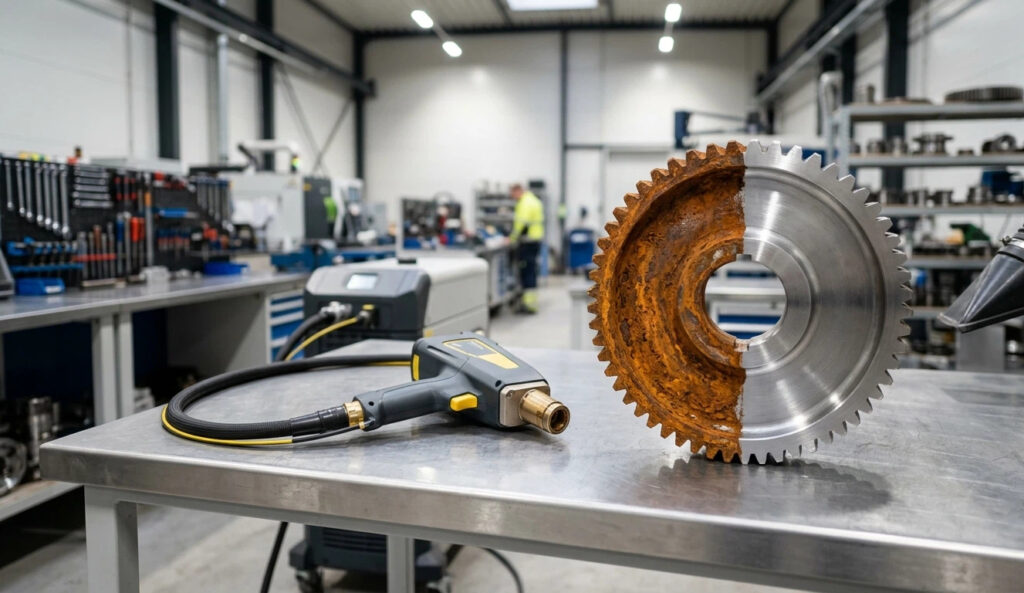
Why Handheld Laser Rust Removal is the Ultimate ROI Tool
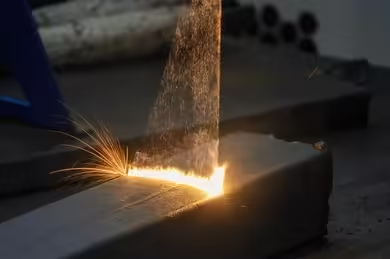
Flexibility is a hidden profit center. In the past, heavy parts had to be transported to a dedicated blasting booth, involving crane time and logistical delays. Modern handheld laser rust removal units have brought the cleaning to the part.
Whether it’s a fixed bridge structure or a massive casting on a factory floor, a technician can deploy the laser instantly. This “on-site” capability eliminates transport costs and reduces the “wait time” in a production cycle. When you factor in that a laser requires zero cleanup—no sand to sweep, no chemicals to neutralize—the “turnaround time” per part drops by as much as 60%.
Evaluating Laser Rust Removal Equipment for Longevity
Not all laser rust removal equipment is created equal. To ensure your Operation expense per hour stays low, you must evaluate the TCO (Total Cost of Ownership). The most critical component is the fiber laser source.
Leading manufacturers like IPG Photonics or Raycus offer sources with an MTBF (Mean Time Between Failures) of 100,000 hours. If you run your machine 8 hours a day, 250 days a year, that is 50 years of theoretical life.
However, the “cost” increases if you buy “cheap.” Low-quality chillers or poorly shielded optical cables can lead to downtime. In the B2B sector, downtime is the most expensive consumable. Investing an extra $5,000 upfront in a machine with premium components usually saves $20,000 in repairs over its first three years of operation.
Environmental and Safety Compliance
In 2026, environmental regulations have made the disposal of grit and sludge a bureaucratic nightmare. The Laser Rust Removal Cost includes a “green dividend.” Because the process is dry and chemical-free, there is no “waste” other than the evaporated rust particles, which are captured by a HEPA vacuum system.
Furthermore, the safety profile is vastly improved. While laser safety (eye protection) is mandatory, you eliminate the risks of silicosis from sandblasting and the skin burns associated with chemical stripping. Lowering your insurance premiums and avoiding OSHA or EPA fines are tangible financial benefits that rarely show up on a simple price tag but significantly impact your bottom line.
Final Verdict
The Laser Rust Removal Cost is an investment in efficiency. While the entry price is higher than traditional tools, the plummeting Operation expense per hour and the elimination of consumables create a “break-even” point that is impossible for sandblasting to beat in high-volume environments.
If your facility is still stuck in the “dust age,” you are paying for inefficiency. By switching to high-performance laser rust removal equipment, you aren’t just cleaning metal—you are cleaning up your balance sheet.
FAQ
How much does a laser rust removal cost for a small business?
A reliable 1000W handheld system for a small shop typically costs between $8,000 and $12,000. For most shops, the ROI is achieved within 10-14 months through media and labor savings.
What is the actual Operation expense per hour for a 3000W unit?
Expect roughly $3.50 to $5.00 per hour, primarily driven by higher electricity consumption. However, the cleaning speed is roughly 3x faster than a 1000W unit, making the cost per square foot much lower.
Does rust removal with laser damage the underlying metal?
No. When properly calibrated, the laser pulse evaporates the rust (ablation) but reflects off the shiny base metal. It is a “self-limiting” process that preserves the original dimensions of the part.
Is it difficult to train staff on handheld laser rust removal?
Modern systems feature “Smart Presets.” Most operators can become proficient in under 2 hours. Unlike welding, which requires years of skill, laser cleaning is highly intuitive.