

Laser Paint Stripper Guide: Selective Coating Removal Without Surface Damage
In the high-stakes world of aerospace maintenance and automotive restoration, the margin for error is zero. Traditional methods of removing paint—such as chemical baths that leach toxic runoff or abrasive grit blasting that creates micro-fractures—are increasingly viewed as liabilities. Enter the laser paint stripper, a sophisticated tool that has transitioned from laboratory curiosity to an essential asset for modern surface preparation.
Commonly referred to as a “Laser Ablation System,” this technology offers a level of precision that mechanical tools simply cannot match. By utilizing a high-intensity beam of light, a laser paint stripper can selectively vaporize coatings, turning solid pollutants into gas without ever making physical contact with the underlying material.
Table of Contents
The Physics of Selective Coating Removal
The magic of a laser paint stripper lies in the principle of “selective absorption.” Every material has a specific ablation threshold—the amount of energy required to break its molecular bonds. Modern selective coating removal works because the laser energy is tuned to a frequency that is aggressively absorbed by the paint but reflected or ignored by the substrate.
When the laser pulse hits the surface, the coating undergoes a rapid thermal expansion and subsequent evaporation. This process, known as photothermal ablation, happens so quickly that the heat does not have time to conduct into the base metal or composite. This ensures that there is no “Heat-Affected Zone” (HAZ), preserving the mechanical properties of the part.
According to research conducted by the Laser Institute of America (LIA), laser cleaning systems provide a “non-contact, non-abrasive” solution that eliminates the risk of surface work-hardening. You can explore their technical papers on laser-material interaction at the Laser Institute of America.
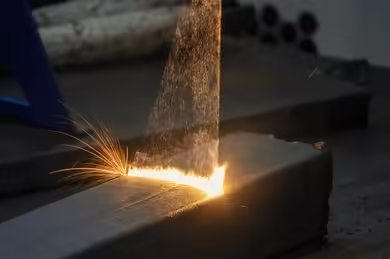
How to Use a Laser Paint Stripper on Aluminum and Carbon Fiber
The most significant challenge for any surface technician is dealing with sensitive materials. Aluminum is prone to warping under heat, while carbon fiber composites can be easily ruined by chemical solvents that dissolve the resin matrix. Understanding how to use a laser paint stripper on aluminum and carbon fiber is critical for protecting these high-value assets.
When working with aluminum, the laser paint stripper must be calibrated to a pulsed mode. This prevents heat buildup, ensuring the structural temper of the aluminum remains intact. For carbon fiber, the precision is even more vital. Because carbon fiber is dark and can absorb laser energy, the system uses ultra-short pulses—measured in nanoseconds—to “flick” the paint off the surface before the resin can react.
In the aerospace sector, engineering bolted steel tanks for hurricane zones often requires similar precision in localized coating repair. Whether it’s a fuselage or a storage vessel, the laser paint stripper ensures that the protective oxide layer of the aluminum is left undisturbed, preventing future corrosion.
Eliminating the “Scuff”: Why Mechanical Sanding is Obsolete
For decades, “scuffing” the surface was a necessary evil. To get a new coat of paint to stick, technicians had to create a mechanical profile using sandpaper or grit. However, this removes a layer of the actual substrate. A laser paint stripper changes the game by cleaning the surface at a microscopic level.
Through selective coating removal, the laser removes oxides, oils, and old paint, leaving a chemically pure surface. This “active” surface actually promotes better adhesion for new coatings than a mechanically scuffed one. By using a laser paint stripper, facilities can extend the life of their components because they aren’t losing microns of material every time the part is refurbished.
The International Organization for Standardization (ISO) outlines surface cleanliness requirements in ISO 8501-1. Laser systems are increasingly being used to meet these stringent “Sa 3” (White Metal) cleanliness standards without the mess of traditional media. View the standard details at the ISO Official Site.
Turning Contaminants into Gas: The Environmental Advantage
One of the biggest hurdles in industrial stripping is the disposal of hazardous waste. Chemical strippers create gallons of toxic sludge. Sandblasting creates airborne dust that requires massive filtration systems. The laser paint stripper is a “media-less” solution.
The system uses an integrated vacuum extraction unit located directly at the laser head. As the laser paint stripper vaporizes the paint, the particles are captured in a HEPA filter. This turns a messy, dangerous job into a clean, “green” process. For companies looking to reduce their environmental footprint, switching to a laser paint stripper is the most effective way to eliminate VOCs (Volatile Organic Compounds) from their workflow.
Operational Safety and Laser Safety Standards
While a laser paint stripper is incredibly efficient, it is a high-power Class 4 laser structure. Safety is paramount. Proper use requires designated “Laser Controlled Areas” and specialized eyewear designed to block the specific wavelength of the machine.
Third-party authorities like OSHA and the ANSI (American National Standards Institute) provide strict guidelines for the safe operation of these units. Specifically, ANSI Z136.1 provides the “Safe Use of Lasers” framework that all industrial operators should follow. You can find these safety protocols via the ANSI Webstore.
By integrating a laser paint stripper into your production line, you aren’t just buying a tool; you are upgrading to a safer, more predictable, and highly repeatable engineering process.
Final Thoughts
The initial investment in a laser paint stripper is higher than a box of sandpaper or a drum of chemicals. However, the ROI is found in the lack of consumables, the reduction in labor hours, and—most importantly—the elimination of damaged parts.
When you prioritize selective coating removal, you are investing in the longevity of your hardware. Whether you are learning how to use a laser paint stripper on aluminum and carbon fiber for a small project or a massive industrial overhaul, the results remain the same: a surface that is cleaner, stronger, and ready for the future.
FAQ
Does a laser paint stripper damage the metal underneath?
No. When properly calibrated, the laser energy is absorbed only by the coating. The metal substrate reflects the energy, leaving the surface un-scuffed and structurally sound.
Can I remove rust with the same machine?
Yes. A laser paint stripper is a multi-functional tool. By adjusting the frequency, you can switch from stripping paint to removing heavy rust or oxide layers.
How fast is a laser paint stripper compared to sandblasting?
While sandblasting might be faster on massive, non-sensitive structures, the laser is faster for precision work because it requires zero cleanup and zero masking of sensitive areas.
Is it safe to use on carbon fiber?
Yes, but it requires an experienced operator or a pre-set program. The laser must pulse fast enough to vaporize the paint without letting heat soak into the carbon resin.
What is the power requirement for these systems?
Most portable units run on standard 220V industrial power, making them easy to integrate into existing workshops or hangars.