

1500W vs 2000W Laser Welder for Sheet Metal: Power, Thickness, Cost & Best Choice
About how to choose 1500W VS 2000W Laser Welder This question:For most standard sheet metal fabricators, a 1500W laser welder is fully sufficient to handle standard thin-plate welding requirements. However, if your operations demand higher throughput, capability for thicker materials, continuous continuous production, or uncompromising weld stability, upgrading to a 2000W system is the more suitable choice.
Table of Contents
Ultimately, the true selection criteria isn’t simply “more power is better.” The decision strictly comes down to your material types, thickness range, required welding speed, budget, and overall production takt time.
-
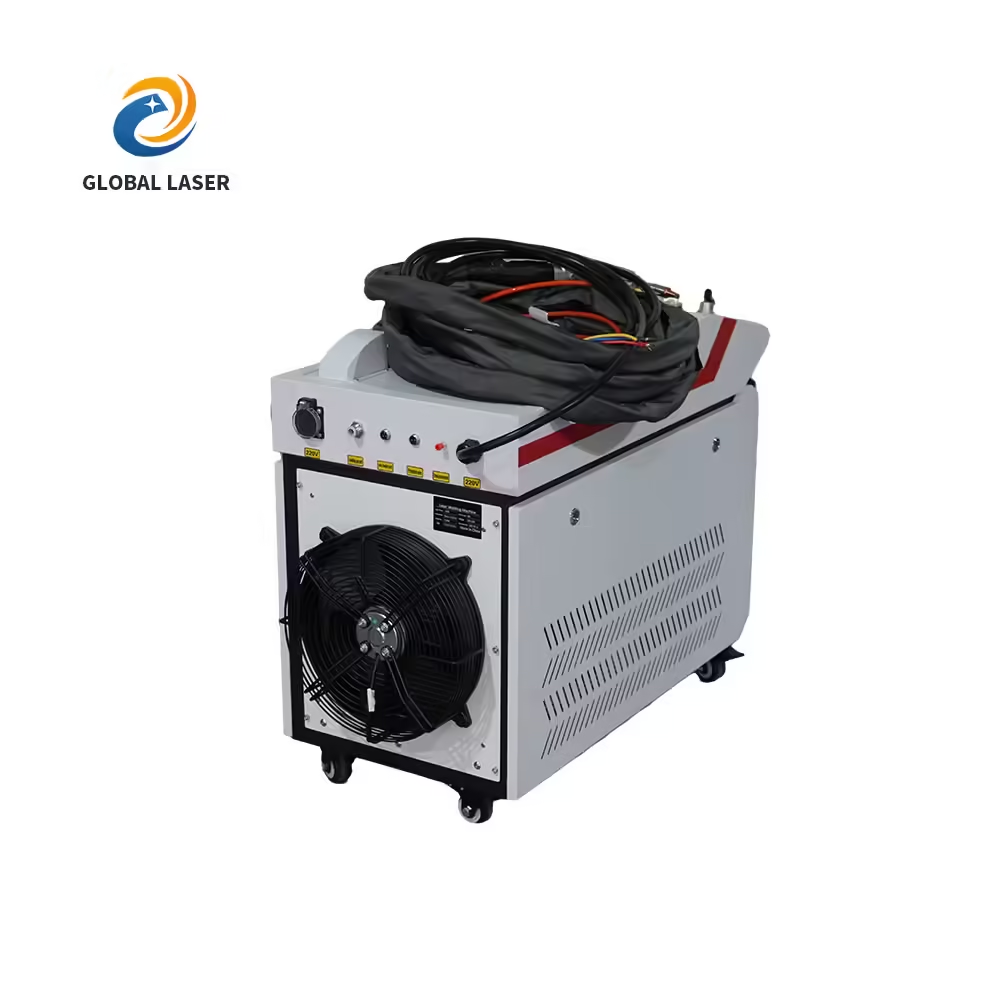 Model :GL-HW1500 | 3-in-1Rating :4.77Prices :$3,500 – $5,000
The Smart Upgrade from Traditional TIG/MIG Welding The GlobalLaser 1500W 3-in-1 Laser System is the ultimate cost-saving multi-tool for light metal fabrication. Instantly switch between flawless welding, rust removal, and precise cutting. It requires zero professional welding experience, drastically reducing your labor dependency while delivering clean, deformation-free joints on thin stainless steel and aluminum.
-
Core Capabilities: Weld, Clean, Cut (3-in-1).
-
Ideal For: Sheet metal fabrication, kitchenware manufacturing, window/door assembly, and auto body repair.
-
-
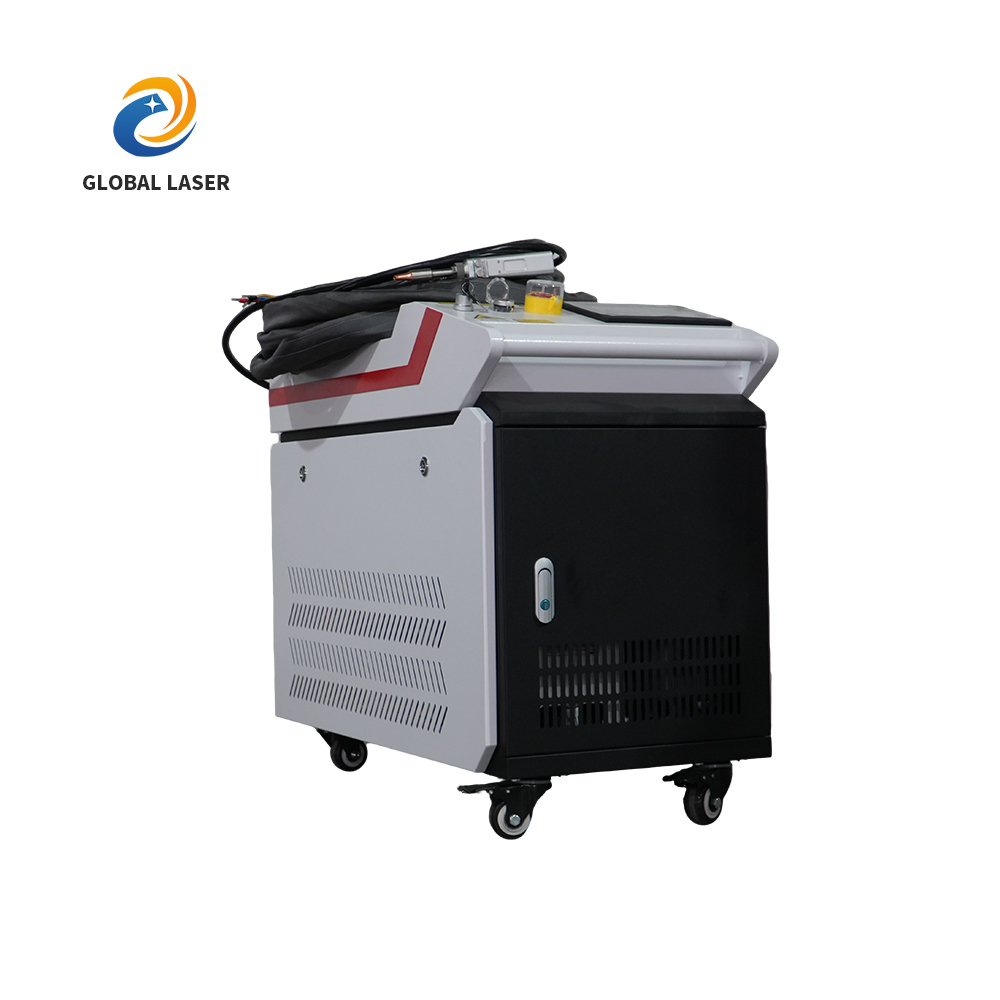 Model :GL-HW2000 | 3-in-1Rating :4.82Prices :$4,500 – $6,500
Commercial-Grade Power for Thicker Fabrications.
Step up to heavy-duty performance. The GlobalLaser GL-HW2000 delivers 2,000 watts of continuous-wave power, allowing you to effortlessly penetrate up to 6mm of stainless steel, carbon steel, and aluminum. This commercial 3-in-1 handheld system combines deeper, high-speed welding, aggressive pre/post-weld cleaning, and precision metal cutting into a single mobile unit. It is the ultimate upgrade for high-volume fabrication shops demanding stronger joints, faster travel speeds, and zero thermal distortion.
Why Power Matters in Sheet Metal Laser Welding
What 1500W and 2000W really mean
In laser welding, power directly determines the energy input into the metal. Higher power generally translates to stronger penetration capability and faster welding speeds.
However, high power is not universally better for all scenarios. When working with thin sheets, excessive power increases the risk of high heat input, which can lead to thermal distortion (warpage), burn-throughs, and higher overall operating costs.
Sheet metal applications where power selection matters most
Choosing the right power level is critical in industries where precision and structural integrity meet. Common applications include:
- Stainless steel cabinets
- Kitchen equipment
- Sheet metal enclosures
- Electrical boxes
- Metal furniture
- HVAC ducts
- Auto parts sheet components
1500W vs 2000W Laser Welder: Key Differences at a Glance
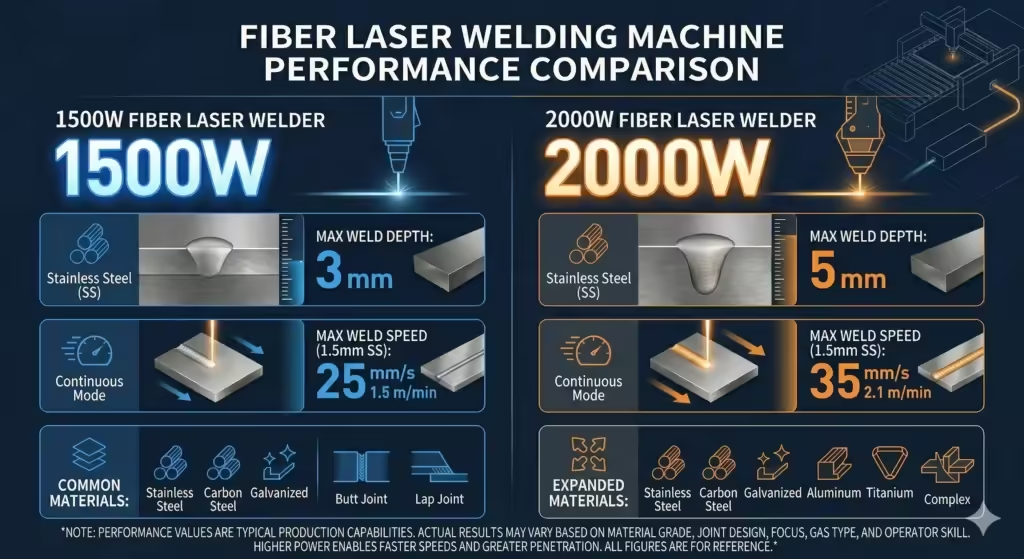
To make the comparison easier, here is a breakdown of how these two power levels stack up against each other in a typical production environment:
| Specification | QYWL-FC1500 (1500W) | QYWL-FC2000 (2000W) |
| Laser power | 1500W | 2000W |
| Laser type | Continuous (CW) | Continuous (CW) |
| Laser source brand | MAX | MAX |
| Optical Fiber cable length | 10m (15m optional) | 10m (15m optional) |
| Controller | SUP-23T | SUP-23T |
| Laser head / Welding head | SUP23T / Single pendulum | SUP23T / Single pendulum |
| Wire feeder | SUP-AMF-A Single | SUP-AMF-A Single |
| Water chiller | S&A CWFL-1500 | S&A CWFL-2000 |
| Power consumption | 7.7kw | 10kw |
| Electric current | 35A | 45A |
| Voltage | 220V, single phase | 220V, single phase |
| Power adjustment range | 10-100% | 10-100% |
| Temperature of water | 22℃-26℃ | 22℃-26℃ |
| Auxiliary gas / Cooling water | Nitrogen, Argon, Air / Distilled, Plasma | Same as 1500W |
| Cleaning head (Lenses & Weight) | D18*T2, D20*4.5, D16*5 / 0.8kgs | Same as 1500W |
| Machine size | 917*490*850mm | 1110*490*850mm |
| Package size | 109*60*143cm (0.94cbm) | 122*60*143cm |
| Net weight | 105kgs | 130kgs |
| Package weight | 170kgs | 200kgs |
Thickness range
- 1500W: Better suited for standard thin to medium-thin sheet welding, handling the bulk of typical fabrication tasks.
- 2000W: Offers a broader thickness range, holding a distinct advantage when processing thicker plates and functioning in high-efficiency scenarios.
Welding speed
- 2000W generally offers faster welding on the same material and thickness.
- 1500W is often more than enough to meet moderate production needs without causing bottlenecks.
Heat input and weld control
- 1500W is much easier to control when working with thin sheets, resulting in cleaner finishes.
- 2000W, if parameters are not perfectly tuned, carries a higher risk of burn-through, thermal deformation, or spatter on thinner materials.
Machine price and operating cost
- 2000W requires a higher initial purchasing cost. Energy consumption, auxiliary equipment requirements, and overall maintenance budgets are usually higher.
- However, in high-capacity factories, the 2000W may achieve a faster payback period due to significantly increased output.
What Thickness Can 1500W and 2000W Handle for Sheet Metal?
I collected some Youtube videos: about laser welding machines with different powers
1500W laser welder thickness capability
A 1500W system is the workhorse for the majority of common sheet metal parts. It offers excellent adaptability for standard materials like stainless steel, carbon steel, and galvanized sheet. It is specifically ideal for thin plates that require fine weld seams and a high-quality aesthetic appearance without post-weld grinding.
2000W laser welder thickness capability
The 2000W system handles a much thicker material range and achieves noticeably faster welding speeds at the same thickness compared to lower power models. It is built for heavy-duty loads, high-takt-time demands, and continuous batch production.
Material matters as much as thickness
You cannot judge power requirements by thickness alone; the metal itself matters:
- Stainless steel & Carbon steel: Both machines handle these well, but 2000W is faster on thicker cuts.
- Aluminum: Because aluminum is highly reflective and conducts heat rapidly, it demands higher machine performance. A 2000W system often provides the extra punch needed.
- Galvanized sheet: Requires strict attention to heat input and welding stability to manage zinc vaporization.
Which One Is Better for Different Sheet Metal Jobs?
For thin stainless steel sheet
1500W is usually enough. It provides easier control and yields cleaner, distortion-free welds for thin-gauge applications like commercial kitchenware or electrical enclosures.
For thicker carbon steel sheet
2000W may offer better speed and deeper penetration, making it highly suitable for higher-efficiency production lines structural components.
For aluminum sheet welding
Aluminum is notoriously demanding. Because of its reflectivity, 2000W can provide more stable performance in some cases by delivering higher peak energy. However, the actual result always depends on thickness, joint design, and operator skill.
For workshops with mixed orders
- If your orders span a wide range of thicknesses and diverse materials, 2000W is more flexible.
- If your orders are primarily focused on common thin-sheet products, 1500W delivers the best cost-performance ratio.
1500W vs 2000W Laser Welder: Cost, ROI and Business Decision
Initial investment
A 1500W system represents a lower entry cost, making it accessible for smaller shops. A 2000W system requires a higher initial budget but brings heavier capabilities.
Productivity and labor efficiency
While a 2000W welder may shorten cycle times and save on labor per part, a 1500W system may already perfectly meet the output demands for small and medium workshops without the need to over-invest.
Which one offers better ROI?
- If you are a small sheet metal shop with custom orders, prototypes, and small batches, the ROI of a 1500W is often much more realistic and faster to achieve.
- If you are running continuous batch production and pursuing maximum output, the long-term ROI of a 2000W will likely be superior despite the higher upfront cost.
How to Choose the Right Laser Welder for Your Sheet Metal Business
Choose 1500W if…
- You process mostly thin sheet metal.
- You have a moderate production volume.
- You are working with a tighter budget.
- You focus on easy operation and stable weld appearance.
- This is your first-time investment in handheld laser welding.
Choose 2000W if…
- You process a thicker sheet range.
- Higher production speed is strictly needed.
- You handle a more demanding material mix (e.g., highly reflective metals).
- You run long-hour daily operations.
- You want stronger future scalability for expanding business.
Questions to ask before buying
- What materials do you weld most often?
- What is your common thickness range?
- Do you prioritize a lower initial budget or higher throughput?
- Is your production job-shop based (custom) or batch production?
- Do you anticipate needing future expansion capacity for thicker metals?
Common Mistakes When Choosing Laser Welder Power
- Assuming higher power is always better: More power on thin sheets just means more distortion and wasted electricity.
- Ignoring material type and actual thickness range: Buying a machine for a thickness you only weld 2% of the time is a waste of capital.
- Choosing based only on machine price: A cheap machine that bottlenecks your production line is the most expensive machine you can buy.
- Not considering operator skill and parameter setup: High power requires a skilled operator to dial in the correct parameters to avoid burning through metal.
- Overlooking future production needs: Buying a 1500W today when you plan to take on heavy-duty contracts next year will force you to buy twice.
FAQ About 1500W vs 2000W Laser Welders for Sheet Metal
Is 1500W enough for most sheet metal applications?
Yes. For standard fabrication involving thin to medium-gauge steel and stainless steel, 1500W provides excellent penetration, speed, and finish.
Is 2000W better for aluminum sheet welding?
Generally, yes. The higher power helps overcome aluminum’s high reflectivity and rapid heat dissipation, resulting in a more stable weld puddle.
Will 2000W cause more deformation on thin sheet metal?
It can, if the parameters are not adjusted correctly. Excessive heat input on thin metal leads to warpage, which is why 1500W is often preferred for very thin applications.
Which is better for stainless steel cabinets and enclosures?
1500W is typically the better choice, as these products require pristine aesthetic finishes and strictly limit thermal distortion.
Is the price difference worth it?
If the 2000W machine removes a production bottleneck and allows you to take on higher-paying, thicker-material contracts, yes. If it sits idle, no.
Which one is better for a small workshop?
For a small workshop transitioning to laser welding, 1500W is highly recommended due to its affordability, ease of use, and versatility.
Can both be used for handheld laser welding?
Yes, both 1500W and 2000W models are standard configurations for modern handheld laser welding machines.
Conclusion: Which One Should You Choose?
1500W is the better choice for many standard sheet metal businesses that mainly process thin to medium sheets and want a cost-effective, easy-to-control solution.
2000W is the better choice for factories that need higher speed, wider thickness coverage, and stronger continuous production capacity.
The best machine ultimately depends on your actual materials, thickness range, production volume, and budget.
Not sure whether 1500W or 2000W is right for your sheet metal production?
Send us your material type, thickness range, and application requirements. Our engineering team will evaluate your data and recommend the most suitable, cost-effective laser welding solution for your business.
Send us your material type, thickness range, and application requirements. Our engineering team will evaluate your data and recommend the most suitable, cost-effective laser welding solution for your business.